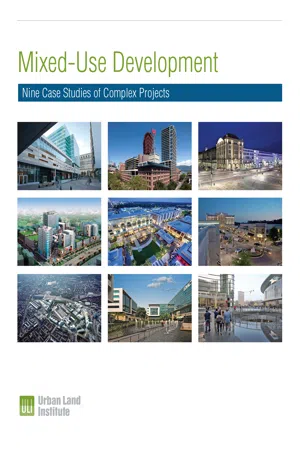
This publication provides a detailed look at nine leading examples of mixed-use projects from around the world that have been developed in recent years. The case studies are drawn from the ULI Case Studies program, which showcases innovative approaches and best practices in real estate and urban development.
The nine mixed-use projects featured offer a wide range of approaches to mixed-use development globally, including three developments in the United States, two in China, and one each in Canada, the United Kingdom, Germany, and Italy. The case studies range from
high-rise projects in central business districts—such as Porta Nuova in Milan, Italy, and Woodward's in Vancouver, Canada—to suburban town centers, such as CityCentre in Houston, Texas, United States, and North Hills in Raleigh, North Carolina, United States.
In addition to the case studies themselves, this report provides a brief overview of the key traits for this group of case studies, as well as the lessons learned at each project.
- 139 pages
- English
- ePUB (mobile friendly)
- Available on iOS & Android
eBook - ePub
Mixed-Use Development: Nine Case Studies of Complex Projects
About this book
Information
Topic
ArchitectureSubtopic
Architecture GeneralLarge Urban Mixed-Use Development Districts
King’s Cross

Illustrated buildout of King’s Cross, looking west: the 67-acre (27 ha) site forms one of the largest city-centre regeneration schemes in Europe.
PROJECT SUMMARY
King’s Cross is a mixed-use, urban regeneration project in central London that is also a major transport hub for the city. Located on the site of former rail and industrial facilities, the 67-acre (27 ha) redevelopment is ongoing and involves restoration of historic buildings as well as new construction, with the entire plan organised around internal streets and 26 acres (10.5 ha) of open space to form a new public realm for the area. Principal uses include 3.4 million square feet (316,000 sq m) of office space, close to 2,000 residential units, 500,000 square feet (46,400 sq m) of retail and leisure space, a hotel, and educational facilities. The site is served directly by six London Underground lines, two national mainline train stations, and an international high-speed rail connecting to Paris.
Spanning a 67-acre (27 ha) site of disused railway lands in central London, King’s Cross is being transformed from an area once known for lost industry into a vibrant mixed-use city quarter. Thousands of workers, residents, and students now inhabit King’s Cross, the largest area of city-centre redevelopment in Europe. When it is completed in 2020, 45,000 people a day will benefit from the 3.4 million square feet (316,000 sq m) of office space, 500,000 square feet (46,400 sq m) of retail and leisure space, and close to 2,000 homes.
“We were always struck by how incredible it was that we had 67 acres [27 ha] in one holding so close to the centre of the city,” says partner Robert Evans of Argent, the master developer and asset manager for King’s Cross. “The vision was to create a scheme which would be part of London, a busy place with lots going on, somewhere that could always surprise. It would have all the things that any other successful district of the city would have.”
A fully mixed-use scheme comprising old and new buildings is assembled around 26 acres (10.5 ha) of public space. Ten new public squares and 20 new streets will deliver an accessible, high-quality mixed-use environment with a strong focus on art, culture, and heritage. Overall, one-quarter of the scheme is dedicated to culture and leisure uses, and the first phases are already open to the public.
A new piece of London, with its own brand-new postcode, King’s Cross is a vibrant urban space. Proximity to one of the busiest transport interchanges in the city provides major appeal to global firms and offers a great location for residences.
An environmental exemplar, the development hosts several BREEAM (Building Research Establishment Environmental Assessment Methodology) “Outstanding” buildings. An Energy Centre will provide most of the development’s heat demand, contributing to the developer’s aims to create one of the more sustainable developments in the United Kingdom.
The Challenge
King’s Cross posed a classic regeneration challenge. In 1996, when the decision was made to finally develop the scheme, the area required a fresh identity to encourage a healthier neighbourhood and attractive destination. Only a decade ago, King’s Cross was suffering from years of decline, a “Cinderella” district that had long been shunned by big business and investment.
During the Victorian era it was a thriving industrial transport hub, but by the 1970s its distribution buildings and warehouses had fallen to dereliction. Nightclubs and artists moved in, but the area suffered from an unsavoury reputation. By the 1980s, it was the lowest-rent area for central London offices, with commercial stock mostly unchanged since the 19th century. The area was densely populated with lower-income groups, council tenants, and local enterprises.
With about one-quarter of the scheme now complete, a new and fresh identity is successfully taking root. As a result, King’s Cross has won an array of awards, and praise from London mayor Boris Johnson. King’s Cross has also become an exemplar of place-making practice within the U.K. real estate community.

An elevated view of the 86,100-square-foot (8,000 sq m) Granary Square, with bridges across Regent’s Canal. It has drawn more than 175,000 visitors since it opened in 2012.
The Site
King’s Cross is being built on a 67-acre (27 ha) piece of inner-city land in central London, 2.5 miles (4 km) north of Charing Cross and 2.8 miles (4.5 km) northwest of Liverpool Street in the City of London. The teardrop-shaped site slopes upwards from Euston Road to the Regent’s Canal, which cuts the site in half, and then continues to gently slope upwards to its boundaries.
Before development began, the site consisted of disused buildings, railway sidings, warehouses, and contaminated land, as well as a variety of historic buildings, structures, and surfaces that had survived the site’s former existence as a Victorian townscape. The south half of the site was densely occupied with structures from the transport hub, including gasworks, gasholders, railways, and storage and interchange buildings.
The scheme is situated in the London boroughs of Camden (mostly) and Islington and is bordered to the south by Euston Road and St. Pancras International and King’s Cross rail stations. This transport hub is expected to support 63 million passengers a year from 2020 and offers access to six London Underground lines, two national mainline train stations, and an international high-speed rail connecting Eurostar passengers to Paris in just over two hours.
The Regent’s Canal runs east to west through the middle of the site, and the Camley Street Natural Park, an urban nature reserve, lies within the area alongside the western bank of the canal. Although the site’s boundaries do not include either, the developer has always aspired to engage positively with these neighbours, adopting a “blurred boundary” approach that complements the King’s Cross public realm and green-space offering.
Development Team
The King’s Cross Central Limited Partnership (KCCLP) is developing the mixed-use scheme. KCCLP is the collective name for the single landowner that comprises three groups: U.K. property developer Argent (owning 50 percent via Argent King’s Cross Limited Partnership); the U.K. st...
Table of contents
- Cover
- Title Page
- Copyright
- Contents
- Introduction
- Compact, Small-Site Mixed-Use Projects
- Mixed-Use Projects Combining Retail Malls, Hotels, and Offices
- Mixed-use Town Centers and Urban Villages in Suburban Areas
- Large, Urban Mixed-use Development Districts
Trusted by 375,005 students
Access to over 1.5 million titles for a fair monthly price.
Study more efficiently using our study tools.
Frequently asked questions
Yes, you can cancel anytime from the Subscription tab in your account settings on the Perlego website. Your subscription will stay active until the end of your current billing period. Learn how to cancel your subscription
No, books cannot be downloaded as external files, such as PDFs, for use outside of Perlego. However, you can download books within the Perlego app for offline reading on mobile or tablet. Learn how to download books offline
Perlego offers two plans: Essential and Complete
- Essential is ideal for learners and professionals who enjoy exploring a wide range of subjects. Access the Essential Library with 800,000+ trusted titles and best-sellers across business, personal growth, and the humanities. Includes unlimited reading time and Standard Read Aloud voice.
- Complete: Perfect for advanced learners and researchers needing full, unrestricted access. Unlock 1.5M+ books across hundreds of subjects, including academic and specialized titles. The Complete Plan also includes advanced features like Premium Read Aloud and Research Assistant.
We are an online textbook subscription service, where you can get access to an entire online library for less than the price of a single book per month. With over 1.5 million books across 990+ topics, we’ve got you covered! Learn about our mission
Look out for the read-aloud symbol on your next book to see if you can listen to it. The read-aloud tool reads text aloud for you, highlighting the text as it is being read. You can pause it, speed it up and slow it down. Learn more about Read Aloud
Yes! You can use the Perlego app on both iOS and Android devices to read anytime, anywhere — even offline. Perfect for commutes or when you’re on the go.
Please note we cannot support devices running on iOS 13 and Android 7 or earlier. Learn more about using the app
Please note we cannot support devices running on iOS 13 and Android 7 or earlier. Learn more about using the app
Yes, you can access Mixed-Use Development: Nine Case Studies of Complex Projects by Dean Schwanke in PDF and/or ePUB format, as well as other popular books in Architecture & Architecture General. We have over 1.5 million books available in our catalogue for you to explore.