- 206 pages
- English
- ePUB (mobile friendly)
- Available on iOS & Android
eBook - ePub
About this book
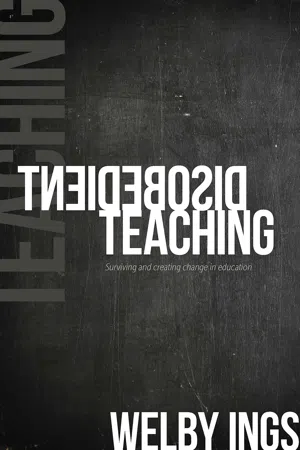
This book is about disobedience. Positive disobedience. Disobedience as a kind of professional behaviour. It shows how teachers can survive and even influence an education system that does staggering damage to potential. More importantly it is an arm around the shoulder of disobedient teachers who transform people's lives, not by climbing promotion ladders but by operating at the grassroots.
Disobedient Teaching tells stories from the chalk face. Some are funny and some are heartbreaking, but they all happen in New Zealand schools. This book says you can reform things in a system that has become obsessed with assessment and tick-box reporting. It shows how the essence of what makes a great teacher is the ability to change educational practices that have been shaped by anxiety, ritual and convention.
Disobedient Teaching argues the transformative power of teachers who think and act.
Information
Topic
EducationSubtopic
Education GeneralPART ONE
CHANGE-ABILITY
a black poppy
Let me start by telling you about the first time I was introduced to the cost of disobedience. To do so we will need to go back to a rugby field at Te Awamutu College. It was 1972. In this year James K. Baxter died, the Equal Pay Act became enshrined and Suzanne Donaldson won the Loxene Golden Disc Award. But before all of these things happened there was a lunchtime incident on the field in front of the main block that would change my life. It would be the first instalment in a progression of lessons about influencing change.
The incident occurred because my twin sister and I, having decided that attendance at the school’s compulsory Anzac Day service should be optional, had organised a student peace rally. We had made 20 small, black Anzac poppies out of wire and paper, and we painted them with Indian ink stolen from the art room. Selling them to raise money for the peace movement seemed like a magnificent idea. If it was a movie it would have had a swelling 1960s soundtrack, but being rooted in the real world we were forced to make do with an anti-war poem my sister had composed and a wee jam jar containing five ten-cent coins. These were the proceeds from sales of the poppies by 12.35 in the afternoon.
My sister and I stood on the field in front of the school surrounded by a small cluster of ‘cool’ sixth form kids. Our chests were decorated with protest poppies and swollen with the indignation and passion that only 16-year-old adolescents can achieve. We were poised to overthrow the tyranny of the secondary school power structure.
I can still remember Mr Mitchell. He came walking across the field with one of those curious smiles that people in authority use to mask a problem. A number of the more strategic sixth formers surreptitiously unpinned their poppies, stuffed them into their pockets and dissolved into the background. When he reached us he glanced down at the opening lines of the poem:
I bought your blood red poppy and painted it death black
You child who sells the poppy, paint your soul like that.
Then he looked up. The milk of human kindness curdled on his face. With a swipe he whipped the tray of poppies aside, stamped one paper flower into the grass and marched my sister and me off to his office. The cool kids fled. Halfway across the field, when we tried to reason with him, he swung around and told us loudly that we were disrespectful and an outrage and we would be expelled.
Because my sister and I lived a long way out in the country we couldn’t be sent home straightaway. The school bus didn’t head off until 3.30pm. I think we spent 20 minutes being shouted at in the principal’s office, then we were made to stand at the doors of the school hall, wearing our black poppies as the Anzac veterans filed in for the service. In my memory all sound has gone from this picture. It plays in slow motion. I stand looking at my sister and we are trying not to cry. Our education has come to a brutal end. The elderly people who pass between us stare with a mixture of bewilderment and disgust.
When we got home that afternoon our parents were waiting for us. The school had phoned them. We were frightened. Nothing like this had ever happened in our family. My mum and dad were good people. They worked hard so we could get an education and have opportunities they never had. We had been brought up to think about other people’s feelings – and to be respectful.
Having all of the cowardice of my convictions I followed my sister as we wheeled our bicycles up the hill. I can recall the curious sound of the broken spoke clanking on my front wheel. It was like a gallows marker. When we reached the house silence descended. We looked down, and my parents looked down, and nobody moved. This was a terrible thing.
Then eventually my father spoke. He said they didn’t agree with what we’d done, and my mum told us that we had hurt people and changed nothing. Then they did a curious thing. Dad took our bikes and propped them up against the side of the house. Then he turned around and told us that they were proud that we stood up for something that we believed in, even when everybody else deserted.
Then, they held us.
They taught me my first lessons about disobedience and change. If you want to alter the conditions around you, you have to learn to work with people, and you need to have people who love you.
the waiting game
Sometimes the organisations we stand up against are very strong. When we seek to change them by throwing ourselves in dramatic gestures against their values we often end up being marginalised or dismissed. This is true of teaching.
In education we often know that things are wrong. Policies and emphases are rolled out, but not all lauded ideas work. Sometimes we experience these flaws as students, sometimes as teachers and sometimes as parents. Over-assessment, systematisation, disproportionate emphasis on one way of knowing, inflexibility, limited trust, and a preoccupation with how material is presented over a focus on the humanity of learning can all operate as distortions in schools. Our anxieties hover over us when we watch our children losing hope, when we mutter in staffrooms about fashionable ideas that become unwritten policy, or when we remain silent, knowing what we are doing is flawed. We are afraid that we are not empowered to change things, or that if we disobey we will be seen as unprofessional.
But our powerlessness is an illusion. Change is possible, and ordinary people achieve it. People like you. People who think about things and imagine richer horizons. People who find themselves in cul-de-sacs and create effective ways out. People who still believe in the power of transformation.
One of the things I learned very early in teaching was that waiting for permission means very little ever gets changed. Often in organisations we are advised to tread water until we find ourselves in more secure positions. The problem, of course, is that such advice is rarely given by the kinds of people who transform the world around them.
the loyal grenadier
I remember when I was a student at teachers’ college I was sent home from a practicum because I wouldn’t wear a tie. In the afternoon when I caught a return bus out to the school, wearing a cravat, I found myself directed back to a disciplinary committee. I thought to myself, ‘I’ll wait until I get out of teachers’ college, then I’m going to change some things.’
In my first year of teaching I received a reprimand from the Auckland Education Board and was told by the principal to wait until I was certificated before I tried to change anything. After I was conditionally certificated I found myself in a primary school under the watchful eye of a senior teacher, who every day walked into my classroom, tapped her wristwatch and called out ‘Maths time’. I produced lesson plans that had to be left on her desk and signed before I was allowed to teach them. And with my colleagues I despondently marched my classes of small Pacific Island children around and around the asphalt to her scratchy recording of The Loyal Grenadier. This, she informed us, was to teach the children discipline. My friends told me, ‘Wait until you get to be a senior teacher, then you can change some things.’
All this time I huddled with similarly disgruntled colleagues in groups in the staffroom. We had bought the lie that we were powerless and, as a result, we became so. We were following the paths of thousands of teachers before us, dissipating the energy that we could use to change things into criticism and complaint. Our ideas didn’t take root, they didn’t grow and they didn’t make things better for other people. We became non-reformers who traded in our vision for a droll kind of cynicism that enabled us to survive but never altered the status quo.
We were told to wait, and we waited for something that never came.
I wonder about the rhetoric of waiting. I have friends who have become principals of schools. They have sacrificed a great deal to climb up through the ranks, yet often when we sit down together I hear them confronting the same frustrations we experienced back in teachers’ college. They aren’t free either. They can’t move because of the Education Review Office, or parents’ expectations, or boards of trustees. They end up doing things they find morally and philosophically questionable because they are always accountable to someone else. They are controlled by the same fear of failing that everyone in hierarchies experiences. They are afraid to disobey.
The truth is that each of us, irrespective of where we stand in an organisation, has the ability to change things. It’s just a matter of studying the system around us and finding effective strategies. No teacher is powerless. It is the nature of education that we should question, and it is the nature of professionalism that we should seek to improve on practice that we recognise as flawed.
But what is it that enables certain people to change things? Well, let’s have a look at this.

PART TWO
CREATIVITY
the disobedient thinker
Some people are disobedient thinkers. They are the shapers of our world. They create alternatives and open doors in walls that the rest of us believed were blank surfaces. They change things because they think beyond limitations. They ask questions that ordinary people don’t, and they give themselves levels of permission others avoid.
Disobedient thinking is really just another way of describing creativity. It is a normal ability that we all have, and we encounter it all the time. It is a beautiful human attribute, arguably the most precious thing we possess. Being able to create is not a celestial gift granted by a divine muse who flits across the horizon and kisses the polished cheeks of a few selected artists and poets. It is an ordinary way of thinking that allows us to adapt and extend conditions that keep us constrained. Without it, evolutionally we would never have been able to develop because we would never have moved beyond the established. This is why we feel euphoric when we encounter creative solutions. We laugh at the insightful disobedience of wit, we smile when we encounter innovative solutions to mundane problems, and we applaud creativity when we experience it surfacing through the proscribed and mediocre. We are reminded that productive disobedience broadens our world.
optimism and necessity
The ability to think disobediently is a fundamental part of being human. Historically, philosophers, inventors, economists and social reformers have questioned the limitations of what exists. They have imagined alternatives and offered solutions that have brought us to better places. Indeed, a fundamental idea underpinning the rise of liberal democracy was that greater freedom of thought would allow human beings to reach their destined levels of creative potential. This freedom to think disobediently has become a sustaining source of improvement in contemporary society. In a technologically democratised world where millions of people now have levels of agency that were never available in the past, we witness changes built on the potentials of the open-source movement. These changes, enhanced by online peer groups, now enable levels of information exchange and realisation that dissolve the levels of control that have traditionally been the prerogative of affluent elites. Such a situation advantages those who can think creatively. Disobedient thinkers who can look into the heart of what exists and conceive effective alternatives increasingly have the capacity to realise new social, economic, technological and political reforms that better meet ordinary people’s needs.
the social editor
However, our natural propensity to think disobediently is constrained by something silent and controlling. It grew up with you, and it attentively stands just behind your shoulder. It is your social editor. It got in to bed with you last night and it accompanied you on your way to work this morning. It is the cautioning voice that says ‘no’ to your ideas because they might sound silly, or they might not work, or they might be unstable, or they might make you look like a fool. Your social editor has phenomenal power and it causes you to function at levels far below your potential. It trains you to approach problems complicitly. In the pursuit of social integration, it teaches you not to stand out and it shuts down initiatives that might potentially lead to disruption. It also suggests that you are not empowered to change things.
the perniciousness of cool
For students, this social editor often operates through the construct of ‘being cool’. Being cool prescribes the way we act and think so that we fit in with sanctioned ideas. In the distorted pursuit of authentic identity, we adopt prescribed instructions about what to wear, how to look, what to value, what to think, what to buy and what to disparage. Originality is substituted by a socially endorsed replacement that has been shaped by somebody else. As kids work their way through childhood and adolescence trying to find their identity, ‘cool’ becomes a controlling agent and a limit on productive disobedient thinking. Taking risks that might threaten coolness is consciously avoided.
And this is why coolness is an insidious thing. While it purports to be about individual agency, coolness is actually something shaped by those who seek to align our anxieties with commercial or ideological solutions. A pernicious feature of this, of course, is that although coolness is manufactured by other people, it is policed by its victims. Vulnerable kids end up monitoring themselves and their peers, and they alienate those who don’t conform.
Disobedient thinking, risk-taking and ideas that might lead to public failure are scrupulously avoided. Terms like ‘loser’, ‘try hard’, ‘fail’ and ‘shame’ become the language of peer control. And it becomes ubiquitous. The pursuit of coolness systematically discourages us from acting as significant change agents, irrespective of our age. Cool people don’t take risks. They adopt, adapt and reinforce what has been pre-established, and then they pretend that it is a sign of individuality.
This policed construct of compliance has an equivalent in organisations (including schools) in the concept of the unquestioning ‘team player’. While, of course, any social organisation needs people to function effectively with those around them, in dysfunctional environments team playing can come to mean substituting individual, critical action for subservience to dominant ideas and values. We are encouraged to perform obedience. When dominant ideas become threatened we are taught that thinking and operating outside the norm is unprofessional and disrespectful. If we disrupt an empowered idea, we can sometimes find ourselves framed as being undermining and unfair to our colleagues.
This phenomenon becomes particularly pronounced in damaged systems that try to preserve certain ideas as their inherent flaws b...
Table of contents
- Front Cover
- Title Page
- Copyright
- CONTENTS
- ACKNOWLEDGEMENTS
- DEDICATION
- PROLOGUE
- PART ONE: CHANGE-ABILITY
- PART TWO: CREATIVITY
- PART THREE: ASSESSMENT
- PART FOUR: PASSION
- PART FIVE: THE BUSINESS OF SUCCESS
- PART SIX: INFLUENCING CHANGE
- NOTES
- BIBLIOGRAPHY
Trusted by 375,005 students
Access to over 1.5 million titles for a fair monthly price.
Study more efficiently using our study tools.
Frequently asked questions
Yes, you can cancel anytime from the Subscription tab in your account settings on the Perlego website. Your subscription will stay active until the end of your current billing period. Learn how to cancel your subscription
No, books cannot be downloaded as external files, such as PDFs, for use outside of Perlego. However, you can download books within the Perlego app for offline reading on mobile or tablet. Learn how to download books offline
We are an online textbook subscription service, where you can get access to an entire online library for less than the price of a single book per month. With over 1.5 million books across 990+ topics, we’ve got you covered! Learn about our mission
Look out for the read-aloud symbol on your next book to see if you can listen to it. The read-aloud tool reads text aloud for you, highlighting the text as it is being read. You can pause it, speed it up and slow it down. Learn more about Read Aloud
Yes! You can use the Perlego app on both iOS and Android devices to read anytime, anywhere — even offline. Perfect for commutes or when you’re on the go.
Please note we cannot support devices running on iOS 13 and Android 7 or earlier. Learn more about using the app
Please note we cannot support devices running on iOS 13 and Android 7 or earlier. Learn more about using the app
Yes, you can access Disobedient Teaching by Welby Ings in PDF and/or ePUB format, as well as other popular books in Education & Education General. We have over 1.5 million books available in our catalogue for you to explore.