- 208 pages
- English
- ePUB (mobile friendly)
- Available on iOS & Android
eBook - ePub
About this book
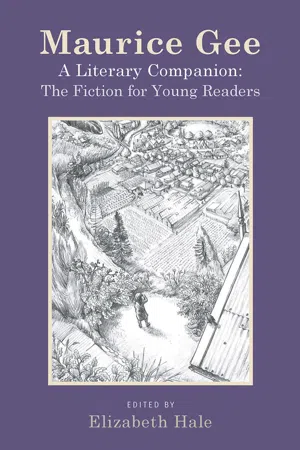
Maurice Gee's fiction for younger readers blends exciting stories with serious issues. Told through a range of genres, from fantasy to realism, adventure to science fiction, mysteries, psychological thrillers and gangster stories, they offer a distinctive body of work that shows New Zealand to children and young adults. This book is the first of two that pays tribute to Maurice Gee's distinctive contribution to New Zealand literature. It argues that the depth and excitement of Gee's fiction for young readers makes for an impressive introduction to New Zealand culture, history and storytelling. Overview chapters explore the motivations, themes, contexts and reception of Gee's work, from the fantasy novels
Under the Mountain,
The World Around the Corner and the O and Salt trilogies, to the five realist and historical novels, including
The Fat Man,
The Champion and
The Fire-Raiser. This volume will appeal to students, teachers, readers and writers of New Zealand literature, children's literature and fantasy literature. A second book, by Lawrence Jones, will discuss Gee's fiction for adult readers.
Information
1 THE EARLY FANTASY NOVELS
‘a kind of perturbation, held within the pages’
The great instrument of moral good is the imagination.
—SHELLEY, A Defence of Poetry
Good must be won daily in the battle that never ends.
—GEE, The Halfmen of O
Maurice Gee ‘is a remarkable man’, Kevin Ireland tells us: ‘He’s a very pure person with a powerful interest in the darker side of other people’s lives.’1 Improbable though it may seem, this paradoxical interest is perhaps most evident in Gee’s fantasies for children. In reading these stories, we are highly conscious of what he has acknowledged as a general obsession: ‘the human capacity for cruelty and inflicting pain on others’. ‘This is something I can’t come to terms with properly. What human beings are capable of doing to one another, I return to it again and again.’2 This view of human rapaciousness, angling into violence, extends into the worlds Gee imagines for children, in the fantasies as well as in the historical novels, and makes tough demands of his young readers. Gee’s fantasy stories articulate a vision that seems common to all his work, yet, as he himself maintains, he takes up the genre in part because it is traditionally a site of pleasure, promising a good end. How dark can fantasy get?
Gee has written eight works of what he has termed ‘fantasy/adventure’ for young readers: five novels in the period 1979–85, including Under the Mountain and the O trilogy and, for a slightly younger audience, The World Around the Corner; then – after the historical realist novels written between 1986 and 1999 – the Salt trilogy in 2007–10.3 This is a significant body of work; yet fantasy still seems to be something of an exception in Gee’s fiction corpus. For all his insistence on his desire to entertain, and his clear recognition that fantasy offers exactly this order of pleasure, he has never written in this mode except for children. As Bill Manhire has noted: ‘The interesting thing about Gee’s work for children is the extent to which it has welcomed fantasy, a possibility the adult novels never seem to entertain.’4 Gee himself has consistently played down the value of his fantasy adventures for children in relation to his adult fiction; he has acknowledged that the mix of impulses that led to his writing them included a belief that children’s fiction offered greater financial rewards than writing for adults, as well as a simple pleasure in the writing itself. Where the adult novels involved ‘explorations of guilt and delving into psyches’,5 the children’s fantasies developed the power of ‘a horizontal, straight-line sort of story-telling’.6
When writers choose to write for such apparently diverse audiences – adults and children – the choice almost invariably prompts the obvious question. Tolkien meets it by claiming that he writes for children of all ages; Gee claims less grandly that, in writing for children, the labour virtually disappears: ‘It’s fun for me and fun for the readers.’7 It is worth noting that nothing quite like Gee’s fiction for children had appeared in New Zealand writing when he set about writing his first novel, Under the Mountain, in 1974. When it was published some years later, Joy Cowley called it ‘the best New Zealand book yet produced for readers nine years and over’.8 In 2004, when Gee won the Gaelyn Gordon Award for a Much-loved Book for Under the Mountain, it had proved highly popular in New Zealand and internationally; it was in its fourteenth edition and had sold over 20,000 copies.9
My business in this chapter is partly to honour the brilliance of Gee’s performance in these stories. My major concern, however, is to explore their unanticipated power to provoke thought and convey a sense of passionate interior life. In the interview from which the Gee epigraph to this chapter comes, he states his ambition for his adult fiction, ‘the Plumb and Prowlers sort’: ‘I try to give a sense of life going on beyond the pages … localised in a mind, it’s a kind of perturbation, held within the pages.’ It is precisely this perturbing inner/outer, local/textual character in his early fantasy adventures that makes them such rewarding experiences for child or adult reader – and critic.
The books and their readers
Gee’s self-deprecation when commenting on the significance of his fantasy fiction for children seems to have been persuasive: although they are widely reviewed, the fantasies have received virtually no extended critical attention. Criticism has tended to be limited to comparisons with the work of other fantasists; or to discussions of his performance with respect to specific issues, in the context of New Zealand fiction writing. Diane Hebley’s wide-ranging survey of imaginary topographies, The Power of Place: Landscape in New Zealand children’s fiction, 1970–1989, is a case in point.10 Another, more recent and much more ambitious study is the collection of essays edited by Anna Jackson, A Made-Up Place: New Zealand in young adult fiction, in which several contributors have taken up Gee’s work, although none with a sustained concern for developing a critical account of his interest in a New Zealand fantasy.11 Gee’s writing for children has figured in a number of postgraduate theses. The most important, by Vivien van Rij, has led to an essay, ‘The pursuit of wholeness in Maurice Gee’s O trilogy’, in which, leaning on Jung, van Rij makes a determined bid to define an ethical centre for the children’s writing that relates closely to Gee’s major concerns in his adult fiction.12 This essay stands out as much for its singularity as for its insight: it is the only critical study of the early fantasies.13
In its ongoing reference to the adult fiction, van Rij’s critical reading of the O trilogy offers a particularly forceful, considered example of modern criticism of Gee’s fantasies, which in general places them in contexts determined by his life or his history as a novelist of national importance. In an interview with Colleen Reilly, Gee contributes to a flattening criticism of his writing for children, measured in broad contrasts between the differing objectives of his adult and children’s fiction:
[Gee] … I do a lot of straining and heaving.
[Reilly] Does that include in the children’s books?
No, no, there the object is simply narrative clarity and narrative pace.
There is no element of what would be called ‘fantasy’ in the adult novels, yet the children’s novels are full of fantasy.
It’s a different function altogether. I simply play games with the fantasy. I look on it as a kind of relaxation.
But there’s no desire to include that in your adult work?
No, there’s not.14
Gee’s brilliance in ‘[playing] games with the fantasy’ tends less to confirm the validity of the rather limiting views here expressed than to require testing them. In taking up that challenge in this chapter, I am concerned especially with Under the Mountain and the O trilogy – all aimed at young adolescent readers – but also, briefly, with his novel for children, The World Around the Corner. The peculiar value of the latter is that it underscores Gee’s willingness to make testing demands of his young readers. It possesses marked narrative complexity, and it suggests compellingly that Gee makes no intellectual or ethical compromise in writing for this age group. All his fantasies, indeed, share an ethical drive alongside a commitment to fascinating and stirring their audiences by helter-skelter action.
Gee and the ends of fantasy
The ethical power in Gee’s fantasies seems to have a good deal to do with his discovery of the formal resources of the fantasy/adventure genre. If there is not much to be gained from detailed comparisons with the work of other fantasists, it is instructive to know that Gee has acknowledged the stimulus he found in Alan Garner’s The Weirdstone of Brisingamen when he first contemplated writing fantasy for children. Arguably, too, connections between his works and other major texts in the tradition such as C.S. Lewis’s Narnia stories and Tolkien’s Middle Earth epics are unmistakable. These creative relations do imply recognition of the characteristic moves of this kind of story. At least in part, however, the peculiar excellence of Gee’s fantasies is grounded in a certain resistance to the genre, especially to the near invariable optimism of its conclusion. In Gee’s stories the ending is never exactly happy, and that refusal of a fundamental narrative convention constitutes a challenge – and suggests one line of explanation of the felt power of his stories.
In ‘Creeks and kitchens’, his Margaret Mahy Award lecture, Gee defines with useful economy what he aimed to produce in writing his adventure fantasies: ‘Put the emphasis on movement, develop narrative pace, tell a story pure and simple.’ In Garner’s novel he discovered the situational strategy that guaranteed the kind of narrative energy he desired: ‘place the child characters in dreadful danger from some supernatural or monstrous thing, while leaving them in their natural everyday world with no way of making adults see the danger’.15 Manifestly such a narrative is charged with tension for an audience of child readers, creating a dynamic relationship that impels the reader into identification with the hero. Reviewing his own childhood reading, Gee talks enthusiastically about a favourite collection of Robin Hood stories and recalls, pointedly, the impact of the 45 Zane Grey novels he read. He describes the picture they left of ‘the sweat-stained man on the dusty horse, galloping into the badlands with the posse at his heels’, and suggests it dramatically figures an ethical insight – ‘that we are essentially alone, that we are in some sense fugitive’.16 The difference that Garner introduces into this complex is that the hero no longer possesses an automatic superiority by virtue of his adulthood; rather, adult society all too often becomes at best the ‘posse’ in an ambivalent relation with the hero, often representing in fact the danger the child hero must face. If that intensifies the sympathy in a reader’s identification with the protagonist, it also points up the social isolation with which such characters are threatened.
Much adventure writing for children, of course, depends on separating the child from his or her parents, but fantasy tends to remove the protagonist more absolutely from parents and normal society, even as it burdens this character with an added responsibility – to save not the aging horse threatened with slaughter but the entire parental world from threatening doom. The consequence is a developing sense of the importance of certain values: in Gee’s five early fantasies, moral courage, duty and self-sacrifice are the heroic qualities that will ensure the continuation of a world under threat.
Colin Manlove notes that fantasy ‘tends to be moral in character, depicting the different natures of good and evil, and centrally concerned with viewing conduct in ethical terms’.17 Because fantasy works with polarities in organising the conflict between its central characters, the genre seems to have allowed Gee to project a sense of the threat of evil with great force and clarity. The hero/heroine shows dogged determination in extreme peril, faces difficult decisions, performs acts of spectacular heroism and self-sacrifice and finds the strength and purpose to persist in combat with threatening evil. Yet for Gee, the contest between good and evil never has a decisive outcome. The concept of an ever-recurring evil is central to his fantasy writing – developed most extensively in the O trilogy. Marna, who features only in the first book of the trilogy, is the closest we get in Gee’s early fantasy novels to the figure of the wise woman of myth. She cautions her young visitors from Earth against complacency: ‘Good must be won daily in the battle that never ends’ (HO 77). This is a lesson that all of Gee’s fantasies enforce in their different ways; it also justifies critical reluctance to credit the claim that Gee makes, not infrequently, that his stories succeed sufficiently if they succeed simply as fun, engrossing tales.
Nothing in Gee’s own comments on these stories quite suggests he would deny their power to convey certain virtues or values. He himself recognises that the O trilogy, at least, points to certain lessons ‘about the pollution and degradation of the environment and of natural things, about the danger of nuclear weapons, about the abuse of political power’.18 It might indeed be argued that these books offer something quite as profound as the analysis of history and character Gee carries out in his adult fiction. Bill Manhire registers this force in Gee’s fantasy writing: ‘Magic and fantasy … are a means of exploring and intensifying life, not of evading it.’19 Marna’s advice mixes stoicism and pragmatism but, as we will see, it presents a vision of the good, locked in defining opposition to evil, that has immense cultural resonance – as an ideal of achieved integrity. What is remarkable is that however serious, however complex the vision of integrity, Gee’s first ambition is to give expression to this sense not in lessons, but in histories.20
Something of this understated but undeniable seriousness can be seen in Gee’s refusal to shield his youthful audience from fundamental realities:
It seems to me that in so much children’s literature the children go through terrifying adventures; they face great danger, they are heroic; they do all these things and come out the other end victorious. There is no price paid. No consequences. And life’s not like that.21
In both Under the Mountain and the O trilogy, while good wins in the conflict with evil, there is a cost – arguably excessive. In Under the Mountain there is Ricky’s death at the hands of the evil Wilberforces. Ricky is the cousin of the twins who are elected to take on the significant task the story relates. We are persuaded to like him, partly because he is a young man, full of vitality, and because he has protected his cousins from the Wilberforces. His death serves no narrative need but, perversely, answers Gee’s larger purpose in creating a genuinely tragic awareness in the tale. For all his canny adaptation of fantasy’s conventions, Gee here simply refuses to play the generic game; he is concerned primarily to demonstrate the fateful consequences of action, not to provide the consolation of a happy ending.22
Generic hybridity and ambiguous vision in Under the Mountain and The World Around the Corner
In the last pages of Under the Mountain, the 11-year-old twin protagonists Rachel and Theo save the Earth from annihilation by aliens. This moment is both haunting and horrendous, since the twins’ triumph is achieved at a terrible price: devastation and the death of many – presumably including the twins’ aunt and uncle, who stand in for their parents throughout the story. Furthermore, the explosion that brought about this ruin is unanticipated, the result of a moment’s weakness, a lapse in concentration. Theo drops the magical stone he must use in the fight against the alien invaders, the wormlike Wilberforces; the stone is damaged, with catastrophic results: instead of being reduced to dust, the huge worms explode beneath the volcanoes where they lie sleeping, in a catastrophe that rocks the entire region. In such small failures, we recognise a general law that binds action to consequence – a greater law than the generic principle that mostly brings fantasy to a happy conclusion. We cannot help but take pleasure in the children’s success in their combat with the Wilberforces, but the final sign of this triumph is less than glorious – the prospect that the children face is merely ‘shelter from the wind and ash’ (UM 155). Gee’s play with scale, which sees children engaged in cosmic conflict, finally does not despatch reality from the textual world of the story, nor real-world expectations.
We might approach this issue differently: in wr...
Table of contents
- Front Cover
- Title Page
- Copyright
- Contents
- Editors’ note to the series
- Acknowledgements
- Introduction
- 1 The early fantasy novels
- 2 The good, the bad – and ironic reversals
- 3 Mining Gee
- 4 ‘What I must steer clear of’
- 5 Writing horizontally and vertically
- 6 Patterns of exchange
- 7 Representation and responsibility
- Notes
- Contributors
- Bibliography
- Index
- Back Cover
Trusted by 375,005 students
Access to over 1.5 million titles for a fair monthly price.
Study more efficiently using our study tools.
Frequently asked questions
Yes, you can cancel anytime from the Subscription tab in your account settings on the Perlego website. Your subscription will stay active until the end of your current billing period. Learn how to cancel your subscription
No, books cannot be downloaded as external files, such as PDFs, for use outside of Perlego. However, you can download books within the Perlego app for offline reading on mobile or tablet. Learn how to download books offline
We are an online textbook subscription service, where you can get access to an entire online library for less than the price of a single book per month. With over 1.5 million books across 990+ topics, we’ve got you covered! Learn about our mission
Look out for the read-aloud symbol on your next book to see if you can listen to it. The read-aloud tool reads text aloud for you, highlighting the text as it is being read. You can pause it, speed it up and slow it down. Learn more about Read Aloud
Yes! You can use the Perlego app on both iOS and Android devices to read anytime, anywhere — even offline. Perfect for commutes or when you’re on the go.
Please note we cannot support devices running on iOS 13 and Android 7 or earlier. Learn more about using the app
Please note we cannot support devices running on iOS 13 and Android 7 or earlier. Learn more about using the app
Yes, you can access Maurice Gee by Elizabeth Hale in PDF and/or ePUB format, as well as other popular books in Literature & Literary Criticism. We have over 1.5 million books available in our catalogue for you to explore.