- 396 pages
- English
- ePUB (mobile friendly)
- Available on iOS & Android
eBook - ePub
About this book
Making a New Land presents an interdisciplinary perspective on one of the most rapid and extensive transformations in human history: that which followed Maori and then European colonization of New Zealand's temperate islands. This is a new edition of
Environmental Histories of New Zealand, first published in 2002, brimming with new content and fresh insights into the causes and nature of this transformation, and the new landscapes and places that it produced. Unusually among environmental histories, this book provides a comprehensive analysis of change, focusing on international as well as local contexts. Its 19 chapters are organized in five broadly chronological parts: Encounters, Colonising, Wild Places, Modernising, and Contemporary Perspectives. These are framed by an editorial introduction and a reflective epilogue. The book is well illustrated with photographs, maps, cartoons and other graphics.
Information
1.
Introduction
Eric Pawson and Tom Brooking
AOTEAROA NEW ZEALAND holds a special place in global environmental history.1 It is an isolated land of mountains, beaches, wetlands and forests. According to the foundation stories of its first colonists, the North Island was fished out of the southern ocean by the demigod Māui, while his waka, or canoe, became the South Island. The descendants of those colonists, the Māori, had named and claimed these as their own territories by the time the ‘large land, uplifted high’ was ‘discovered’ a few hundred years later by Europeans. In the stories of these newer colonists, named ‘Pākehā’ by their predecessors, New Zealand was first understood as a remnant of the great southern continent, which at that time was believed to be a necessary counterweight to the landmass of Eurasia. Later it came to be a fragment of the ancient supercontinent Gondwana, cast adrift before the advent of mammals.2 The Australian ecologist Tim Flannery refers to it as ‘a completely different experiment in evolution to the rest of the world’, showing ‘what the world might have looked like if mammals as well as dinosaurs had become extinct 65 million years ago, leaving the birds to inherit the globe’.3
The human experiments of making places for living in these islands are more recent than those conducted elsewhere, considered now to be seven to eight hundred years old at most. The effects of Māori hunting, fire and horticulture were extensive. But they were less dramatic than 200 years of Pākehā transformations, initiated as part of the European imperial drive to incorporate new territories into the capitalist world economy using the panoply of people, animals, plants and, less intentionally, pathogens. In turn, the consequences of such experiments for human livelihoods have had to be borne. There has been the hazardousness of rapid and sometimes extreme weather changes, and the risks from events such as earthquakes and floods. These result from the country’s location astride a tectonic plate boundary, with its mountains and ranges intercepting moisture-laden winds from the southern ocean and the subtropics. There have been contests for land between Māori and Pākehā, vigorous throughout the nineteenth century and not forgotten by Māori since, and environmental interventions resulting in resource destruction, soil erosion and the spread of unwanted, and costly, pests and weeds.4
Relations between people and environments in New Zealand share many of the characteristics of such interactions elsewhere, when migrants arrive in new lands and seek to come to terms with what they find. But, consistent with geographic theories of place, both the context for these interactions and the manner in which they have intersected with this context and each other have produced very particular outcomes. As Joe Powell, the Australian historical geographer, has suggested, ‘the best environmental stories … recognise locational integrities in so far as they have a very definite resonance in [particular] national and regional contexts.’5 To this should be added cultural contexts, as there is not nor ever has been but one New Zealand. Rather there is a kaleidoscopic complex of Māori and Pākehā identities in place, and the tensions that go with this.6
The purpose of this book is to narrate the ways in which human–environment interactions in the places of Aotearoa New Zealand have been constructed. The Introduction situates the project in the context of current thinking and practice in environmental history. It also introduces the individual chapters and explains how they have been grouped so as to provide the reader with clear signposts for approaching them as a collection.
Making a new land
A recent definition of environmental history suggests that it is ‘a kind of history that seeks understanding of human beings as they have lived, worked and thought in relationship to the rest of nature through the changes wrought by time’.7 The breadth of this statement is an advantage: it opens a very broad canvas. In identifying the everyday matters of living, working and thinking, it focuses on the role of everyone as actors in environmental history, not merely the ‘leading figures’ approach of conventional historical writing in the past. But in other ways the definition is problematic. It is not ‘time’ that brings change, but the actions of human and non-human agents. And it is not just time past that environmental history should consider, but the ways in which past and present behaviours shape environmental futures. Perhaps the reason for the growing popularity of the field internationally since the 1970s, and in New Zealand in the last decade or more, is that the ways in which history is written reflect the preoccupations and anxieties of its times.8
Consider the photograph in Figure 1.1. This was taken about 1875 by James Bragge, a Wellington photographer born in County Durham. Rather than concentrating on portraiture, the lifeblood that sustained his contemporary practitioners, Bragge fitted out a horse-drawn cart as a portable darkroom that allowed him to capture the development of the new city and its environs. He received an award at the Sydney International Exhibition in 1879 for a series of views commissioned by the Wellington City Council. This was a year after his second expedition across the Rimutaka Ranges, north of the city, where he recorded the extension of the railway and the farming frontier into places previously covered in tussock grass, thick bush and forest.9 The photograph is of what Bragge called ‘Five Mile Avenue’ in the Forty Mile Bush in the upper Wairarapa. Outwardly it is a portrayal of the impressiveness of the bush; even, given the small size of the human figure, its oppressiveness.
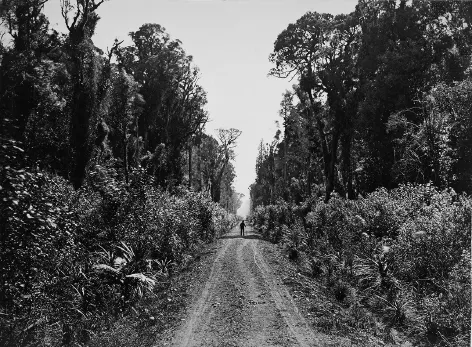
Figure 1.1 ‘Five Mile Ave, Forty Mile Bush’, photograph by James Bragge, c. 1875. Source: negative no. D000086, Museum of New Zealand Te Papa Tongarewa
Bragge’s photograph, however, is no more innocent as a record of what he saw than any other of the extensive records that survive from this time as documents of environmental change. Scholarship on photography has demonstrated that as a practice it was as central to contemporary discourses of colonisation as were written accounts and maps.10 Photographers brought to their images, especially in the selection of viewpoints and the manner of framing scenes, an ‘imaginative geography’ that implicitly betrayed their view of nature and its relation to human endeavour. This photograph highlights not so much the bush but the avenue that draws the invading eye through the trees. And if the smallness of the human figure implies awe of the vegetation, it can equally be suggested that the man is not cowed by it. Rather, he represents the colonial mission to cut down or burn the trees, to convert potentially fruitful land to grass, or to transform external resources into social value. As the editor of the Manawatu Times put it in 1877: ‘although the smoke may inconvenience us and the charred avenues offend the eye, we must accept all thankfully as a mark of local progress.’11 The photograph documents culture as much as it does nature.
It has been argued that ‘the environment[s] we inhabit [are] inseparable from human culture’ – in other words, from the ways in which we see and use environments.12 Everything that surrounds us – rural and urban landscapes, coastlines, even the sea – is shaped, traversed and harvested in accordance with cultural imperatives and social needs. Our awareness of these environments, and our representations and interpretations of them, reflect human traditions and expectations. Far from being ‘objective’, this awareness is shaped by deep-seated assumptions about actual or idealised relations between people and nature.13 For Māori, kaitiakitanga (guardianship) is ‘an obligation to safeguard and care for the environment for future generations … it is an inherited commitment that links … the spiritual realm with the human world and both of those with the earth and all that is on it’.14 In contrast, the world view of Europeans reflects a subject position that constructs nature as something external to the individual. It is this assumption that is inherent in the Treaty of Waitangi drawn up on behalf of the British Crown and signed with Māori tribes in 1840.15 For both peoples, therefore, nature and people have been deeply intertwined, whether this connection is recognised or covert. The making of a new land has been a social process.
This point was recognised by an earlier generation of European commentators. Edward Gibbon Wakefield, the post-Enlightenment dreamer, wrote in his Art of Colonization about the necessity of renaming apparently virgin country, including land occupied by Māori who had not used it in ways recognisable to Europeans, as it ‘make[s] part of the moral atmosphere of the country’.16 To Wakefield, colonisation would produce a new geography, ‘improving’ that which had been ‘wilderness’ into the Eden of the Book of Genesis. Improvement was the ideology of colonisation: it applied to both lands and peoples, and one of its most potent symbols was the garden. Henry Sewell, the Canterbury colonist, proclaimed in the 1850s: ‘The first creation was a garden, and the nearer we get back to the garden state, the nearer we approach what may be called the true normal state of Nature.’17 The result was deforested landscapes such as that photographed in the mid-1920s by Jesse Buckland above Akaroa, on Banks Peninsula (Figure 1.2). In the words of a local author, ‘True gloomy Rembrandt like shadows have disappeared … but we cannot help fancying that to the thinking person the present landscape is far more gratifying … in the stead of the past beauties are smiling slopes of grass …’18
The production of this garden colony was seen as a triumph of progressiveness. It had accomplished in one century, as Kenneth Cumberland wrote in the American Geographical Society’s Geographical Review in the early 1940s, ‘what in Europe took twenty centuries, and in North America four’. Cumberland had only recently arrived in Canterbury from Britain; his was an initial broad-brush analysis of what he saw happening around him. He followed it with many years of more detailed research into New Zealand’s landscape development.19 For a while he worked alongside a Canadian visitor in the Geography Department at Canterbury University College, the historical geographer Andrew Hill Clark. Clark in turn published a book based on his extensive fieldwork in the South Island: The Invasion of New Zealand by People, Plants and Animals (1949). This, he wrote, was ‘a report on a revolutionary change in the character of a region, which occurred in a period of less than two centuries’.20 These writers also recognised the considerable environmental costs of the transformation. In part they drew from the great American cultural geographer of the time, Carl Sauer, who had observed in 1938 that ‘the growing mastery of man over his environment’ must set against ‘the revenge of an outraged nature’.21
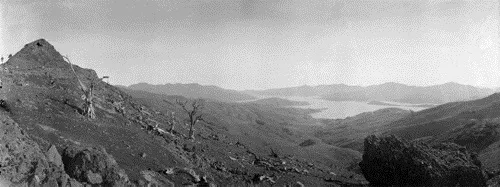
Figure 1.2 A landscape of ‘improvement’ with the forest stripped bare for grass, photo by Jesse Buckland looking towards Akaroa, c. 1925. Source: AK: 2003.18.2, Akaroa Museum
Cumberland devoted much of his early career to recording and analysing the extent of the soil erosion that emerged with the removal of bush in wet hill-country areas, such as Bragge’s Wairarapa, and the degradation of the South Island hill country from what he interpreted as overstocking, as well as from the invasion of pests like rabbits.22 In 1986, New Zealand was the subject of a lengthy case study in the American Alfred Crosby’s Ecological Imperialism, which put such invasions in a wider global frame.23 In 1999, another American, William Cronon, wrote the preface for a reissue of Herbert Guthrie-Smith’s study of environmental change on his Hawke’s Bay sheep station, Tutira, first published in 1921, which Cronon described as ‘one of the great English-language classics of environmental history’. In Tutira, Guthrie-Smith discussed the effects of interventions on the land as ‘the cumulative result of trivialities’, and wondered if, after a lifelong commitment to improvement, it would not have been better to ‘admire, conserve, let well alone’.24
New narratives
The reissue of Guthrie-Smith’s book, and the death of Cumberland in 2011, have brought these key texts in New Zealand environmental history back into wider view. As a field of academic study and popular interest, the contemporary practice of environmental history, however, has relatively recent roots. Its cause has been helped by the interest shown by overseas scholars such as Crosby, Cronon and Thomas Dunlap,25 but a turning point came with the publication, just before the new millennium, of the New Zealand Historical Atlas. This was perhaps the first time that environmental perspectives were incorporated in a mainstream historical project. The Atlas does this not just for pre-European Māori, but also for the century and a half after the signing of the Treaty of Waitangi in 1840 between the British Crown and Māori tribes. That it was a product of a team drawn from a range of disciplines, but primarily geography and history, helps to explain this. So too does the context of its making: it was begun in 1990 as a sesquicentennial project to mark 150 years of the signing of the Treaty, at a time when a new environmental politics was prominent (leading in 1991 to the Resource Management Act, for example).26
The writing of history itself has changed as well, albeit less evenly. One highly regarded book, James Belich’s Making Peoples (1996), explored at some length the resource dependence of Polynesian colonists in New Zealand, although once it switched attention to Anglo-Celtic immigrants, environmental transformation faded from the account, as if culture had without question subsumed nature. The same can be said of the second volume, Paradise Reforged (2001), as it told the story of New Zealand’s move from colony to self-governing dominion, and on to an independent nation state. Michael King’s History of New Zealand (2003) does however acknowledge the work of making environments by both Māori and Pākehā.27 The third edition of the Oxford History of New Zealand, published in 2009 (the first two editions were 1981 and 1992), included for the first time a chapter specifically devoted to environmental history, written by Paul Star, who had earlier noted that since Crosby had ‘painted the broad brushstrokes in his book, no New Zealand historians [had] taken a closer look’.28
The first edition of this current book, published in 2002, set out to extend these brushstrokes and to fill in some of the detail between. The Introduction described how its narratives ‘incorporate a range of approaches to environmental history, as is ...
Table of contents
- Front Cover
- Title Page
- Copyright
- Contents
- List of Figures and Tables
- Contributors
- Preface
- 1 Introduction
- PART I ENCOUNTERS
- PART II COLONISING
- PART III WILD PLACES
- PART IV MODERNISING
- PART V PERSPECTIVES
- Notes
- Glossary of Māori terms
- Index
- Back Cover
Trusted by 375,005 students
Access to over 1.5 million titles for a fair monthly price.
Study more efficiently using our study tools.
Frequently asked questions
Yes, you can cancel anytime from the Subscription tab in your account settings on the Perlego website. Your subscription will stay active until the end of your current billing period. Learn how to cancel your subscription
No, books cannot be downloaded as external files, such as PDFs, for use outside of Perlego. However, you can download books within the Perlego app for offline reading on mobile or tablet. Learn how to download books offline
Perlego offers two plans: Essential and Complete
- Essential is ideal for learners and professionals who enjoy exploring a wide range of subjects. Access the Essential Library with 800,000+ trusted titles and best-sellers across business, personal growth, and the humanities. Includes unlimited reading time and Standard Read Aloud voice.
- Complete: Perfect for advanced learners and researchers needing full, unrestricted access. Unlock 1.5M+ books across hundreds of subjects, including academic and specialized titles. The Complete Plan also includes advanced features like Premium Read Aloud and Research Assistant.
We are an online textbook subscription service, where you can get access to an entire online library for less than the price of a single book per month. With over 1.5 million books across 990+ topics, we’ve got you covered! Learn about our mission
Look out for the read-aloud symbol on your next book to see if you can listen to it. The read-aloud tool reads text aloud for you, highlighting the text as it is being read. You can pause it, speed it up and slow it down. Learn more about Read Aloud
Yes! You can use the Perlego app on both iOS and Android devices to read anytime, anywhere — even offline. Perfect for commutes or when you’re on the go.
Please note we cannot support devices running on iOS 13 and Android 7 or earlier. Learn more about using the app
Please note we cannot support devices running on iOS 13 and Android 7 or earlier. Learn more about using the app
Yes, you can access Making a New Land by Eric Pawson,Tom Brooking in PDF and/or ePUB format, as well as other popular books in Biological Sciences & Australian & Oceanian History. We have over 1.5 million books available in our catalogue for you to explore.