eBook - ePub
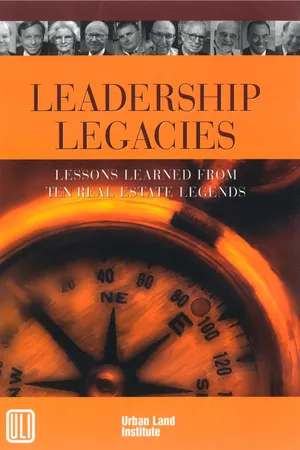
Leadership Legacies
Lessons Learned From Ten Real Estate Legends
- 83 pages
- English
- ePUB (mobile friendly)
- Available on iOS & Android
eBook - ePub
Leadership Legacies
Lessons Learned From Ten Real Estate Legends
About this book
Combining the best lessons from legends in the real estate industry, this book shares leadership insights from Trammell Crow, Charles Fraser, James Graaskamp, Gerald Hines, James Rouse, Don Terner, Robert Venturi, Denise Brown, Steve Siegel, and Sam Zell.
Information
CHAPTER ONE
TRAMMELL CROW: Transforming the Business Model
Desiree French
LEADERSHIP LESSON
Leaders create more leaders.
“A group of people, working closely together, can provide the deliverables of direction, ensuring competence and ensuring that change is implemented. To do so requires participants to share similar values, to develop a commitment to each other and the organization, and to allow those who possess complementary skills to lead when appropriate.”
Leading for a Change: How to Master the 5 Challenges Faced by Every Leader—Ralph D. Jacobson, Keith Setterholm, and John Vollum
In national and international real estate circles, the Trammell Crow Company stands out as one of the top commercial real estate services companies in the United States.
The man who made it all possible is Trammell Crow, the company’s legendary founder who started out more than 55 years ago building industrial warehouses in Dallas. He went on to grace the landscape with the likes of the deluxe Anatole Hotel in Dallas, Peachtree Center in Atlanta, Embarcadero Center in San Francisco, and Dallas Market Center, the largest wholesale trade and merchandise mart in the world.
In the 1970s and 1980s, the Trammell Crow Company was the largest commercial developer in the country. It attained that distinction based on a unique and powerful corporate culture that embraced a spirit of entrepreneurialism and trust.
Crow, a visionary and risk taker who surrounded himself with very capable people—specifically, young people with fire in their bellies—pioneered the concept of speculative real estate development. But he is, perhaps, noted most for creating partnerships to build projects rather than adhering to a traditional corporate organizational structure.
“I believe [he] is the father of the partnership structure in real estate,” says Ron Terwilliger, national managing partner of Trammell Crow Residential and a former ULI chairman. “He probably has created more partners, who have created more wealth in real estate, than anyone else.”
And for that, his former partners are eternally grateful. Hundreds have achieved huge financial success and security. But, more important, they were given the opportunity of a lifetime, while in their 20s and 30s, to become partners in the fastest growing show in town. In exchange for extremely low salaries at the outset, many were able to reap hefty future rewards and eventually move on to create their own companies and organizations.
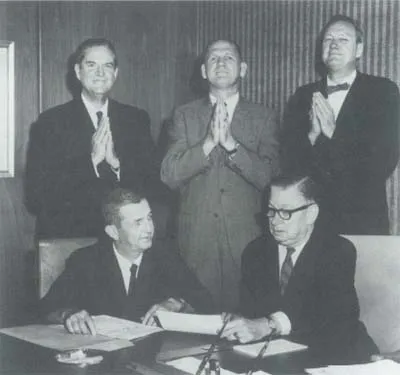
Crow (standing, middle) at Mercantile Bank “praying for a loan” for Trade Mart in 1957, with colleagues Storey Stemmons (left) and John Stemmons (right).
Courtesy of the Crow family
“He spawned a whole generation or two of very successful real estate people. Many of them today are great leaders all over the country,” says Ned Spieker, one of those former partners who, today, is managing partner of Spieker Partners, Inc., in Menlo Park, California. He is also the former chairman of Spieker Properties, Inc., an office-industrial real estate investment trust purchased by Equity Office Properties for $7.3 billion in 2001.
Spieker was 25 when Crow made him a general partner more than two decades ago. He remained with the company for 17 years. “The lesson I learned from Trammell,” says Spieker, “was to share. The only way you can build a large business is to share the profits and the glory. You have to create trusted leaders that you treat on an equal plane. I took that principle from Trammell and applied it in my own companies.”
Crow’s strategy was simple but innovative. After developing industrial projects in Dallas, he ventured into other parts of the country in the mid-1960s and began to diversify his portfolio. To expand his reach, he built the business using capital and operational partners.
Crow gave his partners, who opened offices for him around the country, meaningful ownership shares in the projects, not just lip service. They shared in the equity of a building and the decentralization of the organization, allowing them to have tremendous control. He recognized that ownership was a very powerful incentive to monitor expenses and maximize profits.
The partnerships, as one former partner put it, were a “rising tide business.” If one of his partnerships did well, then Crow also did well. If one did not, he had to ride along with the tide.
Crow was different from other executives in that he met with his young recruits, many of whom were leasing agents—on the first rung on the partnership ladder—during their first interviews at his company. But he did not ask the typical interview questions. He would ask someone about his relationship with his father and whether the recruit was a churchgoer—questions generally considered taboo today.
“He was more interested in the composition of the individual. Trammell looked for someone with brains who was a good guy,” says Jon Hammes, a former partner and now managing partner with Hammes Company, a development firm in Milwaukee. “He wanted to be associated with people who would succeed.”
Eventually, some in the real estate industry began to refer to Crow’s partners as “clones” because they all had something in common with Crow and with each other. They shared the fundamental and very intangible attributes that Trammell sought—high personal standards and sound character, a strong work ethic, enormous energy, and an entrepreneurial spirit.
“The principles and entrepreneurial spirit that Trammell fathered have molded many of us as we have gone on to establish our own companies and organizations,” continues Hammes. “Those principles include employing the type of people you build a company around, using the concept of meritocracy, making ownership possible, having ethical standards, and building an organization where people are more than just employees. The model he mentored me on is a sound model. It has worked for me in my own business.”
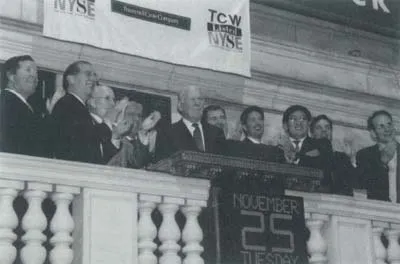
Crow (middle) watches as stock in the Trammell Crow Company is opened to the public on the New York Stock Exchange in November 1997.
Courtesy of the Crow family
During its heyday in the mid-1980s, the Trammell Crow Company was hiring 125 master of business administration graduates per year, up from a mere one or two in the early 1970s. At one point, Crow had more than 600 partnerships.
His partners were a loyal bunch. When Crow ran out of money and was hit hard by rising interest rates, mounting debt, and a glut of office buildings and other real estate in the mid-1970s, his partners rallied to the rescue and anted up $100 million.
“We just sat around in a circle and said we would raise the money and loan it back to him,” says Spieker. “That doesn’t happen often, but because he created such trust among the partners, he just called on us and we came to his aid. There was a great deal of love there.”
It was an example of the very powerful bond that Crow had forged, one that was truly unique in comparison to other organizations. The partners shared a strong sense of brotherhood. It was something that Crow had personally cultivated within the organization. The partners were partners in the truest sense of the word.
In fact, when Crow once spoke at the Harvard Business School, he was asked to identify the most important element in creating a successful organization. He replied that it was “love.”
“Trammell believed in that, and he felt that if you had a general sense of love for people you would be more successful than not. And if you believed in what you were doing, you would be more successful,” says Hammes. “He created a culture that I don’t know has ever been replicated.”
Crow is said to have put forth to all his employees a fatherly or grandfatherly disposition, whether they were secretaries or accountants. “He was not the aggressive, pin-you-to-a-corner type. On the other hand, he was not a fool either. If you got on the wrong side of him, it could be taxing,” says Bob Kresko, a former Crow partner who has a part ownership in Krombach Partners, an affiliate of a real estate brokerage business in St. Louis. “The great thing about Trammell is that you didn’t have to agree with him 100 percent in order to work with him.”

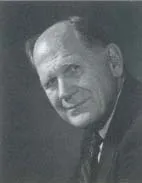
Trammell Crow
BIOGRAPHY
At 89, Trammell Crow has, by all accounts, lived a full life as a humble yet extraordinary entrepreneur. But besides developing properties and establishing himself as an icon in real estate, the former Navy commander has been equally fond of collecting Asian art, particularly jade, of which he has accumulated more than 1,200 artifacts.
Some even quip that Crow went into the hotel business—he built the upscale Anatole Hotel in Dallas and founded the Wyndham Hotel chain—simply to have a place to store his voluminous works of art from Japan, China, and India.
Crow seemed to make purchases of all kinds—a ranch, land, paintings, or sculptures—wherever he traveled. “Trammell never saw a deal he didn’t like. He didn’t like to say ‘No,’” chuckles Ned Spieker. “Trammell knew where the accelerator was, but he never knew where the brakes were.”
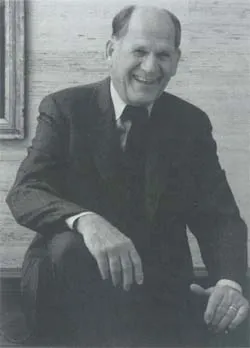
In recruiting an employee, Crow sought “someone with brains who was a good guy.”
Courtesy of the Crow family
When Spieker worked in San Francisco, Crow would visit about once every six months, presumably to talk shop. Instead, they would end up in Gump’s—a famous retail store that sells exclusive and high-quality merchandise mostly from the Pacific rim—for a behind-closed-doors art sale. Afterwards, Crow would hop into the car and head back to the airport.
A graduate of Dallas public schools and Southern Methodist University, Crow was the fifth of eight children from a lower-middle-income family. Formally trained as an accountant, he had no previous experience in real estate or architecture before setting foot in the real estate arena to help his wife manage a warehouse she had inherited.
Throughout his career, Crow had an exceptional ability to cultivate relationships in the political as well as business and financial arena. He was actively involved in the Republican Party. He supported, and was very close to, George W. Bush and Gerald Ford.
Bob Kresko, a former Crow partner a...
Table of contents
- Cover
- Title Page
- Copyright
- Contents
- Foreword: Harry H. Frampton III
- Acknowledgments
- Dedication
- Chapter One – Trammell Crow: Transforming the Business Model
- Chapter Two – Charles E. Fraser: Living the Vision
- Chapter Three – James Graaskamp: Reinventing Real Estate Education
- Chapter Four – Gerald D. Hines: Creating the Culture
- Chapter Five – James Rouse: Leading From the Heart
- Chapter Six – Stephen B. Siegel: Listening and Learning
- Chapter Seven – Donald Terner: Bridging the Gap in Low-Income Housing
- Chapter Eight – Robert Venturi and Denise Scott Brown: Collaborating for Success
- Chapter Nine – Sam Zell: Investing in People
- Appendix 1 Bibliography
- Appendix 2 ULI Leadership Development Initiative
Trusted by 375,005 students
Access to over 1.5 million titles for a fair monthly price.
Study more efficiently using our study tools.
Frequently asked questions
Yes, you can cancel anytime from the Subscription tab in your account settings on the Perlego website. Your subscription will stay active until the end of your current billing period. Learn how to cancel your subscription
No, books cannot be downloaded as external files, such as PDFs, for use outside of Perlego. However, you can download books within the Perlego app for offline reading on mobile or tablet. Learn how to download books offline
Perlego offers two plans: Essential and Complete
- Essential is ideal for learners and professionals who enjoy exploring a wide range of subjects. Access the Essential Library with 800,000+ trusted titles and best-sellers across business, personal growth, and the humanities. Includes unlimited reading time and Standard Read Aloud voice.
- Complete: Perfect for advanced learners and researchers needing full, unrestricted access. Unlock 1.5M+ books across hundreds of subjects, including academic and specialized titles. The Complete Plan also includes advanced features like Premium Read Aloud and Research Assistant.
We are an online textbook subscription service, where you can get access to an entire online library for less than the price of a single book per month. With over 1.5 million books across 990+ topics, we’ve got you covered! Learn about our mission
Look out for the read-aloud symbol on your next book to see if you can listen to it. The read-aloud tool reads text aloud for you, highlighting the text as it is being read. You can pause it, speed it up and slow it down. Learn more about Read Aloud
Yes! You can use the Perlego app on both iOS and Android devices to read anytime, anywhere — even offline. Perfect for commutes or when you’re on the go.
Please note we cannot support devices running on iOS 13 and Android 7 or earlier. Learn more about using the app
Please note we cannot support devices running on iOS 13 and Android 7 or earlier. Learn more about using the app
Yes, you can access Leadership Legacies by Patricia Riggs,Desiree French,Michael Sheridan in PDF and/or ePUB format, as well as other popular books in Business & Real Estate. We have over 1.5 million books available in our catalogue for you to explore.