Focusing on three South African communities the authors dismiss the idea that some groups are voiceless, arguing that they are being deliberately ignored by dominant news media
The dominant news media are often accused of reflecting an 'elite bias', privileging and foregrounding the interests of a small segment of society while ignoring the narratives of the majority. The authors of Tell Our Story investigate this problem and offer a hands-on demonstration of listening journalism and research in practice. In the process they dismiss the idea that some groups are voiceless, arguing that what is often described in such terms is mostly a matter of those groups being deliberately ignored. Focusing their attention on three very different South African communities they delve into the life and struggle narratives of each, exposing the divide between the stories told by the people who actually live in the communities and the way in which those stories have been understood and shaped by the media. The three communities are those living in the Glebelands hostel complex in Durban where over 100 residents have been killed in politically motivated violence in the past few years; the Xolobeni community on the Wild Coast, which has been resisting the building of a new toll road and a dune mining venture; and Thembelihle, a settlement south-west of Johannesburg that has been resisting removal for many years. The book concludes with a set of practical guidelines for journalists on the practice of listening journalism.
eBook - ePub
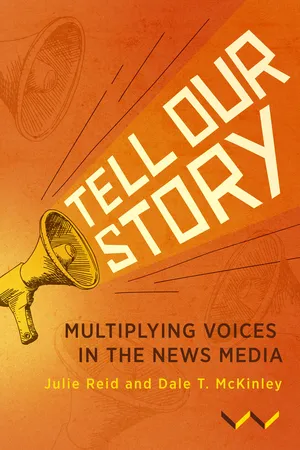
Tell Our Story
Multiplying voices in the news media
- 234 pages
- English
- ePUB (mobile friendly)
- Available on iOS & Android
eBook - ePub
About this book
Information
CHAPTER
1
The Importance of Voice and the Myth of the ‘Voiceless’
Julie Reid
Voice as a process – giving account of oneself and what affects one’s life – is an irreducible part of what it means to be human; effective voice (the effective opportunity to have one’s voice heard and taken into account) is a human good.
— Nick Couldry, Why Voice Matters
As social animals, all human beings instinctively and naturally yearn to give an account of themselves and to tell their own stories. But, to operate as if certain peoples lack this desire or ability is to behave towards them as if they are not human (Couldry 2010). In recent years, philosophers and social scientists have pondered the notion of ‘voice’ as a type of catch-all phrase that infers more than the literal meaning of the word, that is, the sounds and words one makes when speaking. Jim Macnamara (2012) conceptualises ‘voice’ as more than the verbal act of speaking since it includes human communication of all types, such as voting, protesting, online participation and artistic production. More broadly, voice, or rather the ability to practise voice, relies on inclusion and participation in political, economic and social expression and processes, and involves affording people the space to actively contribute to decisions that affect their lives. Jo Tacchi (2008: 1) calls the denial of the right of peoples to participate in such activity, ‘voice poverty’.
Voice today is theoretically understood to encompass a broad spectrum of communicative activity, which includes: iterating one’s view, story and position in the world; having that story or position listened to by others; having one’s story recognised as something that matters; and, further, having it mediated or carried via a means of communication (such as the news media) to the broader collective or society. Admittedly, that is putting things rather simply because there are complex and multilayered problems and conditions relevant to each one of these steps. A number of writers examine the intricacies of this process, the notion of ‘voice’, its definition, its theorisation, its associated processes and, crucially, the characteristic challenges prevalent in the disablement of the effective practice of voice. Particularly notable among these is work done by Susan Bickford (1996), the research collective called the Listening Project (O’Donnell, Lloyd and Dreher 2009) and Nick Couldry (2009, 2010). Bickford (1996) offers a landmark and detailed examination of voice and associated listening in her book, The Dissonance of Democracy: Listening, Conflict, and Citizenship, in which she explores ‘pathbuilding’ communicative practices. Here, citizens engage with one another’s perspectives through an ongoing process of speaking and listening, though not necessarily with the goal of social coherence. Instead, the discord, which naturally arises during these interactions, encourages participants to re-evaluate their own speaking practices (Bickford 1996).
Charles Husband (1996, 2008) amplifies the ethical importance of listening by advocating the ‘right to be understood’ as a fundamental communication right. Lisbeth Lipari (2010) proposes a paradigm shift that places listening at the centre of communication rather than speaking, and she defines a perspective on listening, which she calls ‘listening being’. While the largest body of literature emphasises the notion of listening as central to communication, Couldry (2009, 2010) focuses the critical lens on voice. We take particular direction from his explication of the various characteristics of ‘voice’. However, while he identifies a number of different levels of voice, we will mention only those that are relevant here in relation to how voice is either carried out or ignored by the dominant news media, and what the implications are for journalism.
While the body of scholarly literature on communicative voice and listening, and the associated ethics involved, is steadily growing, we do not offer a detailed literature review of such writings here because this has already been presented at length elsewhere (see, for example, Dreher 2009, 2017; Macnamara 2012; O’Donnell 2009; O’Donnell, Lloyd and Dreher 2009). Rather, what we offer in this book is a demonstration of such theory in practice: we intend this as an example of active listening, with the purpose of surfacing and amplifying voice as a means to illustrate how this could be translated into journalistic practice for application in the news media.
In this book, we have kept the theoretical side of things unapologetically simple. This is because, with respect to our scholarly peers, we do not want the journalists, future journalists-in-training, newsmakers and editors who read this book to become discouraged by complexities and near-unfathomable musings so characteristic of academic writing (Heleta 2016). Rather, we adopt the principled position of offering a text that is easy to read, easy to understand and more broadly accessible, knowing that this approach offers greater potential to catalyse the type of change that we advocate in this book. We aim to provide research that is accessible to working journalists, as a practical demonstration for how to enable voice through listening and, in doing so, do good journalism. We also want this project to speak to ordinary citizens who may aspire to talk and be heard, and whom much of this book is about, as a testament that they have every right to demand a news media that listens to them and takes their stories seriously.
Since the ordinary grassroots citizen is at the heart of this project, the notion of voice as the initial act of speaking and telling one’s own story is our primary point of departure. The concept of voice is, however, for us and for many other theorists, inextricably linked to the act of listening. The two, voice and listening, are coupled: the accompaniment of listening, together with speaking, are two parts of the same equation where neither can be determined as entirely successful without the other (Dreher 2009).
The first and most crucial aspect is to acknowledge that everyone has a voice, and no one is voiceless. The voicelessness of the ‘voiceless’ is an unfortunate myth. Jan Servaes and Patchanee Malikhao (2005), for example, attest that people are ‘voiceless’ not because they have nothing to say, but because nobody cares to listen to them. People, all people, regardless of their personal status, class, wealth, education, gender, race or ethnicity, have something to say and have stories to tell, if only we could bear to listen. This means that simply having a voice is not enough. In addition, one needs to know that one’s voice matters, that it is considered and that it is heard.
So, having a voice relies on the prerequisite of having that voice matter, to be heard and listened to by others. Active and considered listening registers and respects the distinctness and importance of the narrative of the speaker, without which voice will not succeed in being heard (Couldry 2010).
To tell one’s own story is a considered decision. It requires reflection on how to speak, which part or parts of the story to tell, and what to say. Equally, listeners ought to practise critical introspection on how they listen, on what they (choose to) hear, which parts of the story they pay attention to, and which parts they ignore. This means taking an active responsibility for whom, how and what we listen to (Bickford 1996). Of course, societal and normative hierarchies often determine the trajectory of our listening, meaning that we regard some voices as more worthy of being listened to than others (more on this later). But where voice and listening are co-dependent, and if we accept that to deny the effective practice of voice to some (by not listening to them) constitutes oppression and injustice, we must also recognise that reconfiguring listening practice can potentially break up normative traditions and hierarchies, allowing greater space for a plurality of voices (Bickford 1996).
This equation of effective voice (speaking plus engaged listening) is central to the legitimacy of modern democracies. Yet, somehow, the organisation of the human sphere of communication has naturalised and made acceptable the importance of some voices over others to the extent that alternate voices do not matter (Couldry 2010). Men’s voices have always mattered more than women’s, so much so that this seems ‘natural’. Heteronormative narratives dominate our popular culture, while homosexually aligned ones are relegated to the fringe or the obscure, and again we are duped into accepting this as ‘natural’, when in reality there is nothing strange or unnatural about being gay. Elite, middle-class and economically secure voices have always been mediated in abundance, relative to the voices of the poor and working classes.
Importantly, when some segments of society experience a lack of voice, when these are not listened to or heard, societal, political and cultural fissures and/or inequalities naturally arise. Denying voice to some has a material impact. Simply put, when everyone has a voice it is better for society. For example, feminism has long identified the lack of effective voice available to women as a determining factor regarding their social and economic status and inequity, as well as the related negatively connoted identity that is experienced by women in every part of the world (Macnamara 2012). The material impact of women’s lack of voice is clearly evident, measureable and undeniable.
For instance, the 2019 Sustainable Development Goals Index surveyed 129 countries in terms of their progress in meeting the 2030 targets for gender equality. Not a single country in the world was found to be on track to meet these internationally agreed targets, while 2.8 billion women live in countries that are doing too little or nothing to empower women and end inequality. Women the world over still suffer diminished power and under-representation in governmental bodies, including parliaments, in upper management positions in both the private and public sector, and in the economy, while women are still unaccountably, though predominantly, paid less than men for doing the same work (Ford 2019). When half of the world’s routinely marginalised voices bear direct symmetry with the same half of the world’s people who are clearly afforded less social, economic and political power than the other half, the importance of effective voice as a key factor for the overall health of society becomes obvious.
And so, firstly, a considered view of voice starts with the acknowledgement that voice, every voice, has value. More forcefully, for societal health and in the interest of justice and equality, every voice must have value. It is important to not only value voice itself, but to also value the societal frameworks, institutions, platforms and resources that themselves value voice, and consciously identify, reject and reform those that do not (Couldry 2010). With regard to such societal frameworks and institutions, the media sphere is not innocent as it routinely maintains what Tanja Dreher (2009: 445) refers to as the ‘hierarchies of language which can be slow to shift’. The task then ‘is to take responsibility for shifting those hierarchies of attention which produce unequal opportunities for speaking and being heard. And it is “a particular kind of listening” which might serve to undo these entrenched hierarchies of voice’ (Dreher 2009: 446).
Secondly, voice needs to be understood as a process, and not as a once-off isolated occurrence. Giving an account of one’s life, events or conditions, telling a story or enacting the natural human activity of relating a narrative is only the first aspect of voice. Much more needs to stem from this in order for voice to be recognised, valued and effective.
For example, voice is socially grounded, meaning that it is not the isolated practice of individuals. No one narrative can be separated from an interlocking set of related narratives, which is why it is crucial to always present a particular voice in its associated context and history – something that dominant journalism often fails to do, as is evident in the following chapters (Couldry 2010).
Couldry (2010: 8) calls voice ‘an embodied process’ that is informed by history, and because each voice is iterated from a ‘distinctive embodied position’ it follows that the trajectory of each voice is distinct. Simply, we all have different things to say because we are all different. Therefore, when we fail to acknowledge and respect the inevitable differences between voices, we fail to recognise voice itself. In reality, of course, there is no one voice (singular), but a multiplicity of voices (plural). It follows then that we ought to be deeply suspicious when an institution, whose responsibility is to inform us of the events of the world, reports these from a singular (dominant) position.
Clearly, the overarching concept of voice described above involves a great many things. But, from this point on in this book, we will narrow our use of the term ‘voice(s)’ to a more specific connotation. That is not to exclude the importance of the concept and the process as a whole, but we do this here for simplicity and brevity. We include the bracketed ‘(s)’ on the end of the term to invoke the possibility of the plural and to indicate a recognition that there is always more than one solitary voice related to any particular situation, story and context. For the purposes of the remainder of this book, voice(s) points to the narratives and stories of the people this book is about – the members of grassroots communities, who, all of them, have important stories to tell, whose experiences of events have implications for a broader society, country and political landscape, but whose version of events and experiences have been habitually ignored and/or misrepresented by the dominant news media.
In this book, we often refer to what we have termed the ‘dominant media’ for the purposes of our discussion. So what/who do we mean by the dominant media? For us, the dominant media ought to be understood less in terms of the formal structures of media ownership, but more in respect of the direction of the national narrative. That is, the myriad collection of media reports, journalists, editors, articles, broadcasts and media outlets, which collectively direct the trajectory of public discourse on any particular issue towards the same or a similar cohesive understanding of events. In overly simple terms, it is the various news media outlets and reports that all sing to the same tune, and which report on the same events in the same ways. The dominant media is then comprised of media outlets that may fall within the stable of privately owned, corporatised media conglomerates or public service media institutions, but which all behave in accordance with the dominant narrative.
We have selected the term ‘dominant’ to remain in keeping with Stuart Hall’s (1980) outstanding and still relevant explanation of how perspectives (readings) can vary – the ‘dominant’ one, however, primarily orientated toward the status quo. But as much as our different perspectives and readings of events can vary, so too can our retelling of them. This book is about how there are stories, many stories, to be told about any particular scene or situation. And about how the dominant media regularly ignores most of them, in favour of telling only one story.
Importantly, the dominant media maintains the facade of professional journalism in pursuit of truth and in adherence with the highest order of media ethics. The dominant media must mythologise the profession in this way in order to ensure its own credibility. The remainder of this book, however, exposes this facade for what it is – a myth. Roland Barthes ([1957] 1972) formulates a semiotic model for the function of communicated myth, which acts as a mode of speech that is ideologically infused, but which can often operate so unobtrusively that the message is simply accepted as fact, as natural, as entirely justifiable and as the way things are. Simply, a myth is a mode of communicating an idea, the motivations of which are concealed, and the content of which is largely inaccurate, but which dupes people into believing it anyway.
In this book we have focused on three politically, socially and economically marginalised communities involved in differing struggles for social justice: these are the communities of Glebelands, Xolobeni/Amadiba and Thembelihle in South Africa. But many other marginalised groups or communities have suffered a similar non-recognition of their own voice(s) by the dominant media. We mention this here, and highlight the findings of related research studies, conducted independently of our own, to demonstrate how this media behaviour is not unique or isolated to the stories of Glebelands, Xolobeni/Amadiba and Thembelihle.
WHAT DO WE ALREADY KNOW ABOUT THE NEWS MEDIA AND VOICE(S)?
A number of other recent research studies confirm the critique that we deliver here, that the dominant media does not offer adequate voice(s) and representation to the majority of citizens, who in South Africa predominantly are the poor. For example, a 2013 study (Malila 2013), which focused on the youth as media consumers, explored the relationships between young research participants and the media. The study highlights that young, poor, black South Africans feel mostly disconnected from the majority of news media content. Participants expressed the concern that they do not ‘see’ themselves in the news media, the content of which holds little relevance to their concerns, interests and lives. While South African society is bottom heavy and comprised of a large youth segment, little media content concerns the interests of the youth.
According to Jane Duncan (2013b): ‘With the exception of education, youth input on issues of importance was minimal, with practically no youth input on crime. Young men were more pr...
Table of contents
- Cover
- Title Page
- Copyright Page
- Contents
- List of Figures
- Acknowledgements
- Abbreviations and Acronyms
- Chapter 1: The Importance of Voice and the Myth of the ‘Voiceless’
- Part 1 : From the Inside: Voice(s) from the Ground
- Chapter 2: Community Perspective, Experience and Voice
- Chapter 3 : Glebelands Hostel, Durban
- Chapter 4 : Xolobeni, Eastern Cape
- Chapter 5 : Thembelihle Community, Johannesburg
- Part 2 : From the Outside: Dominant Voice
- Chapter 6 : Dominant Media Telling and Elite Communication
- Chapter 7 : The Political Economy of Dominant Power and Storytelling
- Part 3 : New trajectories for Journalism and Voice(s)
- Chapter 8 : Media Diversity and Voice(s)
- Chapter 9 : Rethinking Media Freedom, Revamping Media Ethics
- Chapter : Planting the Seeds of Change
- Notes
- Bibliography
- Index
Trusted by 375,005 students
Access to over 1.5 million titles for a fair monthly price.
Study more efficiently using our study tools.
Frequently asked questions
Yes, you can cancel anytime from the Subscription tab in your account settings on the Perlego website. Your subscription will stay active until the end of your current billing period. Learn how to cancel your subscription
No, books cannot be downloaded as external files, such as PDFs, for use outside of Perlego. However, you can download books within the Perlego app for offline reading on mobile or tablet. Learn how to download books offline
We are an online textbook subscription service, where you can get access to an entire online library for less than the price of a single book per month. With over 1.5 million books across 990+ topics, we’ve got you covered! Learn about our mission
Look out for the read-aloud symbol on your next book to see if you can listen to it. The read-aloud tool reads text aloud for you, highlighting the text as it is being read. You can pause it, speed it up and slow it down. Learn more about Read Aloud
Yes! You can use the Perlego app on both iOS and Android devices to read anytime, anywhere — even offline. Perfect for commutes or when you’re on the go.
Please note we cannot support devices running on iOS 13 and Android 7 or earlier. Learn more about using the app
Please note we cannot support devices running on iOS 13 and Android 7 or earlier. Learn more about using the app
Yes, you can access Tell Our Story by Julie Reid,Dale T. McKinley,Dale T McKinley in PDF and/or ePUB format, as well as other popular books in Social Sciences & Cultural & Social Anthropology. We have over 1.5 million books available in our catalogue for you to explore.