A revealing account of how families adapt to living with a chronically ill child
What is it like to live with a child who has a chronic, life-threatening disease? What impact does the illness have on well siblings in the family? Myra Bluebond-Langner suggests that understanding the impact of the illness lies not in identifying deficiencies in the lives of those affected, but in appreciating how family members carry on with their lives in the face of the disease's intrusion.
The Private Worlds of Dying Children, Bluebond-Langner's previous book, now considered a classic in the field, explored the world of terminally ill children. In her new book, she turns her attention to the lives of those who live in the shadow of chronic illness: the parents and well siblings of children who have cystic fibrosis. Through a series of narrative portraits, she draws us into the daily lives of nine families of children at different points in the natural history of the illness—from diagnosis through the terminal phase. In these portraits, as family members talk about their experiences in their own words, we see how parents, well siblings, and the ill children themselves struggle, in different ways, to contain the intrusion of the disease into their lives.
Bluebond-Langner looks at how parents adjust their priorities and their idea of what constitutes a normal life, how they try to balance the needs of other family members while caring for the ill child, and how they see the future. This context helps us understand how well siblings view the illness and how they relate to their ill sibling and parents. Since the issues raised are not unique to cystic fibrosis but are common to other chronic and life-threatening illnesses, this book will be of interest to all who study, care for, or live with the seriously ill.
eBook - ePub
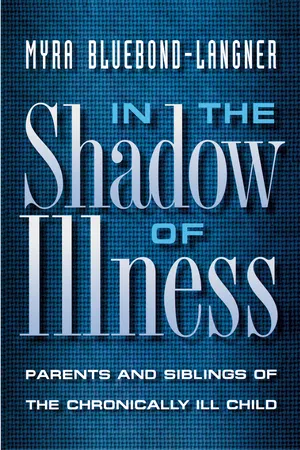
In the Shadow of Illness
Parents and Siblings of the Chronically Ill Child
- English
- ePUB (mobile friendly)
- Available on iOS & Android
eBook - ePub
About this book
Information
Publisher
Princeton University PressYear
2020Print ISBN
9780691050799
9780691027838
eBook ISBN
9780691214702
Topic
MedicineSubtopic
Pediatric MedicinePart One
INTRODUCTION
CHAPTER 1
The Impact of Cystic Fibrosis on Well Siblings
THIS CHAPTER introduces the reader to some of the previous work on well siblings and to the present study. In the first section I review the literature on well siblings with cystic fibrosis (CF) and other chronic, life-threatening illnesses, and I suggest that the real shortcoming lies not in its lack of consistent conclusions, but in its underlying approach.1 In section 2 I describe the population and collection and coding of data for the present study. In section 3 I acquaint the reader with two basic concepts that emerge in the analysis—the strategies that parents use to contain the intrusion of the illness into their lives and the natural history of the illness.
1. APPROACHES TO THE STUDY OF WELL SIBLINGS
Much of the research on well siblings to date has been from what Drotar and Crawford (1985: 360) call “a deficit or disease perspective.” In these studies investigators “have searched for evidence of psychopathology or major dysfunction as the primary impact of catastrophic disease on individuals and families” (Carpenter and Sahler 1991: 194). To accomplish this they often turned to standardized instruments thought to measure social and emotional adjustment in children. These measures, “for the most part, were normed in psychiatric populations” (Carpenter and Sahler 1991: 194). They then analyzed the results in terms of variables that had proven meaningful in other studies of social and emotional adjustment in clinical populations (Delisi 1986).
The types of studies these investigators conducted reflected their motivation, background, and training. These researchers were interested in improving the lives of well siblings. They wanted their work to be of some use in clinical practice (a value I share). Some were in clinical practice and all had some clinical background or training. Given their orientation and background, their approach to the question is not surprising. In clinical work one prefers to rely on controlled studies with large samples, with clearly defined and delimited predictors of outcomes, and to make recommendations based on those findings.
This literature, however, is marked by contradictory findings and divergent interpretations of those findings. A substantial portion of the literature evaluates negative effects on the well siblings. Researchers report a panoply of problems: psychosomatic disorders,2 somatic disorders,3 accident proneness,4 behavior disorders,5 behavior problems,6 hyperactivity,7 irritability,8 bedwetting and soiling,9 regression,10 stealing,11 fire starting,12 aggressiveness,13 generalized hostility and rebelliousness,14 poor social adjustment,15 laziness,16 withdrawal,17 poor school performance,18 learning disabilities and learning problems,19 low self-esteem20 and feelings of being socially stigmatized,21 social isolation,22 rejection,23 anxiety,24 depression,25 anger,26 resentment,27 jealousy,28 guilt,29 shame,30 fear for their own health,31 and negative body image.32
At the other end of the spectrum are those who find that chronic, life-threatening illnesses do not necessarily have negative effects on well siblings and may actually have positive ones. For example, in a study of the well siblings of children with cancer, Kramer (1984: 49) found that “the effects of the leukemic illness on the well siblings were not all negative. The same experiences that engendered the negative feelings of isolation, frustration, anxiety and resentment also brought about positive and adaptive responses in the healthy siblings and their families.” In a similar vein, Harder and Bowditch (1982: 118) in their study of the well siblings of children with CF noted that the “occurrence of cystic fibrosis apparently has helped some siblings to be less self centered; . . . having the disease in the family improved their ability to empathize and communicate with the ill and to cope with difficult circumstances.” Some investigators have even gone so far as to characterize the presence of a seriously ill child in the family as an opportunity for the well sibling. Gayton, Friedman, Tavormina, and Tucker (1977: 893) called attention to researchers like Pless and Pinkerton, who suggested that “handicapping illnesses do not invariably result in maladjustment and that on the contrary in some instances may provide opportunities for the growth of personality.” Iles (1979) found the well siblings of children with cancer became “more compassionate, tolerant, empathetic, and appreciative of their own health” (Kupst 1986: 176). In her survey of the literature on the well siblings of children with cancer, Walker (1990: 358) cited studies with evidence for such positive effects as: “increased ability for empathy and sensitivity, enhanced personal maturation and self concept, an increase in family cohesion, and a perceived ability to cope with negative changes.”
There is also a midrange of studies which reject both positive and negative labeling (Gayton, Friedman, Tavormina, and Tucker 1977: 888; Drotar and Crawford 1985: 355; Tritt and Esses 1988: 218). Some would like to have investigators “define competencies rather than deficits” (Carpenter and Sahler 1991: 194). Some of these researchers and clinicians find the well siblings to be “within the normal range of social competence” (O’Brien 1987: 5075-B), “not any less well adjusted than controls” (Binks 1982: 43), and not deviant or disturbed in the way that many of the studies would suggest (Switzer 1984: 1926-B; Gayton, Friedman, Tavormina, and Tucker 1977: 888). Kupst (1986: 84) and others find that “while the experience of serious illness in a brother or sister may present several upsetting and uncomfortable situations for a child, most of them appear to be able to cope with it, especially over time.” Others, like Carpenter and Sahler (1990: 202), take the position that “these children do not appear to be at risk for major psychological disturbance. On the other hand, by clinical experience, minor dysfunction as an indicator of distress occurs frequently.”
Several of these researchers urge their colleagues to examine particular domains of psychological function and social adjustment before concluding that chronic illness has a negative impact on well siblings. For example, Drotar, Crawford, and Bush (1984: 109) argue that “the general mental health of siblings is not necessarily impaired, but their social adaptation may be vulnerable.” Breslau and her colleagues put a finer point on this. They found that “siblings of disabled children [study included children with cystic fibrosis, cerebral palsy, myelodysplasia, and multiple handicaps] did not manifest higher rates of severe psychologic impairment or greater overall symptomatology when compared to control subjects. [However] on two scales measuring interpersonal aggression with peers and within the school, siblings of disabled children scored significantly higher indicating greater pathology in these behavioral domains” (Breslau, Weitzman, and Messenger 1981: 350). Similarly, Cadman, Boyle, and Offord (1988: 119) found “little increased risk for psychiatric disorders or social maladjustment. The two exceptions appear to be increased risk for emotional internalizing disorder, including depression, anxiety or obsessive-compulsive thoughts and actions as well as difficulty getting along with peers.”
Evaluating the results of studies of well siblings is no easy task. Most often one is not comparing equivalent pieces of work. There is a tremendous range of variation in: theoretical perspectives or orientations (e.g., family systems, coping, crisis, and stress),33 study populations (e.g., disease[s], severity), period in the illness (e.g., time of diagnosis, physical deterioration, quiescence or terminal phase), type of study (e.g., research, clinical, quantitative, qualitative), sample size and criteria (e.g., age, sex, socioeconomic background), informants (e.g., well siblings, parents, teachers), assessment approaches and instruments (e.g., observational accounts, psychological scales, behavioral checklists), terminology, and reported findings. And this is just to name but a few of the differences. It is not surprising that the studies often appear to contradict one another.
Even within the same disease population researchers’ findings vary. Consider these three examples from studies of the well siblings of children with CF. Allan, Townley, and Phelan (1974) found numerous problems in the well siblings. Gayton, Friedman, Tavormina, and Tucker (1977) did not. Allan and his colleagues worked in what Brett would def...
Table of contents
- Cover Page
- Title Page
- Copyright Page
- Dedication
- Contents
- List of Tables
- Preface
- Acknowledgments
- Part I: Introduction
- Part II: Portraits in Waiting: Nine Families
- Part III: Containing the Intrusion
- Glossary
- Works Cited
- Index
Trusted by 375,005 students
Access to over 1.5 million titles for a fair monthly price.
Study more efficiently using our study tools.
Frequently asked questions
Yes, you can cancel anytime from the Subscription tab in your account settings on the Perlego website. Your subscription will stay active until the end of your current billing period. Learn how to cancel your subscription
No, books cannot be downloaded as external files, such as PDFs, for use outside of Perlego. However, you can download books within the Perlego app for offline reading on mobile or tablet. Learn how to download books offline
Perlego offers two plans: Essential and Complete
- Essential is ideal for learners and professionals who enjoy exploring a wide range of subjects. Access the Essential Library with 800,000+ trusted titles and best-sellers across business, personal growth, and the humanities. Includes unlimited reading time and Standard Read Aloud voice.
- Complete: Perfect for advanced learners and researchers needing full, unrestricted access. Unlock 1.5M+ books across hundreds of subjects, including academic and specialized titles. The Complete Plan also includes advanced features like Premium Read Aloud and Research Assistant.
We are an online textbook subscription service, where you can get access to an entire online library for less than the price of a single book per month. With over 1.5 million books across 990+ topics, we’ve got you covered! Learn about our mission
Look out for the read-aloud symbol on your next book to see if you can listen to it. The read-aloud tool reads text aloud for you, highlighting the text as it is being read. You can pause it, speed it up and slow it down. Learn more about Read Aloud
Yes! You can use the Perlego app on both iOS and Android devices to read anytime, anywhere — even offline. Perfect for commutes or when you’re on the go.
Please note we cannot support devices running on iOS 13 and Android 7 or earlier. Learn more about using the app
Please note we cannot support devices running on iOS 13 and Android 7 or earlier. Learn more about using the app
Yes, you can access In the Shadow of Illness by Myra Bluebond-Langner in PDF and/or ePUB format, as well as other popular books in Medicine & Pediatric Medicine. We have over 1.5 million books available in our catalogue for you to explore.