Since the 1960s the number of highly educated professionals in America has grown dramatically. During this time scholars and journalists have described the group as exercising increasing influence over cultural values and public affairs. The rise of this putative "new class" has been greeted with idealistic hope or ideological suspicion on both the right and the left. In an Age of Experts challenges these characterizations, showing that claims about the distinctive politics and values of the professional stratum have been overstated, and that the political preferences of professionals are much more closely linked to those of business owners and executives than has been commonly assumed.
eBook - ePub
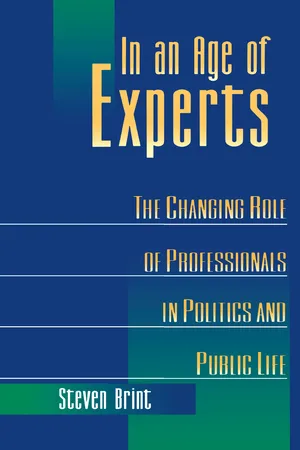
In an Age of Experts
The Changing Roles of Professionals in Politics and Public Life
- English
- ePUB (mobile friendly)
- Available on iOS & Android
eBook - ePub
About this book
Information
Publisher
Princeton University PressYear
2020Print ISBN
9780691026077
9780691033990
eBook ISBN
9780691214535
• CHAPTER ONE •
Introduction: Professionals and the Character of American Democracy
THIS is a book about the people we call professionals—about their social standing, their work, their beliefs and values, and their politics. Ultimately, therefore, it is a book about the uses of trained intelligence in American society and about the relationship of the educated middle class to the larger society and political order.
For the last thirty years, the professional stratum has proven a particular puzzle to social scientists. Very little consensus exists except on one point: the number of people categorized as “professionals” by census bureaus throughout the developed world has been growing in a dramatic fashion. In the United States before World War II, for example, only one percent of all employed people were college-educated and classified by the Census Bureau as “professional, technical, and kindred” workers. Today, the comparable group is twelve times as large.
I define members of the “professional middle class” as people who earn at least a middling income from the application of a relatively complex body of knowledge. Professional services can involve teaching, healing, advocating in court, building, designing, accounting, researching, or any one of a number of other activities requiring advanced training in a field of learning and nonroutine mental operations on the job. Not surprisingly, professionals are the most highly educated of all strata; their education now typically extends beyond the baccalaureate. Usually, professionals are considered to be distinct from business executives and managers, another relatively well educated group, in so far as they are not primarily engaged in the administration of enterprises.1 The professional middle class, therefore, includes most doctors, natural scientists, engineers, computer scientists, certified public accountants, economists, social scientists, psychotherapists, lawyers, policy experts of various sorts, professors, at least some journalists and editors, some clergy, and some artists and writers.
For some, like the sociologist Daniel Bell, the professions are heralds of a new kind of “post-industrial” society in which formal knowledge becomes an ever more important resource in both economic development and social problem solving.2 Here professionalism is most often thought of as providing a self-directing dignity and ethical tone to intellectually demanding work. For others, like the historian Laurence Veysey, the professions are a mere concatenation of occupations, sharing little more than a loose-fitting label and higher-than-average educational requirements (requirements that are often regarded as quite arbitrary).3 Here the ideology of professionalism is usually considered to mask the increasing differentiation of the powerful and the powerless among the college-educated.
Whatever their views on professions as an element of the social structure, a good many observers do find professionals to be increasingly visible in public life. One recent commentator, Barbara Ehrenreich, has noted that the authorities who dominate discussions in the public arena are “all members of this relatively privileged group”: “When we see a man in work clothes on the screen, we anticipate some grievance or, at best, information of a highly local or anecdotal nature. On matters of general interest or national importance, waitresses, forklift operators, steamfitters—that is, most ‘ordinary’ Americans—are not invited to opine.”4 Others have shown that as the professions have advanced, labor unions have retreated as centers of political influence. Where the proportion of the work force enrolled as union members has slipped to under 20 percent in recent years,5 membership in professional associations has grown from 7 to 16 percent in the last quarter century.6 Similarly, between 1960 and 1980, at a time of rapid growth in the Washington “pressure community,” professional associations tripled their percentage representation among all interest organizations (from 5 to 15 percent), while union representation dwindled from 10 to 3 percent.7
In spite of their visibility in public life, the political preferences of professionals remain very much in dispute. Once considered among the solidly conservative elements of American society,8 the professions are now sometimes depicted as the source of a new kind of class conflict in which “knowledge-based” professional elites engage in a half-hidden, half-open conflict with “profit-oriented” business owners and executives for power and status in the advanced societies. It is a theory that has aroused the fears of such conservative political thinkers as Irving Kristol and Kevin Phillips, the hopes of such liberal thinkers as Alvin Gouldner and Barbara Ehrenreich, and the analytical interest of a wide range of social scientists, from Seymour Martin Lipset to Pierre Bourdieu, and historians, from Robert Wiebe to Harold Perkin and Sheldon Rothblatt.9 In the view of the “new class”theorists, the main lines of class division have become inverted in advanced societies like the United States, with the most consequential conflicts occurring between articulate, intellectually oriented professionals and property-owning business people, rather than between capital and labor. For many of these theorists, the leading edge of “new class” dissent can be found in and around the universities, where an enlarged vision of human life stands in contrast to the economistic consideration of human beings as “human resources.” Others, eschewing the “new class” theory, find in professionals a group with a tendency to play the role of social balance wheel, moderating the more extreme passions and interests of democratic politics.10 Still others continue to find in them a generally conservative, business-oriented middle class.11
In this book, I will attempt to resolve some of the puzzles that have grown up around the professional stratum by looking at professions and professionalism as historically evolving sociological forms. This rethinking is based on an examination of the history of professions as a form of organization and status category, and on an examination of the development of expert labor in the American economy. In this respect, my study is very much in the Weberian tradition of sociology, a tradition that emphasizes the historical development of meaningful forms of social life.
My analysis will focus on two important outcomes of recent historical changes: first, the triumph of the idea of professionals as agents of formal knowledge over the older idea of professionals as “trustees” of socially important knowledge; and, secondly, the splintering of the professional stratum along functional, organizational, and market lines. Politically, these changes have led, I will argue, to a polarization of views within the professional stratum, rather than to a separation of professionals from other social classes and strata. The 10–15 percentage point differences that separate highly educated professionals and high-income business people on most political issues, while certainly of interest, are dwarfed by the differences separating the liberal and conservative wings of the professional stratum.
A third change that I will emphasize is demographic and compositional. Both the explosive growth and the changed compositional mix in the professions have had important effects on the political views of professionals, though in opposite directions. In many professional occupations, a growing number of practitioners has stimulated an aggressive search for new economic opportunities, a situation encouraging more market-oriented attitudes and more conservative political outlooks on issues related to the economy. At the same time, the professions are now composed of a more diverse population mix, and this new diversity has supported an opposite movement—toward greater liberalism—on social issues related to tolerance and majority-minority relations.
PROFESSIONS IN THE AGE OF “COLLECTIVE MOBILITY”
The modern professions are the product of a dynamic era of white-collar professionalization encompassing roughly the century between 1860 and 1960. The period can be characterized as one in which a great many white-collar occupations—from engineers to social workers—sought “collective mobility” through efforts to emulate the “established professions” of medicine, law, theology, and the professoriat.12 The main actors in this movement were the leaders of the professional associations, who sought to raise the status and standards of their occupations’ activities. New markets for specialized labor provided the essential grounds out of which emerging professions developed. The universities conferred the essential mark of professional status by allowing some occupations to enter their gates and by refusing others’ claims to require formal and advanced training. Engineers were readily accepted but business managers were for many years excluded. State governments provided special protections for many professions by adopting licensing requirements, and they provided critical legitimating recognition for all professions and would-be professions by recognizing a larger public interest in competent performance of many jobs requiring formal academic training.
New markets controlled by people with formal academic training legitimated and regulated by the state—these are the social structural coordinates out of which the modern professional stratum developed. Yet, as a prism of common experience, the professions during this period are best thought of as a form of collective organization, as a status category, and as representing a coherent ideology
The professions, alone among occupations, rely on higher education as a requisite for access to markets. This institutional fact has created conditions for a certain number of common powers and privileges, the most widespread of which has been autonomy in relation to how work is to be accomplished. Part of the strength of occupational organization in the professions grew out of a common emphasis on credentialing and voluntary memberships in the professional associations, and part was based on the successful institutionalization of occupational authority as an alternative to managerial hierarchy. In this sense, the professions represented, as Eliot Freidson has argued, an occupational principle of authority, based on ties to universities and organizations of practitioners. This occupational principle serves as an alternative to the more common administrative principle of organization, based on hierarchical authority.13 All professionalizing occupations sought to establish at least a substantial degree of occupational self-governance and therefore a substantial limitation in the allowable range of managerial control of work activities. When university professors during the Progressive era, men such as Richard Ely and E. A. Ross, insisted on the incompetence of managerial authorities to decide on questions of intellectual quality, they struck the first blows for the occupational principle of authority over the managerial principle in bureaucratic organizations.14
With organization came new conceptions of status. The social creation of expectations concerning professional life involved both popular and more explicitly sociological understandings. Folk expectations about professional status oscillated—and still do—between an upper-middle-class pole, emphasizing the combination of learning and high incomes typical of only the most prestigious professional occupations, and a middle-class pole, emphasizing the conjunction of a rationalist outlook, occupational competence, and middle-class respectability that could be attained by a much wider range of educated people. Sociological analyses sought to identify the structural roots of professional distinction. They also tended, however, to accept in a rather uncritical way some of the more debatable idealizations of the ethical standards and service orientation of professions15
The ideology of professionalism during this dynamic age centered on ideas about community and authority, I am speaking here of very specific kinds of community and authority. Community was understood as the aggregation of socially important functions, not as some more general kinship with members of one’s country or nation. Each profession was understood to work on a single important sphere of social life—such as conflict resolution, health, design, education—and the whole of the realm of socially essential knowledge could be realized only through the aggregation of these many spheres. Authority, too, had a distinctive meaning. It was cultural, rather than social; the authority that grows out of acceptable levels of understanding—the ability to apply successfully—a body of relatively demanding knowledge.16
As an ideology, professionalism had both a technical and a moral aspect. Technically, it promised competent performance of skilled work involving the application of broad and complex knowledge, the acquisition of which required formal academic study. Morally, it promised to be guided by an appreciation of the important social ends it served. In demanding high levels of self-governance, professionals claimed not only that others were not technically equipped to judge them, but also that they could not be trusted to judge them.17 The idea was expressed in classic form by the British economic historian and social critic R. H. Tawney: “[Professionals] may, as in the case of the successful doctor, grow rich; but the meaning of their profession, both for themselves and for the public, is not that they make money, but that they make health, or safety, or knowledge, or good government, or good law. . . . [Professions uphold] as the criterion of success the end for which the profession, whatever it may be, is carried on, and [subordinate] the inclination, appetites, and ambition of individuals to the rules of an organization which has as its object to promote the performance of function.”18 These functions, for Tawney and for many other advocates of the professions, were activities that embodied and expressed the idea of larger social purposes.
In this respect, the idea of professions, so intertwined with the development of modern capitalism and the modern welfare state, nevertheless showed a remarkable resonance with much older cultural and political priorities in the Anglo-American world: the idea of work in a calling, a rationalist frame of mind, collective self-governance, and high levels of self-direction in day-to-day work activities.
In its inclusiveness, the dominant model served many important functions for the emerging white-collar professions. Occupations like schoolteaching and social work with dubious technical capacities could nevertheless claim a kind of moral superiority, and they could at least look forward to further technical achievements as an important aspiration. Occupations like engineering with a more secure technical base often found it convenient to identify themselves as serving larger social purposes.
From the beginning of the period of collective mobility, however, a rival idea of professions existed in industrial organization, and it is this rival idea that has become dominant in our own time. Here the fundamental concept was of intellectual training in the service of purposes determined by organizational authorities or market forces. For professionals who saw themselves primarily as “experts” or “specialists,” the issue of social contribution had little intrinsic meaning. Most often, it was assumed that social contribution could be measured, more or less unproblematically, by the market value of specialized skills. The newer kind of “expert professionalism” was in full bloom already at the 1916 celebration of the new campus of the Massachusetts Institute of Technology, when floats sponsored by the major corporations of early 20th-century America chugged down the streets of Nantasket Beach in honor of a university designed in large part to serve the technical needs of American industry. Among the newer “professions,” those whose skills were most highly valued on the market had less compunction about shaking free of the precapitalist ideals of “social trustee professionalism.” Throughout the period of “collective mobility,” applied science and engineering provided an alternative interpretation of professionalism, one that privileged specialized skills and discounted any broader societal “responsibilities.”19
THE TRANSFORMATION OF THE PROFESSIONAL STRATUM
As a status category, the label “professional” has...
Table of contents
- Cover Page
- Title Page
- Copyright Page
- Dedication
- Contents
- Chapter One: Introduction: Professionals and the Character of American Democracy
- Part One: The Professional Stratum in America
- Part Two: Experts, Intellectuals, and Professionals
- Notes
- Index
Trusted by 375,005 students
Access to over 1.5 million titles for a fair monthly price.
Study more efficiently using our study tools.
Frequently asked questions
Yes, you can cancel anytime from the Subscription tab in your account settings on the Perlego website. Your subscription will stay active until the end of your current billing period. Learn how to cancel your subscription
No, books cannot be downloaded as external files, such as PDFs, for use outside of Perlego. However, you can download books within the Perlego app for offline reading on mobile or tablet. Learn how to download books offline
We are an online textbook subscription service, where you can get access to an entire online library for less than the price of a single book per month. With over 1.5 million books across 990+ topics, we’ve got you covered! Learn about our mission
Look out for the read-aloud symbol on your next book to see if you can listen to it. The read-aloud tool reads text aloud for you, highlighting the text as it is being read. You can pause it, speed it up and slow it down. Learn more about Read Aloud
Yes! You can use the Perlego app on both iOS and Android devices to read anytime, anywhere — even offline. Perfect for commutes or when you’re on the go.
Please note we cannot support devices running on iOS 13 and Android 7 or earlier. Learn more about using the app
Please note we cannot support devices running on iOS 13 and Android 7 or earlier. Learn more about using the app
Yes, you can access In an Age of Experts by Steven Brint in PDF and/or ePUB format, as well as other popular books in Economics & Economic History. We have over 1.5 million books available in our catalogue for you to explore.