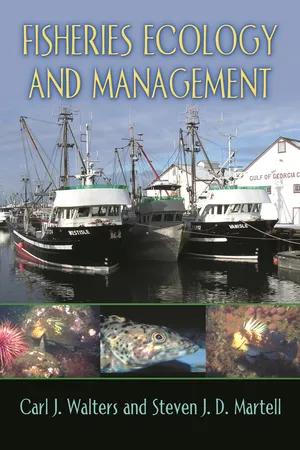
Quantitative modeling methods have become a central tool in the management of harvested fish populations. This book examines how these modeling methods work, why they sometimes fail, and how they might be improved by incorporating larger ecological interactions. Fisheries Ecology and Management provides a broad introduction to the concepts and quantitative models needed to successfully manage fisheries.
Walters and Martell develop models that account for key ecological dynamics such as trophic interactions, food webs, multi-species dynamics, risk-avoidance behavior, habitat selection and density-dependence. They treat fisheries policy development as a two-stage process, first identifying strategies for varying harvest in relation to changes in abundance, then finding ways to implement such strategies in terms of monitoring and regulatory procedures. This book provides a general framework for developing assessment models in terms of state-observation dynamics hypotheses, and points out that most fisheries assessment failures have been due to inappropriate observation model hypotheses rather than faulty models for ecological dynamics.
Intended as a text in upper division and graduate classes on fisheries assessment and management, this useful guide will also be widely read by ecologists and fisheries scientists.
- 424 pages
- English
- PDF
- Available on iOS & Android
eBook - PDF
Fisheries Ecology and Management
About this book
Information
Publisher
Princeton University PressYear
2020Print ISBN
9780691115450
9780691115443
eBook ISBN
9780691214634
Table of contents
- Cover Page
- Half-title Page
- Title Page
- Copyright Page
- Dedication Page
- Contents
- List of Figures
- List of Tables
- Preface
- Acknowledgments
- Part One: Changing Objectives and Emerging Assessment Methods
- Part Two: Elementary Concepts in Population Dynamics and Harvest Regulation
- Part Three: Use and Abuse of Single-Species Assessment Models
- Part Four: Modeling Spatial Patterns and Dynamics in Fisheries
- Part Five: Food Web Modeling to Help Assess Impact of Fisheries on Ecological Support Functions
- Part Six: Strategies For Ecosystem Management
- Appendix: Definitions for Mathematical Symbols
- Bibliography
- Index
Trusted by 375,005 students
Access to over 1.5 million titles for a fair monthly price.
Study more efficiently using our study tools.
Frequently asked questions
Yes, you can cancel anytime from the Subscription tab in your account settings on the Perlego website. Your subscription will stay active until the end of your current billing period. Learn how to cancel your subscription
No, books cannot be downloaded as external files, such as PDFs, for use outside of Perlego. However, you can download books within the Perlego app for offline reading on mobile or tablet. Learn how to download books offline
Perlego offers two plans: Essential and Complete
- Essential is ideal for learners and professionals who enjoy exploring a wide range of subjects. Access the Essential Library with 800,000+ trusted titles and best-sellers across business, personal growth, and the humanities. Includes unlimited reading time and Standard Read Aloud voice.
- Complete: Perfect for advanced learners and researchers needing full, unrestricted access. Unlock 1.5M+ books across hundreds of subjects, including academic and specialized titles. The Complete Plan also includes advanced features like Premium Read Aloud and Research Assistant.
We are an online textbook subscription service, where you can get access to an entire online library for less than the price of a single book per month. With over 1.5 million books across 990+ topics, we’ve got you covered! Learn about our mission
Look out for the read-aloud symbol on your next book to see if you can listen to it. The read-aloud tool reads text aloud for you, highlighting the text as it is being read. You can pause it, speed it up and slow it down. Learn more about Read Aloud
Yes! You can use the Perlego app on both iOS and Android devices to read anytime, anywhere — even offline. Perfect for commutes or when you’re on the go.
Please note we cannot support devices running on iOS 13 and Android 7 or earlier. Learn more about using the app
Please note we cannot support devices running on iOS 13 and Android 7 or earlier. Learn more about using the app
Yes, you can access Fisheries Ecology and Management by Carl J. Walters,Steven J. D. Martell in PDF and/or ePUB format, as well as other popular books in Biological Sciences & Ecology. We have over 1.5 million books available in our catalogue for you to explore.