In the United States, less than one worker in five is currently in a labor union, while in Sweden, virtually the entire workforce is unionized. Despite compelling evidence for their positive effects, even the strongest European unions are now in retreat as some policymakers herald the U.S. model of market deregulation. These differences in union power significantly affect workers' living standards and the fortunes of national economies. What explains the enormous variation in unionization and why has the last decade been so hostile to organized labor? Bruce Western tackles these questions in an analysis of labor union organization in eighteen capitalist democracies from 1950 to 1990. Combining insights from sociology and economics in a novel way, Western views unions as the joint product of market forces and political and economic institutions.
The author argues that three institutional conditions are essential for union growth: strong working-class political parties, centralized collective bargaining, and union-run unemployment insurance. These conditions shaped the impact of market currents and explain variations across industries, across countries, and over time for the four decades since 1950. Between Class and Market traces the story of the postwar labor movements supported by a blend of historical investigation and sophisticated statistical analysis in an innovative framework for comparative research. Western tightly integrates institutional explanation and comparative method in a way that balances comparative generality with the unique historical experiences of specific cases.
eBook - ePub
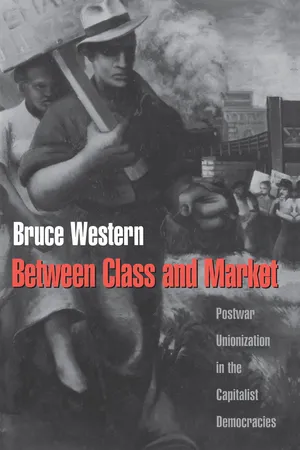
Between Class and Market
Postwar Unionization in the Capitalist Democracies
- English
- ePUB (mobile friendly)
- Available on iOS & Android
eBook - ePub
About this book
Information
Publisher
Princeton University PressYear
2020Print ISBN
9780691010335
9780691016177
eBook ISBN
9780691214573
Part I
THE PROBLEM
One
Class Power, Market Power, and the Comparative Method
BY 1950, trade unions had become key players in the capitalist democracies of Europe, North America, and the Pacific region. In each of the advanced capitalist countries, unions organized between a third and two-thirds of all workers. For many observers, strong unions in the smokestack industries were at the heart of a compromise between labor and capital that could drive economic growth and social improvement (Dahl and Lindblom 1953; Dahrendorf 1959; Crosland 1956). Forty years later, things had changed markedly. Some union movements had grown to organize entire labor markets, others represented only a rump in traditional manufacturing sectors, and the relevance of big industrial unions to economic development was being questioned even by sympathetic commentators (Bluestone and Bluestone 1992; Sabel 1995). How did we get from there to here? Why did some labor movements enjoy remarkable growth in the postwar period, while others withered, and why has the last decade been so hostile to organized labor? To answer these questions, this book examines the growth and decline of trade union organization in the postwar capitalist democracies. This involves a study of eighteen countries over a period of four decades, from 1950 to 1990.
My main argument is briefly stated: Labor movements grow where they are institutionally insulated from the market forces that drive up competition among workers. Three institutional conditions have been essential for union growth. First, working-class parties enlisted the power of the state to promote union organizing. Second, centralized industrial relations reduced employer resistance to unions and enabled a coordinated approach to unionization. Third, unions that managed unemployment insurance successfully recruited those at the margins of the labor market. Working-class parties, labor market centralization, and union-managed unemployment insurance contribute to a powerful account of union organization that explains variation within national labor markets, across countries, and over time for the three decades since 1950. From the late 1970s, the institutional contours of the capitalist democracies were increasingly buffeted by the global economy. The institutional and organizational power of unions eroded as a result. This story, in a nutshell, describes the main findings of this book.
This analysis stands between traditional perspectives in sociology and economics. From a Marxist perspective in sociology, union growth is a political process. Workers and employers wrestle over class-based collective interests on an institutional surface marked by the accumulation of previous struggles. In the neoclassical view of economics, power in these struggles originates with the conditions of supply and demand in the marketplace. Without market power, unions have little chance of growth.
The sociological and economic perspectives offer important insights, but neither side quite gets it right. Economic conditions are important, but they must be understood in their institutional context. I present an institutional sociology of the labor market that views unions as the joint product of class institutions and market forces. In this contextual approach, collective action in the labor market is shaped by economic conditions that are filtered through the prism of the surrounding institutions.
Class Power and Market Power
Trade unions—much maligned but often studied—raise basic questions about social change and the nature of capitalist societies. Theorists beginning with widely different assumptions have commonly asked whether unions can alter the basic logic of capitalist economies. The question has been treated in two main ways. One side views unions as class representatives advancing a collective interest in freedom from the uncertainty of the labor market. The other sees unions as market agents extracting a rent for their members in collective bargaining.
Unions as Class Representatives
The Marxist analysis of trade unions begins most famously with Lenin. In the context of prerevolutionary Russia, Lenin worried that unions delivered only limited and short-run gains to workers. Modest advances in wages and conditions obstructed revolutionary action led by a vanguard party. Without the party, the labor movement would succumb to a “trade-unionist striving to come under the wing of the bourgeoisie” (Lenin 1968 [1902], pp. 45–46). This question of whether unions could play a significant role in the transformation of capitalism set the terms for political debate on the left after World War II. From the Leninist perspective, unions that helped to administer capitalist economies and enterprises were essentially creatures of capitalism, incapable of radical social change (see Kelly [1988, 186–193] for a short review). Works councils, joint consultation committees, and political exchange between unions and the state were demonized. From this point of view, unions were either dupes in a management power play or collaborators in the class war (e.g., Kelly 1988, 191; Panitch 1981).
Comparative sociologists countered that large unions were class representatives, equipped with power resources to pursue significant social reforms. In this research, high unionization was shown to be strongly associated with the success of social democratic parties, union influence in economic policy, and the development of generous welfare states. Where unionization was low, labor leaders were marginal to economic and social policy. In countries with weak labor parties and flimsy welfare states, the market emerged as an axial principle of social life. The level of union membership was thus seen as a vital influence on the trajectory of capitalist development (Stephens 1979; Hicks 1988; Korpi 1983, 1989; Esping-Andersen 1985, 1990).
Unions as Market Agents
From the neoclassical viewpoint, unions are market agents rather than class representatives. Milton Friedman stakes out one corner of the paradigm, treating unions as monopolistic aberrations that damage the quality of democracy and economic efficiency: “Unions have not only . . . harmed the public at large and workers as a whole by distorting the use of labor; they have also made the incomes of the working class more unequal by reducing the opportunities available to the most disadvantaged workers” (1962, 124). In response to this market distortion, “the first and most urgent necessity in the area of government policy is the elimination of those measures which directly support monopoly” (ibid., 132). From this neoclassical position, there is no real difference between monopoly in labor and monopoly in business. Both are threats to capitalism and freedom and both should be eradicated (Freeman [1986a] cites more sources).
As for the Marxist analysis, social science research challenged the normative claims. Applied economists found that encompassing union movements pursued broad interests in full employment and economic growth. Economies with high unionization and centralized labor markets performed strongly during the postwar period. This was especially true through the recessions of the 1970s. Leaders of encompassing unions restrained their wage claims to help control inflation and unemployment at a time of contracting demand and rising oil prices. Union membership was thus closely related to robust economic performance in hard times (Flanagan, Soskice, and Ulman 1983; Bruno and Sachs 1985; Layard, Nickell, and Jackman 1991).
Unions between Class and Market
If Lenin and Milton Friedman were united in anything, it was in their mutual suspicion of unions. These political instincts reflect the ambiguous place of organized labor in capitalist economies. The contrast between the Marxist and neoclassical positions makes this ambiguity clear. For Lenin, unions betrayed the true interests of the working class by obstructing meaningful social change. For Friedman, unions advanced the collective interest too effectively, subverting the efficiency of an unfettered capitalism. Both positions appear to lack a strong empirical foundation. Union organization has muted the caprice of the market and maintained prosperity. Unlike more transient forms of collective action, such as strike activity, union organization exerts an ongoing and pervasive influence on the development of capitalist democracy. Whatever the empirical limitations, however, viewing unions as class representatives or as market agents illuminates the problem of unionization.
From the Marxist perspective, relations between workers and employers have a collective significance. Capitalist societies are rooted in institutions that express the importance of class as a principle of social organization. Sometimes the unity of interest among workers on one side and among employers on the other is clearly inscribed in the rules regulating work and employment. For instance, representation is class-wide where union officers meet with government and business leaders to make national economic policy. In other settings, classes as organized social forces are virtually invisible. The scope of representation in industrial relations is narrow, and collective interests span only certain firms or occupations. Class provides a way of describing this sort of institutional variation. Instead of referring to an abstract social category, the notion of class refers to how institutions actively consolidate or fragment collective interests in the labor market. For the unionization story, the important point is that class institutions—institutions expressing a market-wide unity of interest among workers—assist broadly based collective action. In short, institutions are a source of class power that drives union growth.
In the neoclassical analysis, labor organizing relies on overcoming competition among workers for jobs. Competition is keen when economic conditions are poor—when labor markets are slack and firms are cutting back on production. Commons (1918, 10) makes this observation at an early point for the United States: “the movement of American prices shows also the movements of American labour.” Modern economic studies follow this line by arguing that the costs of union membership for workers and the incentives for union opposition among employers are highest in the troughs of the business cycle (Ashenfelter and Pencavel 1969; Bain and Elsheikh 1976). The same argument helps explain why unions find it difficult to penetrate the fringes of the labor market, dominated by women, young workers, immigrants, and ethnic minorities. Here, labor market competition is particularly intense and employment too precarious to justify union membership. In contrast to the class analysis, this theory of union growth is essentially structural. The union-organizing problem is a general feature of capitalist labor markets which operates in the same way across times and places. In this structural logic, union growth depends on workers’ market power.
An Institutional Sociology of the Labor Mar...
Table of contents
- Cover Page
- Title Page
- Copyright Page
- Dedication
- Table of Contents
- List of Figures
- List of Tables
- Acknowledgments
- Abbreviations
- Part I: The Problem
- Part II: The Institutional Sources Of Union Growth
- Part III: Estimating The Institutional Effects
- Part IV: The Turbulent 1980s
- Appendix: Data and Methods
- Bibliography
- Index
Trusted by 375,005 students
Access to over 1.5 million titles for a fair monthly price.
Study more efficiently using our study tools.
Frequently asked questions
Yes, you can cancel anytime from the Subscription tab in your account settings on the Perlego website. Your subscription will stay active until the end of your current billing period. Learn how to cancel your subscription
No, books cannot be downloaded as external files, such as PDFs, for use outside of Perlego. However, you can download books within the Perlego app for offline reading on mobile or tablet. Learn how to download books offline
We are an online textbook subscription service, where you can get access to an entire online library for less than the price of a single book per month. With over 1.5 million books across 990+ topics, we’ve got you covered! Learn about our mission
Look out for the read-aloud symbol on your next book to see if you can listen to it. The read-aloud tool reads text aloud for you, highlighting the text as it is being read. You can pause it, speed it up and slow it down. Learn more about Read Aloud
Yes! You can use the Perlego app on both iOS and Android devices to read anytime, anywhere — even offline. Perfect for commutes or when you’re on the go.
Please note we cannot support devices running on iOS 13 and Android 7 or earlier. Learn more about using the app
Please note we cannot support devices running on iOS 13 and Android 7 or earlier. Learn more about using the app
Yes, you can access Between Class and Market by Bruce Western in PDF and/or ePUB format, as well as other popular books in Economics & Labour Economics. We have over 1.5 million books available in our catalogue for you to explore.