Jules Benjamin argues convincingly that modern conflicts between Cuba and the United States stem from a long history of U.S. hegemony and Cuban resistance. He shows what difficulties the smaller country encountered because of U.S. efforts first to make it part of an "empire of liberty" and later to dominate it by economic methods, and he analyzes the kind of misreading of ardent nationalism that continues to plague U.S. policymaking.
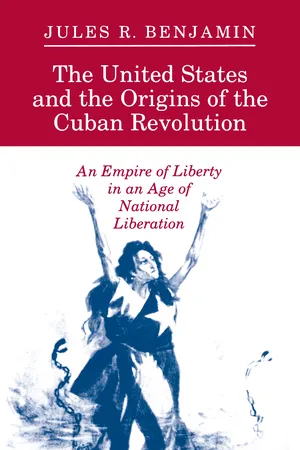
eBook - ePub
The United States and the Origins of the Cuban Revolution
An Empire of Liberty in an Age of National Liberation
- English
- ePUB (mobile friendly)
- Available on iOS & Android
eBook - ePub
The United States and the Origins of the Cuban Revolution
An Empire of Liberty in an Age of National Liberation
About this book
Information
Publisher
Princeton University PressYear
2020Print ISBN
9780691025360
9780691078366
eBook ISBN
9780691214962
CHAPTER 1
THE ERA OF INEVITABLE GRAVITATION: THE UNITED STATES AND COLONIAL CUBA
I
UNITED STATES interest in Cuba is almost as old as the North American nation itself. The earliest attraction was to the island’s commerce, in which Yankee traders became important before the end of the eighteenth century and came to dominate as early as 1820.1 By that time, the trading connection had given rise to a host of reasons for intense U.S. concern with Cuba. The best political minds of the new nation expounded on the strategic, economic, and ideological necessities that tied the island’s fate to the empire of liberty being constructed in North America. Hopes and fears concerning Cuba’s future abound in the writings of John Adams, Thomas Jefferson, James Madison, James Monroe, John C. Calhoun, and John Quincy Adams. Each in his own way expected Cuba to become either a part of the Union or an appendage to it.
Jefferson admitted toward the end of his life that “I have ever looked on Cuba as the most interesting addition which could ever be made to our system of states.”2 At several points during his administration Jefferson seriously considered acts of diplomacy or even war that would result in “our receiving Cuba into our union.”3 James Madison wrote to Jefferson that “I have always concurred with you in the sentiment that too much importance could not be attached to that Island and that we ought, if possible, to incorporate it into our union.”4 As president, Madison sent William Shaler, a partisan of annexation, as United States consul in Havana and informed Britain that “the disposition of Cuba gives the United States so deep an interest . . . that they could not be a satisfied spectator at its falling under any European Government.”5 To these reasons for acquiring Cuba, John Calhoun added that of preventing slave rebellion on the island. As Monroe’s secretary of war, he gave strong support to proposals of annexation that on several occasions came before the Cabinet. His fear of a black Cuba overrode concerns about the war with Britain that some felt annexation of the island might bring about.6 In the end, it was Secretary of State John Quincy Adams, Calhoun’s opponent in the Cabinet debates, who pronounced the most lasting verdict on U.S. relations with Cuba. Adams solved the contradiction between the North American desire for Cuba and her weakness at that point to fulfill it by declaring Cuba’s fate to be ineluctable. As he explained in his often-quoted letter of instruction to Hugh Nelson, the United States minister to Spain:
There are laws of political as well as physical gravitation; and if an apple severed by the tempest from its native tree cannot choose but fall to the ground, Cuba, forcibly disjoined from its own unnatural connection with Spain, and incapable of self-support, can gravitate only toward the North American Union, which by the same law of nature cannot cast her off from its bosom.7
While annexation was considered a natural fate for Cuba, independence was not. The dominant North American view throughout the nineteenth century was that, for reasons of geography, racial composition, and cultural heritage, the island was incapable of self-government. John Adams was among the most pessimistic. Reflecting a widely held view in Protestant North America that Roman Catholicism was hopelessly reactionary, Adams considered the establishment of democracy in Latin America as likely as its appearance in the animal kingdom.8 Jefferson observed that history “furnishes no example of a priest-ridden people maintaining a free civil government.”9 Henry Clay, who held a more generous view of the possibilities of republican government in Latin America, nevertheless concluded in 1825:
If Cuba were to declare itself independent, the amount and character of its population render it improbable that it could maintain its independence. Such a premature declaration might bring about a renewal of those shocking scenes, of which a neighboring Island [Haiti] was the afflicted scene.10
The twin perceptions—that Cuba could not stand on her own and that she would be drawn inexorably toward the United States—rendered the island’s status as a colony of Spain almost congenial. Madrid was the weakest of the European imperial powers and hence constituted no strategic threat. Moreover, she was not a serious commercial competitor. United States trade with colonial Cuba, while harassed by Spanish mercantilism, was soon greater than that of the island with its mother country.11 For much of the century, the view in Washington was that Cuba should remain under Spanish rule until the time came for her to be attached to the United States. The idea of an independent Cuba was one that did not gain serious consideration among North American leaders until the twentieth century, and, even then, many found it difficult to accept.
During the nineteenth century North American confidence about Cuba’s destiny was periodically punctuated by fears that Spanish rule would be replaced by that of a more vigorous imperial power or that Madrid’s legal but unenforceable commercial monopoly over the island might somehow be effectively established. Equally disturbing was the occasional trepidation that Cuba might attempt to gain the independence for which she was unsuited. When the mainland colonies of Spain revolted against Madrid in the second decade of the nineteenth century, many U.S. leaders expressed the fear that the liberation movement might spread to Cuba as well. Secretary of State Clay announced that “the United States are satisfied with the present condition of the Islands [Cuba and Puerto Rico], in the hands of Spain, and with their ports open to our commerce, as they are now open. . . . This Government desires no political change in that condition.”12 Clay’s statement reflected the famous doctrine of President Monroe that “with the existing colonies or dependencies of any European power we have not interfered and should not interfere.” Clearly the possibility of Cuban independence might call the law of gravitation into question. Nevertheless, in the period before the civil war, no liberation movement of serious proportions developed on the island, and as a result U.S. interests and expectations were not seriously challenged.
One group of North Americans, however, could not afford to be complacent. Slaveholders were attracted to the island as a natural field for expanding the peculiar institution. They were also moved by fear that a slave revolt there would create, as it had in Haiti, another black republic—this time just off the shore of Florida. As a result, many southern leaders promoted efforts either to purchase the island or even forcibly to remove Spanish control. Several unofficial military expeditions with the latter end in view were mounted from the southern United States in the 1850s.13
At times the intense southern desire to prevent the “Africanization" of Cuba was complemented by the generalized North American sense of its “manifest destiny" to spread its people and institutions. Stories of Spain’s harsh rule in Cuba were common in U.S. newspapers and reinforced the view that Spain was a reactionary power whose command of the island would be swept away by the march of liberty from the north. Inspired by both southern fears and a broad expansionism, both the Polk and Pierce administrations offered to purchase Cuba, implying to Madrid the eventual loss of its colony if it refused to sell. There was widespread support in the United States for this means of acquiring Cuba. Purchase avoided the more militant schemes of the expansionist Democrats (which courted war with Spain or her protectors), and thus it was congenial even to some Whigs whose normal preoccupation was simply to keep Cuba out of British or French hands and its trade oriented toward the north.14 The difficulty with this neat solution was that no Spanish government, liberal or monarchist, could bring itself to give up the last remnant of its once great New World empire. This left North Americans in something of a box because Britain stood in the way of any forceful U.S. attempt to “free" Cuba.
By the 1850s this dilemma was being eclipsed by sectional controversy. Slavery and expansion were rapidly becoming incompatible, as northerners more and more saw Cuban annexation as a southern plot to preserve its peculiar institution and enhance its representation in Congress. The North American consensus about how to absorb Cuba was breaking down over the same issue that would soon rend the Union itself.
II
For its part, mid-nineteenth-century Cuba was moving in some ways toward and in others away from North American requirements for union. As always, the Spanish residents of the island clung to the authority in Madrid that was both the legal and structural basis of their economic and political power. On the other hand, the native elite, many of them slaveholders, had begun to turn toward North America, complementing the desire of the South for annexation. To complicate matters, liberal intellectuals began to promote an alternative to either Spanish or U.S. control. Reflecting the outlook of native whites of more modest means, they fleshed out the idea of Cuban nationhood.
The sugar boom of the late eighteenth and nineteenth centuries had created a new Creole elite based on ownership of land, slaves, and sugar mills.15 This sugar aristocracy initially looked to Spanish power to protect it from slave revolt but grew nervous as such revolts (though suppressed) erupted in the 1840s. Moreover, the sugar barons grew impatient at Madrid’s inability and unwillingness to promote the healthy growth of their industry, which required access to African slaves and European and North American markets. Early in the nineteenth century Britain had begun a campaign to end the slave trade. Just as Cuba was in the midst of a sugar boom—an industry relying almost completely on slave labor—Britain pressured Spain (beleaguered by the attempt to control its rebellious American colonies) into outlawing the slave trade to her possessions.16 Illegal traffic in slaves helped to sustain the Cuban sugar plantations thereafter, but the sugar aristocracy was frightened by the advance of abolitionist propaganda and especially by the possibility of slave rebellion on an island whose black population had rapidly risen to surpass that of the white by the 1820s.17 Madrid’s attempt to accommodate British pressure and still retain the loyalty of both the powerful Creole sugar oligarchy and the Spanish merchant class in Cuba was failing.
As Spanish power waned, elements of the Creole sugar aristrocracy began to look northward, to a state powerful enough to assure the security of the Cuban slave system and to provide the free trade that would sustain its economic health. Such a tie had its dangers, however. Political liberalism might accompany the economic liberalism of North America. As a result, the Cuban sugar aristocracy wavered between Madrid and Washington as the most effective guarantor of its interests. As part of the Union, slavery could be protected from British abolitionism, and unfettered access to the vital North American market would be assured. But the same threat of war that inhibited Washington—war with Britain to prevent U.S. control or with S...
Table of contents
- Cover Page
- Title page
- Copyright Page
- Dedication
- Contents
- List of Illustrations
- Acknowledgements
- Introduction
- 1. The Era of Inevitable Gravitation: The United States and Colonial Cuba
- 2. The Crusade against Autocracy: The Ending of Spanish Rule
- 3. The Semi-Sovereign Republic of Cuba
- 4. The Contradictions of Constitutionalism, Nationalism, and Corruption
- 5. Embracing Dictatorship: The United States and Batista
- 6. Shunning Dictatorship: The United States and Batista
- 7. Radical Nationalism Resists Gravitation
- 8. Social Revolution Breaks the Tie
- 9. Conclusion
- Bibliography
- Index
Trusted by 375,005 students
Access to over 1.5 million titles for a fair monthly price.
Study more efficiently using our study tools.
Frequently asked questions
Yes, you can cancel anytime from the Subscription tab in your account settings on the Perlego website. Your subscription will stay active until the end of your current billing period. Learn how to cancel your subscription
No, books cannot be downloaded as external files, such as PDFs, for use outside of Perlego. However, you can download books within the Perlego app for offline reading on mobile or tablet. Learn how to download books offline
Perlego offers two plans: Essential and Complete
- Essential is ideal for learners and professionals who enjoy exploring a wide range of subjects. Access the Essential Library with 800,000+ trusted titles and best-sellers across business, personal growth, and the humanities. Includes unlimited reading time and Standard Read Aloud voice.
- Complete: Perfect for advanced learners and researchers needing full, unrestricted access. Unlock 1.5M+ books across hundreds of subjects, including academic and specialized titles. The Complete Plan also includes advanced features like Premium Read Aloud and Research Assistant.
We are an online textbook subscription service, where you can get access to an entire online library for less than the price of a single book per month. With over 1.5 million books across 990+ topics, we’ve got you covered! Learn about our mission
Look out for the read-aloud symbol on your next book to see if you can listen to it. The read-aloud tool reads text aloud for you, highlighting the text as it is being read. You can pause it, speed it up and slow it down. Learn more about Read Aloud
Yes! You can use the Perlego app on both iOS and Android devices to read anytime, anywhere — even offline. Perfect for commutes or when you’re on the go.
Please note we cannot support devices running on iOS 13 and Android 7 or earlier. Learn more about using the app
Please note we cannot support devices running on iOS 13 and Android 7 or earlier. Learn more about using the app
Yes, you can access The United States and the Origins of the Cuban Revolution by Jules R. Benjamin in PDF and/or ePUB format, as well as other popular books in History & Latin American & Caribbean History. We have over 1.5 million books available in our catalogue for you to explore.