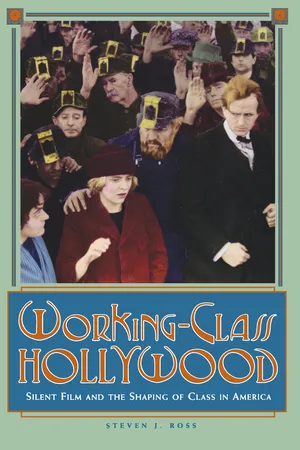
This path-breaking book reveals how Hollywood became "Hollywood" and what that meant for the politics of America and American film. Working-Class Hollywood tells the story of filmmaking in the first three decades of the twentieth century, a time when going to the movies could transform lives and when the cinema was a battleground for control of American consciousness. Steven Ross documents the rise of a working-class film movement that challenged the dominant political ideas of the day. Between 1907 and 1930, worker filmmakers repeatedly clashed with censors, movie industry leaders, and federal agencies over the kinds of images and subjects audiences would be allowed to see. The outcome of these battles was critical to our own times, for the victors got to shape the meaning of class in twentieth- century America.
Surveying several hundred movies made by or about working men and women, Ross shows how filmmakers were far more concerned with class conflict during the silent era than at any subsequent time. Directors like Charlie Chaplin, D. W. Griffith, and William de Mille made movies that defended working people and chastised their enemies. Worker filmmakers went a step further and produced movies from A Martyr to His Cause (1911) to The Gastonia Textile Strike (1929) that depicted a unified working class using strikes, unions, and socialism to transform a nation. J. Edgar Hoover considered these class-conscious productions so dangerous that he assigned secret agents to spy on worker filmmakers.
Liberal and radical films declined in the 1920s as an emerging Hollywood studio system, pressured by censors and Wall Street investors, pushed American film in increasingly conservative directions. Appealing to people's dreams of luxury and upward mobility, studios produced lavish fantasy films that shifted popular attention away from the problems of the workplace and toward the pleasures of the new consumer society. While worker filmmakers were trying to heighten class consciousness, Hollywood producers were suggesting that class no longer mattered. Working-Class Hollywood shows how silent films helped shape the modern belief that we are a classless nation.
- English
- ePUB (mobile friendly)
- Available on iOS & Android
eBook - ePub
About this book
Information
Publisher
Princeton University PressYear
2020Print ISBN
9780691024646
9780691032344
eBook ISBN
9780691214641
Subtopic
Film History & CriticismPart I
THE RISE OF THE MOVIES: POLITICAL FILMMAKING AND THE WORKING CLASS
Introduction
CLASS conflict is not a subject we usually associate with the movies. However, during the first three decades of the twentieth century, when the movie industry was still in its formative stages, movies and movie theaters were battlegrounds for control of the consciousness and class loyalties of millions of Americans. Going to the movies was more than just an evening’s entertainment. It was an experience that could transform lives. This is the story of what movies used to be, of an industry that began long before Hollywood, California, became the nation’s filmmaking capital, and of the people who tried to change the world through film. To understand the tremendous power of early movies, we need to go back several decades before motion pictures made their debut in the United States and enter the world of the millions of working-class men, women, and children whose nickels and dimes would build the American film industry.
During the late nineteenth century, class conflict was a burning issue that created deep cleavages in American society. Progress and Poverty (1879), as the title of Henry George’s best-selling book suggested, were the dual legacies of the industrial revolution: progress for some, poverty for many. Earlier generations of skilled craftsmen who built complete products and were well paid for doing so were slowly replaced by semi- and unskilled factory operatives who performed a series of poorly paid repetitive tasks. If a man lost an arm or a leg on the job, he was let go and forced to fend for himself. This was a world with no health care plans to help with illness or injury, no unemployment insurance for hard times, and no social security for old age. With many fathers unable to feed and house their families, and women paid only a fraction of the wages earned by men, millions of boys and girls were forced to forsake their childhood and go to work in factories, mines, or textile mills, where many were maimed—physically or psychologically—for life.
Life outside the workplace was often bleak, especially for the millions of immigrants who poured into the nation’s cities. Coming to what they had hoped would be the land of opportunity, Italians, Russians, Poles, and other émigrés found themselves living in slums where sanitation was minimal and disease rampant; where infants often died before their first birthday; where the smell of streets fouled by horses assaulted the senses; where crowded tenement flats that lacked ventilation, sanitary facilities, hot water, and sunlight provided little haven from the rigors of daily life.
Life on the farm and on the western frontier proved equally difficult. Fluctuating crop prices meant periodic bankruptcy for families that had worked the land for decades. In the South, former slaves and poor whites entered a new kind of quasi slavery working as sharecroppers. Out in the Far West, Chinese, Japanese, and Mexican immigrants met with extreme prejudice at the hands of Anglo residents who resented them, politicians who discriminated against them, and employers who hired them to perform the most dangerous jobs at low wages.
This was only one side of America. The Civil War that ended in 1865 brought peace to the nation and great wealth to the few who became millionaires from lucrative wartime contracts. Those living in mansions along New York’s Fifth Avenue, in opulent apartments on San Francisco’s Nob Hill, and on estates in Newport, Rhode Island, were interested in the sweet, not the sweat, of life. They did not want to know who made the fabric for their silk gowns or wove the wool for their suits—or who built their homes, their streets, and their city. The “New Rich,” as one former newsman dubbed them, were more concerned with throwing extravagant dinner parties designed to impress their peers. At one such party, “cigarettes rolled in hundred-dollar bills were passed around after the coffee and consumed with authentic thrill.”1 Little wonder, then, that millions of ordinary Americans were filled with a sense of hopelessness and despair, a sense that this was the only way the world could be.
Some people, however, believed justice could be achieved, and risked their lives in its pursuit. In the economic realm, workers repeatedly challenged employers by striking for better pay, fewer hours, and safer working conditions. But working-class protests were frequently beaten back by capitalists who relied on private armies, federal troops, and national guardsmen to suppress strikes—often at the cost of hundreds killed and thousands wounded. In the political arena, impassioned citizens challenged Democrats and Republicans by organizing rival United Labor, Populist, and Socialist parties that promoted agendas for change that were often quite radical in their rhetoric. But these challenges were thwarted by the established parties, who coopted third-party candidates and adopted their more reformist demands.2
There was one realm in which challenges to authority were not so easily suppressed by employers, troops, or politicians. Beginning at Koster and Bial’s Music Hall in 1896 and blossoming after the opening of the first “nickelodeons” (the early name for movie theaters) in 1905, the leisure realm was revolutionized by a new medium that communicated directly with millions of Americans; a realm which, in its early years, expressed political views that were remarkably sympathetic to the plight of the working class.
Movies captured the public imagination like nothing before them. They were markedly different from previous forms of popular culture that were locally created and associated with particular groups or classes. Movies became “mass culture” in two important ways: they were mass-produced commercial products and they reached a mass audience that included all groups, classes, and regions. Although newspapers are generally considered the nation’s first medium of mass culture, their readership was divided by sectarian politics and by the language of the paper. Not many conservatives were likely to read the socialist New York Call, nor were many unionists likely to look at the anti-labor Los Angeles Times. And few native-born Americans were likely to read a foreign-language newspaper. Movies, however, transcended political and language differences and attracted a diverse array of Americans. “Far more people today are reached by the moving picture than by the daily press,” one reporter noted in 1908, “and while we read the newspaper only in parts, the moving picture we see complete.”3
Visual images maintained a strong grip on the mind’s eye and treated complex political issues more clearly than most books, newspapers, or speeches. Immigrants who neither read nor spoke English could understand visual messages. When asked why he had offered political cartoonist Thomas Nast the extraordinary sum of $500,000 to stop caricaturing him and his Tammany Hall cronies in Harper’s Weekly, New York’s infamous “Boss” Tweed reportedly responded: “I don’t care so much what the papers write about me—my constituents can’t read; but they can understand pictures.”4
Film was even more realistic than newspaper cartoons. Watching early movies in a dimly lit storefront theater was a profound and perhaps life-altering experience for millions of workers and immigrants who believed no one knew or cared about their hardships. Imagine their amazement as they looked up and saw their struggles and aspirations on the screen. Surrounded by people who laughed when they laughed and cried when they cried, movie neophytes felt less alone, less alienated than before. Hard-working immigrants who came to the Land of Opportunity only to face poverty and distress might stop blaming themselves for their plight after watching a film like The Italian (New York Motion Picture Co., 1915). Like its hero, Beppo Donnetti, they might begin to realize that many of their problems were caused by crooked politicians, avaricious companies, and a judicial system that turned a deaf ear to the sufferings of the poor. And once they realized this, they and millions like them might try to change the world.
Social realism and political commentary are not the hallmarks of the modern movie industry. Yet there was a time when entertainment and political engagement did not seem incompatible, and when movies and Hollywood were not synonymous in the minds of most Americans. The movie industry began as a small-scale business with small, spartan theaters spread throughout the country and production facilities centered largely in New York, Philadelphia, and Chicago. When entrepreneurs saw how wildly popular the new medium had become among the nation’s working masses, they quickly opened film companies in Florida, Colorado, Texas, New Jersey, Louisiana, and California. The first movie studio did not reach Hollywood until 1911, and even as late as 1914, recounted one silent filmmaker, “the name Hollywood meant nothing to the people of this country; even the picture fans hadn’t heard of it.”5 Only after the outbreak of World War I that year and the suspension of European filmmaking did the modern entity we call “Hollywood” begin to take shape.
From their inception, movies were vehicles of propaganda as well as education and entertainment. They were made by groups that today we would not usually associate with the film industry. Although some middle-class reformers and religious leaders condemned films for their allegedly immoral and corrupting influence, others seized on their potential to sway public opinion and win greater support for their cause. Before expensive multi-reel features severely limited access to the market, the modest costs of making a one- or two-reel film allowed a wide range of reform organizations, labor unions, socialists, communists, politicians, bankers, businesses, woman suffragists, religious associations, and government agencies to produce partisan films that addressed national debates over the values and directions of American society.
Silent films quickly became part of an expanding public sphere in which competing political ideas were discussed and public opinion molded. Motion pictures took people out of their neighborhoods and brought the wonders—and problems—of the age to life in a way that no other medium could rival. In so doing, movies turned local and regional issues into subjects of national concern. What went on in the sweatshops of New York’s Lower East Side or in the textile mills of North Carolina could now be seen by distant audiences in Oklahoma and Nebraska. Similarly, the bitter labor conflicts that raged in western coal and copper fields were portrayed and explained to recently arrived immigrants as well as longtime residents of eastern and southern states.
No sector initially responded with more enthusiasm to the early movies than the nation’s working class. The black sharecropper in Kentucky, the Hungarian steel worker in Pennsylvania, the Jewish garment worker in New York, and the Mexican cannery worker in California reacted so strongly to the poignant scenes of sadness and joy on the screen that they quickly embraced the medium as their own. “For a mere nickel,” explained one contemporary writer, “the wasted man, whose life hereto has been toil and sleep is kindled with wonder; he sees alien people and begins to understand how like they are to him; he sees courage and aspirations and agony and begins to understand himself. He begins to feel a brother in a race that is led by many dreams.”6
For nearly two decades after the first nickelodeon opened in 1905, movies and the working class were intertwined in three important ways: working people were the industry’s main audience; they were the frequent subjects of films; and they were makers of movies—both as employees who labored in studio lots and as independent producers who turned out their own pictures. Often referred to as “the poor man’s amusement,” movie theaters took root in blue-collar and immigrant neighborhoods and slowly spread outward into middle-class areas and small towns throughout the nation. The low cost of moviegoing made films accessible to virtually every man, woman, and child. By 1910, nearly one-third of the population flocked to movie theaters each week; a decade later, nearly half the population did so.7
A medium that “started by being entertainment for people of small means” quickly evolved into what filmmaker William de Mille hailed as “the most socially important form of drama in the world.” Filmmakers were more concerned with portraying the hardships of working-class life during the silent era than at any subsequent time in the industry’s history. Movies turned class struggles previously confined to the hidden, private realm of factories, mines, and fields into highly visible parts of public culture. Displaying a depth of political commitment and range of competing ideologies and passions rarely seen today, silent filmmakers presented conservative, liberal, radical, and populist solutions to the most heated labor problems of the age. And they did so in an entertaining fashion that captured viewers’ attention and lingered in their memories far longer than the printed word or spoken phrase. In comparing the film version of Upton Sinclair’s The Jungle (1914) to the novel, one movie reviewer noted: “It is possible to read the book and then merely register a vow never to eat tinned goods again. But after seeing the picture we begin to have burned into us that Packingtown made enormous profits not simply out of tainted food, but out of the ruined lives of men and women.”8
The openness of a new industry that included producers such as the American Federation of Labor, the Ford Motor Company, the National Association of Manufacturers, the Women’s Political Union, and the National Child Labor Committee allowed a wide range of political points of view to reach the screen. Yet of all these groups, working-class filmmakers were the most ambitious and persistent. As early as 1907, workers, radicals, and labor organizations were making movies that challenged the dominant ideology of individualism and portrayed collective action—whether in the form of unionism or socialist politics—as the most effective way to improve the lives of citizens. Over the next two decades, labor and the left forged an oppositional cinema that used film as a medium of hope to educate, entertain, and mobilize millions of Americans.
The people who led this movement were not filmmakers who happened to be radicals, but members of labor and radical organizations who grasped the manipulative powers of film and used them to reach vast numbers of men and women who never attended union rallies or listened to socialist speakers. These early propagandists of the screen understood film’s potential for uniting diverse groups of wage earners whose religion, ethnicity, language, race, and gender differed but whose basic problems were the same. Coming from a variety of backgrounds, worker filmmakers (a term I use to describe workers, labor or radical organizations, or worker-owned production companies who made labor-oriented films) shared one common goal: to make wage earners understand that their collective power was far greater than they realized; that a united working class could solve many of the problems that plagued the nation.
Presenting their political messages in the form of entertaining melodramas and love stories, worker-made movies offered viewers blueprints for change that enabled them to see what the future could look like. Movie audiences throughout the country watched fiery New York stenographer Louise Laffayette lead striking factory workers in a successful battle for higher wages and union recognition. They watched working-class voters reject the corrupt politics of the past and elect iron molder Dan Grayson to serve as governor of California on the Socialist ticket. They watched European, Hispanic, black, and female textile workers in Passaic, New Jersey, join together to ch...
Table of contents
- Cover Page
- Title Page
- Copyright Page
- Dedication
- Contents
- List of Illustrations
- Preface
- Acknowledgments
- Part I: The Rise of the Movies: Political Filmmaking and the Working Class
- Part II: The Rise of Hollywood: From Working Class to Middle Class
- Epilogue The Movies Talk But What Do They Say?
- Appendixes
- Abbreviations
- Notes
- Index
Trusted by 375,005 students
Access to over 1.5 million titles for a fair monthly price.
Study more efficiently using our study tools.
Frequently asked questions
Yes, you can cancel anytime from the Subscription tab in your account settings on the Perlego website. Your subscription will stay active until the end of your current billing period. Learn how to cancel your subscription
No, books cannot be downloaded as external files, such as PDFs, for use outside of Perlego. However, you can download books within the Perlego app for offline reading on mobile or tablet. Learn how to download books offline
Perlego offers two plans: Essential and Complete
- Essential is ideal for learners and professionals who enjoy exploring a wide range of subjects. Access the Essential Library with 800,000+ trusted titles and best-sellers across business, personal growth, and the humanities. Includes unlimited reading time and Standard Read Aloud voice.
- Complete: Perfect for advanced learners and researchers needing full, unrestricted access. Unlock 1.5M+ books across hundreds of subjects, including academic and specialized titles. The Complete Plan also includes advanced features like Premium Read Aloud and Research Assistant.
We are an online textbook subscription service, where you can get access to an entire online library for less than the price of a single book per month. With over 1.5 million books across 990+ topics, we’ve got you covered! Learn about our mission
Look out for the read-aloud symbol on your next book to see if you can listen to it. The read-aloud tool reads text aloud for you, highlighting the text as it is being read. You can pause it, speed it up and slow it down. Learn more about Read Aloud
Yes! You can use the Perlego app on both iOS and Android devices to read anytime, anywhere — even offline. Perfect for commutes or when you’re on the go.
Please note we cannot support devices running on iOS 13 and Android 7 or earlier. Learn more about using the app
Please note we cannot support devices running on iOS 13 and Android 7 or earlier. Learn more about using the app
Yes, you can access Working-Class Hollywood by Steven J. Ross in PDF and/or ePUB format, as well as other popular books in Media & Performing Arts & Film History & Criticism. We have over 1.5 million books available in our catalogue for you to explore.