Christian theologians have for some decades affirmed that they have no monopoly on encounters with God or ultimate reality and that other religions also have access to religious truth and transformation. If that is the case, the time has come for Christians not only to learn about but also from their religious neighbors. Circling the Elephant affirms that the best way to be truly open to the mystery of the infinite is to move away from defensive postures of religious isolationism and self-sufficiency and to move, in vulnerability and openness, toward the mystery of the neighbor.
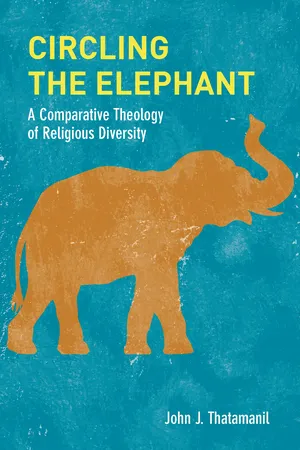
Employing the ancient Indian allegory of the elephant and blind(folded) men, John J. Thatamanil argues for the integration of three often-separated theological projects: theologies of religious diversity (the work of accounting for why there are so many different understandings of the elephant), comparative theology (the venture of walking over to a different side of the elephant), and constructive theology (the endeavor of re-describing the elephant in light of the other two tasks).
Circling the Elephant also offers an analysis of why we have fallen short in the past. Interreligious learning has been obstructed by problematic ideas about "religion" and "religions," Thatamanil argues, while also pointing out the troubling resonances between reified notions of "religion" and "race." He contests these notions and offers a new theory of the religious that makes interreligious learning both possible and desirable.
Christians have much to learn from their religious neighbors, even about such central features of Christian theology as Christ and the Trinity. This book envisions religious diversity as a promise, not a problem, and proposes a new theology of religious diversity that opens the door to robust interreligious learning and Christian transformation through encountering the other.
- 320 pages
- English
- ePUB (mobile friendly)
- Available on iOS & Android
eBook - ePub
About this book
Information
Publisher
Fordham University PressYear
2020Print ISBN
9780823287734
9780823288526
eBook ISBN
9780823288533
1 Religious Difference and Christian Theology
THINKING ABOUT, THINKING WITH, AND THINKING THROUGH
Only on the wide basis of universal revelation could the final revelation occur and be received. Without the symbols created by universal revelation the final revelation would not be understandable. Without the religious experiences created by universal revelation no categories and forms would exist to receive the final revelation. The biblical terminology is full of words whose meaning and connotations would be completely strange to listeners and readers if there had been no preceding revelations in Judaism as well as in paganism.—PAUL TILLICH, Systematic Theology, Vol. I
Should Religious Diversity Be a “Problem” for Christians?
This book sets out to answer a single overarching question: How can Christian communities and Christian theology best flourish in a world marked by deep and enduring religious difference? What must transpire in Christian imagination to ensure that positive engagement with religious difference is recognized as essential to and constitutive of constructive theology? Just as no one imagines that a systematic project that fails to address Christology, pneumatology, or soteriology is adequate, theological labor that fails to address the question of religious diversity is partial at best, and negligent at worst. At present, specialist theologians engage in the work of theology of religious diversity (TRD) and comparative theology (CT), but those tasks are understood as optional rather than integral to Christian theology. The joke seems to be that comparative theologians are only comparatively theological. Comparison is understood to belong to the descriptive labor of religious studies whereas the normative work of constructive theology is expected to operate from resources drawn from within the boundaries of a single tradition alone. Such boundedness is even taken to be the hallmark of theology: philosophy of religion can be universal, but theology must be confessional and particular. The philosopher of religion is the free-range chicken who can wander about and eat what she wants; the theologian, by contrast, must live and eat within the coop of tradition. Hence, the term “comparative theology” seems oxymoronic. If a project is comparative, it cannot be theology; if a project is theological, it must not be comparative. That sensibility is changing, but slowly.
Moreover, when Christians engage the theme of religious diversity, that labor is often framed as a problem to be solved rather than as a promise to be fulfilled. The prompting impulse is rarely a sense of hopeful expectation that Christians have much to learn from their religious neighbors but is instead motivated by a feeling of unease about the recalcitrant persistence of religious diversity. Difference seems to weaken the “plausibility structures” that might otherwise make one’s own faith seem like the only game in town.1
Consider the subtitle of a volume that appears to betray a longing for another world than the one we have—namely, Gerald McDermott’s God’s Rivals: Why Has God Allowed Different Religions?2 Although McDermott intends to take religious diversity seriously and positively—and I argue below that he succeeds in some important ways—the question posed by his subtitle suggests that God not only might have created a world devoid of religious diversity but that some wish He—and only a hypermasculine deity can be imagined to wield such controlling omnipotence—had.3 Theology and, surely, life itself would have been simpler. The cast of the question is a telling instance of what it means to frame religious diversity as problem rather than as promise.
Imagine how non-Christian readers might read McDermott’s subtitle. Might not a Hindu or a Buddhist wonder, “Is the author really asking why the Christian God permits my tradition to exist? Is my very existence a problem for Christian life and thought?” I am reminded of W. E. B. Du Bois’s question about the tragic nature of black experience in the American context: “How does it feel to be a problem?”4 I draw no flat parallel between the violence of black life in America and the challenges posed by religious diversity, but only a massive case of historical amnesia could lead Christians to forget the degree to which we have sought by way of conquest, colonization, and conversion to dissolve the problem of religious diversity by erasing it. A long and tortured history teaches us that no group fares well when it is treated as a problem in need of a solution.
By contrast, to think of religious diversity as a de jure and not merely a de facto good is to imagine with Abraham Joshua Heschel that “in this aeon diversity of religions is the will of God.” Rather than imagine the divine as reluctantly permitting religious others to be, can we imagine instead a God who seeks to be known in, through, and by way of difference and multiplicity? Such an imagination empowers Christians not to regard religious diversity begrudgingly as a reality that must be navigated but as a promise to be received. When we affirm that we need the other in order to arrive at God, we affirm not only an ethical obligation to, and need for, the neighbor but also a theological desire for her. Religious neighbors must be hallowed because we need them to arrive at a deeper encounter with and understanding of divinity. The practices and insights of others can even, in some cases, become sacraments for our way into the divine life, earthy mediations that enable us to access the more.
Can we imagine constructive reflection that begins with just such a sense of promise and expectation, a theological vision in which religious diversity is celebrated rather than reluctantly accepted? Can we imagine theological systems in which every loci within Christian theology is treated with an eye to difference—projects in which Christology is done in conversation with Buddhology and the doctrine of God is formulated in conversation with accounts of ultimate reality as Brahman or Buddha-nature?5 What must happen for such modes of theological practice to be recognized as “normal science” rather than as an elective and fringe exercise?6 Must we usher into being an entirely new theological paradigm before construction and comparison can be understood as inseparable?
The reality of religious diversity has impinged upon Christian communities from the inception of the Jesus movement. In the earliest stages of that movement, Jewish followers of Jesus were just a small and fragile community in a sea of religious difference. In that historical moment, and for several subsequent centuries, the labor of constructing the Christian tradition required explicit and ongoing conversation with a variety of communities and traditions. Christians rarely pause to reflect on the meaning of an obvious truth: every intellectual resource for articulating the meaning of the Christ event came from the non-Christian milieu in which Jesus followers sought to understand the meaning of the life, death, and resurrection of the one whom they called Lord. The only distinguishing mark of the early Jesus movement was its peculiar insistence that Jesus the crucified was the Messiah. Everything else was inherited or borrowed. Christian tradition is, ab initio, “a hybrid affair.”7
This hybridity is not merely a matter of cultural significance; it has theological import. As Paul Tillich observed, apart from the language, symbols, rituals, and metaphysical resources of other traditions, Christians would lack the means to articulate their distinctive convictions. Even the core narratives of the New Testament are products of conversations with a dizzying array of extra-Christian religious resources, most obviously the inheritance of Ancient Israel, the various mystery religions, Hellenistic philosophical schools and, of course, the implicit patterns of sense and meaning-making embedded in the Greek language itself. To learn to think Christianly required thinking with, and sometimes against, those who were not part of the church to such an extent that it is impossible to draw neat lines between “internal” and “external.” What could these terms mean in a period in which tradition itself was under construction?
Tillich was clear about the meaning of Christianity’s indebtedness to other religious traditions: the Christ event and our capacity to receive the meaning of that event stand in need of a larger history of revelation that prepares the ground for the coming of the New Being. For Tillich, Christian life and thought stand in theological debt to the religious history that precedes and makes possible the Christ event. As he put it, final revelation requires and presupposes universal revelation.8 In sum, Christian reflection cannot proceed without the help of non-Christians. For these reasons, it seems a truism to say that constructive theology was, for the first four centuries of the church, also comparative theology. Perhaps, then, we do not need to create a new theological paradigm. We need only to discern how what once was seen as integral to theology came to be regarded as optional, or worse, as superfluous.
A critical question is whether other traditions continue to have positive meaning for themselves and for Christian communities after the Christ event and the establishment of the church. Or does “final revelation” supplant universal revelation? Do Christians still stand in ongoing need of other religious traditions? Do other religious traditions continue to have a place in the divine economy even after the coming of the Christ? Answering these questions with a decisive yes—and in that sense leaving behind the long-standing praeparatio evangelica tradition—is a central goal of this book.
Over time, especially after Constantine’s conversion, Christian communities came to understand themselves as a separate imperially sponsored religious tradition. Recognition by empire was taken to be divine vindication of Christianity’s superiority. Eventually, the border lines between Christianity and its others were understood to be clearly demarcated, giving rise to the possibility of a reflective process that proceeds by appeal to a body of materials—scripture, creeds, and the writings of the church fathers—internal to an independent and self-standing tradition.9 Only then does it become possible to imagine theological reflection as an activity that proceeds without borrowing from and being indebted to larger groups of religiously diverse interlocutors, a process that remains a vital need even today.
A part of this process of tradition constitution is the willful forgetting of the internal multiplicity of our texts, a peculiar (un)learned ignorance which obscures the truth that virtually every line in scripture and the foundational texts of tradition are meaningful only when understood as part of an interreligious conversational matrix in which they came to have meaning at all. When these texts are further secured by claims to special revelation—claims that sever Christian traditions from the broader history of divine revelation—then conditions are in place to imagine that Christian theology can operate by appeal to a deposit of faith that is in no way indebted to religious neighbors.
After imperial recognition, Christians, at least in the West, were rarely compelled to encounter persons from other traditions on a level playing field. Christianity’s religious others lacked the prestige that accrues to a tradition by way of political patronage. This is not to say that Christian traditions were impervious to a variety of philosophical and religious traditions. Far from it! A careful exploration of Christian traditions would reveal a steady stream of moments in which Christian thinkers were shaped by encounters with a variety of non-Christian interlocutors—Jews and eventually Muslims, but also with the “discovery” of the New World, the various indigenous traditions of North and South America. Even the variety within European Christianities shows that there has never been a singular and pristine Christianity without admixture. “Pagan” traditions have always shaped the ritual lives and theological sensibilities of every local form of Christianity.10
The history of Christian theology can be read as a sustained conversation with a variety of non-Christian philosophical traditions starting with Greek and Hellenistic thinkers, the reintroduction of Aristotle in the medieval period by way of encounter with Islamic tradition, and subsequently the secular philosophical traditions of the Enlightenment. The history of Christian reflection is incomprehensible apart from its philosophical conversation partners. It is unclear why contemporaries do not recognize this conversation, especially early engagements with pagan thinkers, as part of the history of interreligious encounter. Much rests on which traditions are regarded as “religious” as opposed to “philosophical.” Perhaps it is safer to think of pagan wisdom traditions as narrowly philosophical rather than as religious because their reception into Christian traditions need not then be recognized as itself a kind of religious hybridization.
Unfortunately, it is anachronistic in the extreme to suppose that there was a neat separation between philosophy and religion in antiquity. Early Christian teachers often styled themselves as philosophers and their communities as philosophical schools. Also, as Pierre Hadot has shown, ancient philosophical schools are better understood as “ways of life” rather than the desiccated exercises in technical reason that sometimes pass for philosophy today.11 The failure to appreciate the porosity between philosophy and religion, generated by an unwillingness to see Christian traditions as hybrid and polydox, gives the impression that interreligious encounter and comparative theology are new realities for the church.12 So much depends on what counts as a “religion.”
There have been moments in the history of European Christianity in which encounters with religious others have been especially jarring. The voyages of exploration and the “discovery” of the New World administered a shock to the theological system. Theologians were compelled to ask, “What does it mean that so many in so much of the world have had no access to saving knowledge of the Christ?” What, then, of the traditional Christian affirmation that God desires to save all, that God so loves the world, if much of that world has lived apart from the saving knowledge of the Christ?
The periodic eruption of these questions notwithstanding, it is hard to detect in premodern Christian theology reflection that dares to imagine that other “religions” might themselves be vehicles of salvific divine agency. That way of framing soteriological questions is hardly possible in historical periods that did not construe the world as composed of a delimited set of religions that might or might not be salvific. When soteriological questions were posed about those “outside the church,” they were framed within another imaginative matrix, one in which the crucial questions were about how the Word or the Spirit operates upon those who are not followers of the Christ. And when questions were raised about the status of other traditions, they were not yet understood as religions in any contemporary sense. Few have thought to examine the metamorphosis of soteriology when it falls under the influence of the modern category “religion.” There is a vast difference between asking about whether the word in seed form (logos spermatikos) or the Holy Spirit is present to other communities and quite another to ask about whether something called a “religion” is salvific.
Even today, the idea that other religions may be, on their own terms, salvific remains contested. But the question “Do other religions save?” is recognized as self-evidently meaningful; liberals offer various affirmative answers against theological conservatives who say no. However, the question only became meaningful in the late nineteenth century, after the establishment of a “world religions discourse.”13 But just what is a “religion” anyway? Does any religion, even Christianity, save?
Aren’t liberals and conservatives buying into a broad range of assumptions that make the very terms of their contestation possible? What do we presume when we classify Hinduism, Buddhism, Judaism, and Christianity as “religions” and each of these religions as ways to salvation? These questions are rarely posed and when posed are often treated with insufficient rigor. Thankfully, a growing chorus of voices is slowing down the conversation in theology of religions to pose these critical queries. The work of thinkers like Jenny Daggers and Paul Hedges and their interrogations of the category “religion” are important landmarks.14 With them, I am mindful that by the time we rank-order religions with respect to their relative soteriological merit—whether we argue for the superiority of our own or the relative parity of all in properly pluralist fashion—we have taken for granted the work of “religion-making,” which renders these traditions into religions, into entities of the same kind.15
It is time to interrogate these processes of religion-making because theology has been impeded by the ways in which we have imagined r...
Table of contents
- Cover
- Half Title
- Series Announcement Page
- Title Page
- Copyright
- Dedication
- Contents
- Preface: Autobiography and Comparative Theology
- Note on Transliteration
- Introduction: Revisiting an Old Tale
- 1. Religious Difference and Christian Theology: Thinking About, Thinking With, and Thinking Through
- 2. The Limits and Promise of Exclusivism and Inclusivism: Assessing Major Options in Theologies of Religious Diversity
- 3. No One Ascends Alone: Toward a Relational Pluralism
- 4. Comparative Theology after Religion?
- 5. Defining the Religious: Comprehensive Qualitative Orientation
- 6. The Hospitality of Receiving: Mohandas Gandhi, Martin Luther King, Jr., and Interreligious Learning
- 7. God as Ground, Singularity, and Relation: Trinity and Religious Diversity
- 8. This Is Not a Conclusion
- Acknowledgments
- Notes
- Index
- About the Author
- Series List
Trusted by 375,005 students
Access to over 1.5 million titles for a fair monthly price.
Study more efficiently using our study tools.
Frequently asked questions
Yes, you can cancel anytime from the Subscription tab in your account settings on the Perlego website. Your subscription will stay active until the end of your current billing period. Learn how to cancel your subscription
No, books cannot be downloaded as external files, such as PDFs, for use outside of Perlego. However, you can download books within the Perlego app for offline reading on mobile or tablet. Learn how to download books offline
Perlego offers two plans: Essential and Complete
- Essential is ideal for learners and professionals who enjoy exploring a wide range of subjects. Access the Essential Library with 800,000+ trusted titles and best-sellers across business, personal growth, and the humanities. Includes unlimited reading time and Standard Read Aloud voice.
- Complete: Perfect for advanced learners and researchers needing full, unrestricted access. Unlock 1.5M+ books across hundreds of subjects, including academic and specialized titles. The Complete Plan also includes advanced features like Premium Read Aloud and Research Assistant.
We are an online textbook subscription service, where you can get access to an entire online library for less than the price of a single book per month. With over 1.5 million books across 990+ topics, we’ve got you covered! Learn about our mission
Look out for the read-aloud symbol on your next book to see if you can listen to it. The read-aloud tool reads text aloud for you, highlighting the text as it is being read. You can pause it, speed it up and slow it down. Learn more about Read Aloud
Yes! You can use the Perlego app on both iOS and Android devices to read anytime, anywhere — even offline. Perfect for commutes or when you’re on the go.
Please note we cannot support devices running on iOS 13 and Android 7 or earlier. Learn more about using the app
Please note we cannot support devices running on iOS 13 and Android 7 or earlier. Learn more about using the app
Yes, you can access Circling the Elephant by John J. Thatamanil in PDF and/or ePUB format, as well as other popular books in Teología y religión & Filosofía oriental. We have over 1.5 million books available in our catalogue for you to explore.