Featuring scholars at the forefront of contemporary political theology and the study of German Idealism, Nothing Absolute explores the intersection of these two flourishing fields. Against traditional approaches that view German Idealism as a secularizing movement, this volume revisits it as the first fundamentally philosophical articulation of the political-theological problematic in the aftermath of the Enlightenment and the advent of secularity.
Nothing Absolute reclaims German Idealism as a political-theological trajectory. Across the volume's contributions, German thought from Kant to Marx emerges as crucial for the genealogy of political theology and for the ongoing reassessment of modernity and the secular. By investigating anew such concepts as immanence, utopia, sovereignty, theodicy, the Earth, and the world, as well as the concept of political theology itself, this volume not only rethinks German Idealism and its aftermath from a political-theological perspective but also demonstrates what can be done with (or against) German Idealism using the conceptual resources of political theology today.
Contributors: Joseph Albernaz, Daniel Colucciello Barber, Agata Bielik-Robson, Kirill Chepurin, S. D. Chrostowska, Saitya Brata Das, Alex Dubilet, Vincent Lloyd, Thomas Lynch, James Martel, Steven Shakespeare, Oxana Timofeeva, Daniel Whistler
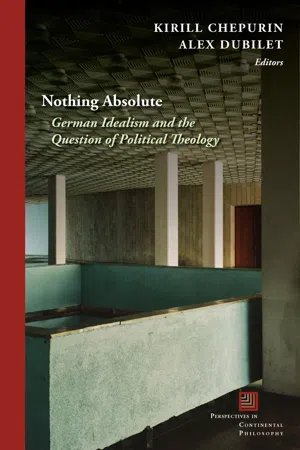
eBook - ePub
Nothing Absolute
German Idealism and the Question of Political Theology
- 256 pages
- English
- ePUB (mobile friendly)
- Available on iOS & Android
eBook - ePub
Nothing Absolute
German Idealism and the Question of Political Theology
About this book
Information
Publisher
Fordham University PressYear
2021Print ISBN
9780823290178
9780823290161
eBook ISBN
9780823290185
1
Knot of the World
German Idealism between Annihilation and Construction
KIRILL CHEPURIN
Blackness is not the pathogen in afro-pessimism, the world is[—]maybe even the whole possibility of and desire for a world.—Jared SextonThe world is its own rejection, the world’s rejection is the world.—Jean-Luc NancyFor we cannot claim to know for sure whether or not our world, although it is contingent, will actually come to an end one day.—Quentin Meillassoux
A specter is haunting contemporary theory—the specter of the world. To think the world radically otherwise; to refuse the very need for a world or to reduce it affirmatively to nothing, a mere illusion or hallucination; to dissolve it in absolute contingency or chaos; to think the reality of that which the world forecloses, subjugates, excludes; to expose the world as totalizing and to find ways of tearing it down or opening it up; to work out an apocalyptic, postapocalyptic, messianic, posthuman ontology, ethics, or politics1—along this entire spectrum, the world remains, even in cases where its remains are thought of as, or after, its end. Even when one could not care less about the world itself, one is troubled by the fact of the world. No matter how spectral the world is declared to be, this fact remains a problem, with which all theory feels the need to engage. Even to say that the world is an illusion, that one ought to desire no world, is to admit that the world is there (and is at issue)—that it has the power to foreclose and divide, to make one hallucinate, and, most importantly, the power to survive, to remain. It is also to imply that the world is necessarily this way. But, why is the world there in the first place? Why this world—of divisions and exclusions, endless striving and endless postponement? Must it even be, this way or at all? Do we have to proceed from the fact that we—the subjects of modernity—are always already in this world?
Among these and similar questions, I would single out one as central: how to think the world without absolutizing or justifying it—to construct a world or the way the world could be, or to reconstruct the way the world is, without falling into the logic of justification—while accounting for the world’s being there, as fact or problem? From Quentin Meillassoux’s thinking of contingency as at once making the world possible and ungrounding it, to the Laruellean Real as prior to and without world and yet also, in the presence of the world, “giving” and “receiving” the world, to the polemics between Afropessimism and black optimism or queer negativity and queer utopianism, this question is inevitably at stake. The relation between world-making and theodicy (in the sense of world justification) marks this as a political-theological question.2 In view of contemporary political theology’s grappling with the problem of the (Christian-modern) world and its modes of legitimation, this question is central to its present and future.3
This is, at the same time, the typical transcendental conjunction, even the transcendental knot: conditions of possibility of experience are necessary for us to even have experience at all, so that to think the possibility of the world is necessarily to justify the world as necessary. This conjunction stems from Immanuel Kant, who formulates it in terms of so-called “transcendental conditions,” that is, conditions of possibility of experience—of the world as it appears to us. For Kant, in order for us to even have experience, it must fulfill certain conditions; it must conform to a specific set of categories and follow certain rules. Thus, the reality of the world (of experience) is always negative and divisive: it is a world of objects separated from the subject and from each other; a world in which unity is secondary to separation and can only be thought by way of mediation (synthesis) and relation. There can be, in fact, no experience unless it conforms to these conditions; the world can only appear in this and no other categorial way for it to cohere. If we are to think a world, it can only be this world—that is, a world structured in this categorial way—because this is the way experience (our being-in-the-world) works. The transcendental thus converts possibility into necessity: to inquire into the conditions under which the world is possible, is to show that these conditions are necessary for us to even think a world at all. The possibility of a world is converted into the necessity of the world. To think the (possibility of the) world is to justify it as necessary: the transcendental turn is a theodical operation.4
This conjunction of possibility and necessity can take many forms—including contemporary ones. For example, to say with François Laruelle that the world functions by way of dividing the Real is to say that, assuming there is a world, this is the way it necessarily works—to determine the world as necessarily this way, to convert a world into the world. This conjunction may also be seen as a tension, within which the above question—of how to think the world without justifying it or exorcizing it—exists.
This tension is already present within German Idealism, spanning the conceptual space between two poles: world annihilation and world construction. In this essay, I will present some of the ways in which German Idealism tried to resolve this tension. The point, however, is not to suggest that German Idealism succeeded in doing so, but to put forward the transcendental knot as a key problem that German Idealism shares with contemporary continental philosophy and political theology. Accordingly, the following sections will approach the transcendental knot from different perspectives to highlight its various aspects and to demonstrate the numerous pitfalls when trying to deal with it—or how the world tends to survive all thinking of its end or rejection. It is crucial to engage with the world, with the way in which it is constructed (and can be deconstructed), and with the real power it possesses rather than announcing the world to be illusory, merely contingent, or easily refusable.
I take the pair of “annihilation” and “construction” from Friedrich Schelling.5 Already in his early metaphysics, “the world” is a structure of divisive relationality: the original opposition between subject and object, the I and the not-I, which is then mediated by the I. Finding itself in the world, the subject is divided from object, faced with external reality as something different, other—something over and against which the I seeks to assert itself. Conflict, opposition, and striving are central characteristics of finitude; the finite world is a world of negativity, alienation, division.
As always already in the world, the I strives to break free of the world—be that through gathering the world into one totality that the I would perfectly possess (the dream of perfect sovereignty) or by purifying itself of any not-I (the dream of perfect dispossession, of having no need for the world). The former is the activity of synthesis: the I brings what is multiple into a unity. The latter is morality, configured as the striving to become absolutely nothing, without any need or lack. It may be seen, however, that the end goal of both strivings is, essentially, the same. “The ultimate end goal of the finite I and the not-I, i.e., the end goal of the world,” Schelling writes, “is its annihilation as a world.” What the I strives toward is absolute freedom from the negativity of the world—from conflict, division, and striving itself. This absolute freedom Schelling calls “absolute bliss.” As negative and divisive, the world is fundamentally unblissful; the I’s existence in such a world is, accordingly, a constant longing for bliss. The world does nothing but defer, postpone, or mediate salvation and fulfillment. It is, after all, through this postponement that the world itself survives. From within the world, bliss cannot but appear as transcendent: as either a paradisal past or a future salvific telos—never now.
Imagine, however, that one would not have to strive for bliss; that the subject, instead of wanting something, could get fulfillment immediately—or not want anything at all. In this state of bliss, the subject would immediately cease to be just that: a subject. If there is nothing to strive for, nothing to negate or overcome, no positions to occupy, possessions to accumulate, or goals to achieve, what would subjectivity consist in? It would amount to simply being what one is. This is precisely absolute freedom: to simply be—without any self-assertion or lack, any further determination, any reason why. The I would become, as Schelling calls it, “absolute”—and thus cease to be an I, a transcendental subject or a subject of striving. As the mere am or is, this state may be termed “absolute being”; as being what it is, this being could only be an “absolute identity”—without any negativity or relation to otherness. As immanent only to itself, absolute freedom cannot become other, cannot transition to negation or any outside. “The absolute,” Schelling insists, “can never be mediated.”6 It is “utterly immanent” and “has no need to go outside itself” (VI, 167). It is an absolute now, without before or after, possibility or actuality: immanently atemporal and amodal.
This kind of radical immanence can only function in and as the absence of a world. It possesses the “absolute power”: the power to “completely annihilate” the world (VI, 122, 104). There are two aspects to this affirmative reduction to Nichts. Firstly, no common measure applies to absolute being (122), so that, from the perspective of the world, the absolute “can be neither object nor not-object, i.e., cannot be anything at all” (101)—can only be a nothingness, “nothing at all (= 0)” (119). Conversely, since the absolute has no place or need for otherness, it is the world that is nothing at all, annihilated immediately by the power of the absolute as the absolutely nothing. This annihilation functions by transporting the philosopher to the zero point that must be thought of as preceding—not following upon—the world. In other words, even though the I always already finds itself in the world, this is not where speculative thought must begin—this is not where Schelling locates the Real. The world is a factually inevitable yet secondary, imposed, negative reality. The zero point of nothingness or bliss is prior to the imposition of the world, annihilating its very possibility.
That is, in fact, why the I strives toward bliss in the first place: because it knows or intuits the world to be forcefully imposed, foreclosing the Real as that which is without negativity or striving—and so seeks to return to it. The temporality of the I’s striving in the world turns out to be one whereby the past is redoubled as the future, the past bliss as future bliss: a utopian loop. As long as the world is there, past and future remain separate, with the world existing precisely in and as this gap. To collapse them—to enact bliss right now—would necessitate a total collapse of the world. Why, then, must the world even be? “The main business of all philosophy consists,” as a result, “in resolving the problem of the being-there (Dasein) of the world.”7 It is with this problem that contemporary theory continues to struggle.
It seems that this problem cannot, however, be resolved other than from within the world. In this, we approach the crux of the issue. At the standpoint of the absolutely Real, there is no world. As soon as the world is there, however, we find ourselves always already in the world. Even if we say with Schelling that, in fact, the absolutely Real is the “essence” of the I or the soul, so that in a more essential sense we are always already nowhere or nothing, prior to the imposition of the world—a fact that the world forecloses—and that the world is therefore an unreal, even illusory thing, this does nothing to make the world go away or cease its violent imposition. At best, it tears us between two “always already”: one blissful, another imposed, with which we still have to engage.
It is, in effect, through this metaopposition that the world is constructed. This tear between the two “always already” itself is (the fact of) the world, existing as the gap within the Real. I am taking the term construction from Schelling’s later philosophy, where it means exhibiting the world speculatively in—or with a view to—the absolute. To put it simply: if absolute identity and freedom are the absolutely Real, then how to think the world? Since there is no world at the standpoint of the absolute, to think t...
Table of contents
- Cover
- Series Page
- Title Page
- Copyright
- Contents
- Introduction: Immanence, Genealogy, Delegitimation
- 1. Knot of the World: German Idealism between Annihilation and Construction
- 2. Utopia and Political Theology in the “Oldest Systematic Program of German Idealism”
- 3. Relational Division
- 4. Otherwise Than Terror: Ten Theses on the Modernist Secular
- 5. Kant’s Unexpected Materialism: How the Object Saves Kant (and Us) from the Moral Law
- 6. Earth Unbounded: Division and Inseparability in Hölderlin and Günderrode
- 7. Kant with Sade with Hegel: The Death of God and the Joy of Reason
- 8. A Political Theology of Tolerance: Universalism and the Tragic Position of the Religious Minority
- 9. Hegel, Blackness, Sovereignty
- 10. Political Theology of the Death of God: Hegel and Derrida
- 11. Exception without Sovereignty: The Kenotic Eschatology of Schelling
- 12. Once More, from Below: The Concept of Reduplication and the Immanence of Political Theology
- 13. On the General Secular Contradiction: Secularization, Christianity, and Political Theology
- List of Contributors
- Index
- Series List
Trusted by 375,005 students
Access to over 1.5 million titles for a fair monthly price.
Study more efficiently using our study tools.
Frequently asked questions
Yes, you can cancel anytime from the Subscription tab in your account settings on the Perlego website. Your subscription will stay active until the end of your current billing period. Learn how to cancel your subscription
No, books cannot be downloaded as external files, such as PDFs, for use outside of Perlego. However, you can download books within the Perlego app for offline reading on mobile or tablet. Learn how to download books offline
We are an online textbook subscription service, where you can get access to an entire online library for less than the price of a single book per month. With over 1.5 million books across 990+ topics, we’ve got you covered! Learn about our mission
Look out for the read-aloud symbol on your next book to see if you can listen to it. The read-aloud tool reads text aloud for you, highlighting the text as it is being read. You can pause it, speed it up and slow it down. Learn more about Read Aloud
Yes! You can use the Perlego app on both iOS and Android devices to read anytime, anywhere — even offline. Perfect for commutes or when you’re on the go.
Please note we cannot support devices running on iOS 13 and Android 7 or earlier. Learn more about using the app
Please note we cannot support devices running on iOS 13 and Android 7 or earlier. Learn more about using the app
Yes, you can access Nothing Absolute by Alex Dubilet, Kirill Chepurin, Alex Dubilet,Kirill Chepurin, Kirill Chepurin, Alex Dubilet in PDF and/or ePUB format, as well as other popular books in Philosophy & Idealism in Philosophy. We have over 1.5 million books available in our catalogue for you to explore.