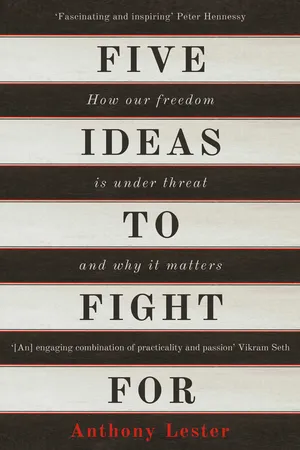
Five Ideas to Fight For
eBook - ePub

Five Ideas to Fight For

How Our Freedom is Under Threat and Why it Matters

  1. 256 pages
  2. English
  3. ePUB (mobile friendly)
  4. Available on iOS & Android
eBook - ePub

Five Ideas to Fight For

How Our Freedom is Under Threat and Why it Matters

About this book

― Human Rights
― Equality
― Free Speech
― Privacy
― The Rule of Law

These five ideas are vitally important to the way of life we enjoy today. The battle to establish them in law was long and difficult, and Anthony Lester was at the heart of the thirty-year campaign that resulted in the Human Rights Act, as well as the struggle for race and gender equality that culminated in the Equality Act of 2010.

Today, however, our society is at risk of becoming less equal. From Snowden’s revelations about the power and reach of our own intelligence agencies to the treatment of British Muslims, our civil liberties are under threat as never before. The internet leaves our privacy in jeopardy in myriad ways, our efforts to combat extremism curtail free speech, and cuts to legal aid and interference with access to justice endanger the rule of law. A fierce argument for why we must act now to ensure the survival of the ideals that enable us to live freely, Five Ideas to Fight For is a revealing account of what we need to protect our hard-won rights and freedoms.
Frequently asked questions

Yes, you can cancel anytime from the Subscription tab in your account settings on the Perlego website. Your subscription will stay active until the end of your current billing period. Learn how to cancel your subscription.
At the moment all of our mobile-responsive ePub books are available to download via the app. Most of our PDFs are also available to download and we're working on making the final remaining ones downloadable now. Learn more here.
Perlego offers two plans: Essential and Complete
  • Essential is ideal for learners and professionals who enjoy exploring a wide range of subjects. Access the Essential Library with 800,000+ trusted titles and best-sellers across business, personal growth, and the humanities. Includes unlimited reading time and Standard Read Aloud voice.
  • Complete: Perfect for advanced learners and researchers needing full, unrestricted access. Unlock 1.4M+ books across hundreds of subjects, including academic and specialized titles. The Complete Plan also includes advanced features like Premium Read Aloud and Research Assistant.
Both plans are available with monthly, semester, or annual billing cycles.
We are an online textbook subscription service, where you can get access to an entire online library for less than the price of a single book per month. With over 1 million books across 1000+ topics, we’ve got you covered! Learn more here.
Look out for the read-aloud symbol on your next book to see if you can listen to it. The read-aloud tool reads text aloud for you, highlighting the text as it is being read. You can pause it, speed it up and slow it down. Learn more here.
Yes! You can use the Perlego app on both iOS or Android devices to read anytime, anywhere — even offline. Perfect for commutes or when you’re on the go.
Please note we cannot support devices running on iOS 13 and Android 7 or earlier. Learn more about using the app.
Yes, you can access Five Ideas to Fight For by Anthony Lester in PDF and/or ePUB format, as well as other popular books in Politics & International Relations & Civil Rights in Law. We have over one million books available in our catalogue for you to explore.
1
Human Rights
‘Power is delightful and absolute power is absolutely delightful.’ Notice on a Home Office immigration official’s desk in the 1960s
‘For too long we have been a passively tolerant society, saying to our citizens “as long as you obey the law, we will leave you alone”.’
David Cameron (13 May 2015)
The way we protect human rights is under sustained attack. Politicians and sections of the press peddle lies and distortions about the European Convention on Human Rights, the Strasbourg Court and the Human Rights Act. They allege that the system distorts justice, preventing evil people from getting their just deserts. They complain that it hampers governments in tackling terrorism and serious crime. They decry rulings preventing deportation to a country where there is a risk of torture or the death penalty. They object when a court rules that bed and breakfast owners must not refuse to accommodate a gay couple. They blame the Human Rights Act when our soldiers are made to account for complicity in torture. They accuse the Strasbourg Court of undermining democracy by being too activist and overriding our sovereign Parliament.
The phrase ‘human rights’ has become a buzzword used to attack judges and the rule of law here and in Europe. It has weakened public confidence in the system that protects our basic rights and freedoms – as well as public confidence in our judges, who cannot answer back.
Journalists and the public need human rights law to protect a free press. Newspapers rely on the Convention to protect free speech, but many editors and their owners do not accept that they must respect the human rights of those whose private lives they expose for commercial gain. That is one reason why the public is fed a diet of half-truths and downright lies about the so-called ‘threats’ to our way of life. Story after story is run each week attacking what they describe as ‘this human rights farce’,1 calling the Human Rights Act a ‘gift to our enemies’,2 and demanding that the government ignore the rulings of ‘this foreign court’.3 That makes good copy and boosts sales, as does salacious gossip about the private lives of public figures. But it undermines public confidence in the very system that protects their and their readers’ free expression.
Populist ministers are also to blame. In September 2013, the Home Secretary, Theresa May, voiced her frustration at her inability to deport the radical cleric Abu Qatada to Jordan because of the risk that evidence gained through torture might be used against him in a trial there. She found it ridiculous that the government should have ‘to go to such lengths to get rid of dangerous foreigners’. That is why, she explained, ‘the next Conservative manifesto will promise to scrap the Human Rights Act . . . It’s why the Conservative position is clear – if leaving the European Convention is what it takes to fix our human rights laws, that is what we should do’.4
The then Lord Chancellor, Chris Grayling, also declared his hostility to the Act and the Strasbourg Court. Kenneth Clarke and Dominic Grieve were the only two Conservative ministers within the coalition to stand up publicly for the European rule of law. Clarke retired and Grieve was removed from office shortly afterwards.
It was not ever thus. After the Second World War, the Conservative Party led the way under Winston Churchill and David Maxwell Fyfe in creating the Convention system. Yet now the Cameron government wants to tear up the Human Rights Act to replace it with a ‘British Bill of Rights’. It invokes the Conservative election manifesto to justify its threatened measures. At first it hinted at the possibility of withdrawing altogether from the Convention and the institutions which oversee it, the European Court of Human Rights and the Council of Europe. It then rowed back from that position. The Prime Minister, Justice Minister, Home Secretary and their supporters in Parliament are populists, driven by the wish to appease anti-European MPs in the Commons and to be rid of Strasbourg Court rulings with which they disagree. They have amended the Ministerial Code to delete the duty to comply with international law and treaty obligations.
Ministers want to be free to send away a suspected terrorist even to a country where he would risk torture or face the death penalty. They would like Parliament to limit the courts’ powers to review the legality of what they can and cannot do. They would like to give more power to themselves in Parliament to overrule judgments that they dislike. If we do not succeed in defending the way we protect human rights, five decades of hard-fought progress will be lost.
What are human rights?
We must strive to protect the basic rights we all enjoy because of our shared humanity. They include the right to life, the right not to be tortured or subjected to inhuman or degrading treatment or punishment, the right not to be enslaved, the right to a fair trial, to freedom of thought, conscience and religion, to freedom of expression, to respect for private and family life, the right to marry, the right to private property, to education, to take part in free and secret elections, and to enjoy these rights without discrimination. They are the bedrock of a democracy based on the rule of law and our common humanity and dignity. They call for special protection against undue interference and abuse whether by elected politicians or public officials.
Human rights are not the gift of governments. They are our birthright. Some believe human rights are part of natural law and religious teachings; for others they are fruits of the eighteenth-century Enlightenment; for pragmatists they are the basic freedoms of the individual. Philosophers and theologians reflect about origins and sources of fundamental rights. I am neither a philosopher nor a theologian. What matters to me is whether they are observed in practice and whether there are effective remedies for victims when they are breached.
Some rights are suitable to be enforced by judges. Others should be put into effect by the government. It is the responsibility of the political branches to secure and protect economic, social and cultural rights. Judges have no competence or expertise to decide how to create a health service, or tackle poverty, or make the trains run on time. It is not the judges’ function to solve political problems or to consult the public about them. Judges have no mandate to make law and must take care to keep off the political grass when deciding how to balance individual rights and the public interest.
It is only rarely, when the democratically elected arms of the state have failed completely to fulfil their obligations to protect economic, social and cultural rights, that the courts may intervene, for example, to prevent starvation or to halt discrimination in providing healthcare. If the courts attempted to impose an economic theory or a political ideology, they would undermine both their legitimacy and public confidence in the administration of justice.
Origins of the European system
The European Convention on Human Rights came into force in 1953. The barbarous atrocities of the Second World War – the mass extermination of millions of Jews, gypsies, gay men and the disabled, mass torture, discrimination and pillage – enabled the newly born Council of Europe to muster enough political will to create the Convention in the late 1940s. Without Hitler’s Nazi Reich, there would have been no Convention – no moral compass to guide governments and to protect the governed through European and national laws.
The Council of Europe’s founders understood the need to forge a new international system of human rights protection that transcended political and legal frontiers. They sought to guard against the rise of new dictatorships, to reduce the risk of relapse into another disastrous European war, and to provide a beacon of hope for the peoples of Central and Eastern Europe living under the yoke of totalitarian Soviet regimes. They were determined never again to permit state sovereignty to shield the perpetrators of crimes against humanity from international liability; never again to allow governments to hide with impunity behind the traditional argument that what a state does to its own citizens or to outsiders is its business and beyond the reach of international law.
The Strasbourg system was a revolutionary initiative. For the first time, individual men and women would be able to enforce their rights against their own governments before an international court, the European Court of Human Rights. British politicians and lawyers made key contributions to the final wording of the Convention. They were determined that it would reflect the values that our country had fought to preserve in our battle against Hitler. The final version is as British as roast beef and Yorkshire pudding.
When the Convention was being prepared, in 1949, Clement Attlee’s Labour government had deep reservations about it. The Cabinet papers reveal that Lord Chancellor Jowett opposed the creation of a supranational court. The Chancellor of the Exchequer, Stafford Cripps, believed the Convention was inconsistent with a planned economy. The Attorney General, Hartley Shawcross, regarded the possibility of UK citizens lodging complaints against their government in Strasbourg as ‘wholly opposed to the theory of responsible government’.5
Like David Cameron’s government today, the Attlee government saw itself as protecting the integrity of the British constitution and the judicial system against subversive European influence. But the Foreign Secretary, Ernest Bevin, argued that the European movement could not be held back and that the UK was in danger of being politically isolated. He persuaded the Cabinet to agree to ratification. It did so reluctantly, on condition that the UK would not allow individuals to take a case against the state to Strasbourg. In those days the system allowed governments to deny individuals the right to bring a case.
On 8 March 1951, the UK became the first among the nineteen founding Council of Europe states to ratify the Convention. Lord McNair, a British scholar of international law, became the first President of the European Court of Human Rights, in 1959. Successive governments continued to refuse the right to complain against the UK to the European Commission and Court of Human Rights or to make the Convention rights part of British law; so the Convention had no practical value to victims in the UK.
It was Harold Wilson’s Labour government that accepted the right of individual petition in January 1966. The decision was taken at a time when the Strasbourg Court had decided only one case. There was no formal decision by the Cabinet and no parliamentary debate. Yet the consequences were far-reaching. It meant that individuals could challenge Acts of Parliament and judgments of our highest courts for violating Convention rights.
After the collapse of the Soviet Empire in 1989, membership of the Con...

Table of contents

  1. Cover
  2. Title Page
  3. Imprint Page
  4. Contents
  5. Dedication
  6. Acknowledgements
  7. No Time for Apathy
  8. 1 Human Rights
  9. 2 Equality
  10. 3 Free Speech
  11. 4 Privacy
  12. 5 The Rule of Law
  13. The Fight Ahead
  14. Index