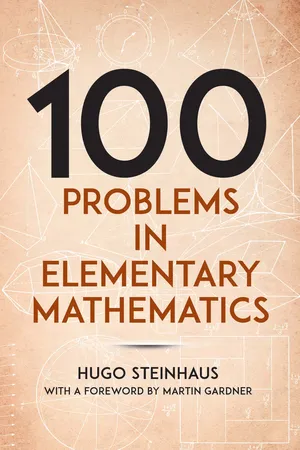
One Hundred Problems in Elementary Mathematics
eBook - ePub

One Hundred Problems in Elementary Mathematics

  1. 192 pages
  2. English
  3. ePUB (mobile friendly)
  4. Available on iOS & Android
eBook - ePub

One Hundred Problems in Elementary Mathematics

About this book

Both a challenge to mathematically inclined readers and a useful supplementary text for high school and college courses, One Hundred Problems in Elementary Mathematics presents an instructive, stimulating collection of problems. Many problems address such matters as numbers, equations, inequalities, points, polygons, circles, ellipses, space, polyhedra, and spheres. An equal number deal with more amusing or more practical subjects, such as a picnic ham, blood groups, rooks on a chessboard, and the doings of the ingenious Dr. Abracadabrus.
Are the problems in this book really elementary? Perhaps not in the lay reader’s sense, for anyone who desires to solve these problems must know a fair amount of mathematics, up to calculus. Nevertheless, Professor Steinhaus has given complete, detailed solutions to every one of his 100 problems, and anyone who works through the solutions will painlessly learn an astonishing amount of mathematics. A final chapter provides a true test for the most proficient readers: 13 additional unsolved problems, including some for which the author himself does not know the solutions.

Frequently asked questions

Yes, you can cancel anytime from the Subscription tab in your account settings on the Perlego website. Your subscription will stay active until the end of your current billing period. Learn how to cancel your subscription.
No, books cannot be downloaded as external files, such as PDFs, for use outside of Perlego. However, you can download books within the Perlego app for offline reading on mobile or tablet. Learn more here.
Perlego offers two plans: Essential and Complete
  • Essential is ideal for learners and professionals who enjoy exploring a wide range of subjects. Access the Essential Library with 800,000+ trusted titles and best-sellers across business, personal growth, and the humanities. Includes unlimited reading time and Standard Read Aloud voice.
  • Complete: Perfect for advanced learners and researchers needing full, unrestricted access. Unlock 1.4M+ books across hundreds of subjects, including academic and specialized titles. The Complete Plan also includes advanced features like Premium Read Aloud and Research Assistant.
Both plans are available with monthly, semester, or annual billing cycles.
We are an online textbook subscription service, where you can get access to an entire online library for less than the price of a single book per month. With over 1 million books across 1000+ topics, we’ve got you covered! Learn more here.
Look out for the read-aloud symbol on your next book to see if you can listen to it. The read-aloud tool reads text aloud for you, highlighting the text as it is being read. You can pause it, speed it up and slow it down. Learn more here.
Yes! You can use the Perlego app on both iOS or Android devices to read anytime, anywhere — even offline. Perfect for commutes or when you’re on the go.
Please note we cannot support devices running on iOS 13 and Android 7 or earlier. Learn more about using the app.
Yes, you can access One Hundred Problems in Elementary Mathematics by Hugo Steinhaus in PDF and/or ePUB format, as well as other popular books in Mathematik & Spiele in der Mathematik. We have over one million books available in our catalogue for you to explore.

Information

CHAPTER I

PROBLEMS ON NUMBERS, EQUATIONS AND INEQUALITIES

1. Exercise on the multiplication table

We construct a sequence of numbers as follows : The first number is 2, the next is 3,
2 . 3 = 6,
the third number of the sequence is 6,
3 . 6 = 18,
the fourth number is 1, and the fifth is 8,
6 . 1 = 6,1 . 8 = 8,
the sixth number is 6, then follows 8, etc.
This is the sequence which we obtain:
The little arcs under the numbers denote the multiplication carried out, the result of which follows the last digit of the sequence. For example, we ought to multiply now 6 by 8 and write down the numbers of the result, namely 4, 8. There will never be a shortage of numbers for multiplication, since the number of arcs is increased by one with each multiplication and the result will yield at least one and often two digits, so that there always appears at least one new digit.
Prove that numbers 5, 7 and 9 never appear in this sequence.

2. An interesting property of numbers

Let us first write an arbitrary natural number (for example, 2583), and then add the squares of its digits (22+52+82+32 = 102). Next, we do the same with the number obtained (12+02+22 = 5), and proceed in the same way (52 = 25, 22+52 = 29, 22+92 = 85, ...).
Prove that unless this procedure leads to the number 1 (in which case the number 1 will of course recur indefinitely, it must lead to the number 145, and the following cycle will occur again and again:
145, 42, 20, 4, 16, 37, 58, 89.

3. Division by 11

Prove that the number
55k+1+45k+2+35k
is divisible by 11 for every natural k.

4. The divisibility of numbers

The number
3105+4105
is divisible by 13, 49, 181 and 379, and is not divisible either by 5 or by 11.
How can this result be confirmed?

5. A simplified form of Fermat’s theorem

If x, y, z and n are natural numbers, and nz, then the relation xn+yn = zn does not hold.

6. Distribution of numbers

Find ten numbers x1, x2, ..., x10 such that
(i) the number x1 is contained in the closed interval <0, 1>,
(ii) the numbers x1 and x2 lie in different halves of the interval <0, 1>,
(iii) the numbers x1, x2 and x3 lie each in different thirds of the interval <0, 1>,
(iv) the numbers x1, x2, x3 and x4 lie each in a different quarter of the interval, etc. and, finally
(v) the numbers x1, x2, ..., x10 lie each in a different tenth of the closed interval <0, 1>.

7. Generalization

Is the above problem solvable if instead of 10 numbers and 10 conditions there are n numbers and n conditions (where n is an arbitrary natural number)?

8. Proportions

Consider numbers A, B, C, p, q, r whose mutual dependence is expressed as follows:
A : B = p,B : C = q,C : A = r.
Write the proportion
A : B : C =
:
:
is such a way that in the empt...

Table of contents

  1. Cover
  2. Title Page
  3. Copyright Page
  4. Contents
  5. Foreword
  6. Preface
  7. Chapter I: Problems on Numbers, Equations and Inequalities
  8. Chapter II: Problems on Points, Polygons, Circles and Ellipses
  9. Chapter III: Problems on Space, Polyhedra and Spheres
  10. Chapter IV Practical and Non-Practical Problems
  11. Chapter V Problems on Chess, Volleyball and Pursuit
  12. Chapter VI Mathematical Adventures of Dr. Abracadabrus
  13. Chapter VII Problems Without Solution