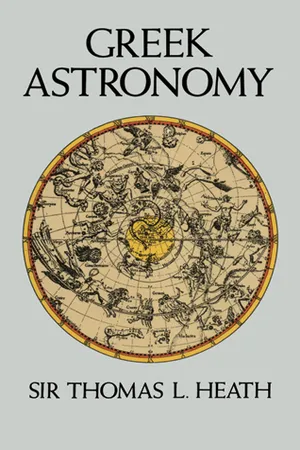
Astronomy as a science began with the Ionian philosophers, with whom Greek philosophy and mathematics also began. While the Egyptians and Babylonians had accomplished much of astronomical worth, it remained for the unrivalled speculative genius of the Greeks, in particular, their mathematical genius, to lay the foundations of the true science of astronomy. In this classic study, a noted scholar discusses in lucid detail the specific advances made by the Greeks, many of whose ideas anticipated the discoveries of modern astronomy.
Pythagoras, born at Samos about 572 B.C., was probably the first to hold that the earth is spherical in shape, while his later followers anticipated Copernicus with the then-startling hypothesis that the earth was not the center of the universe but a planet like the others. Heraclides of Pontus (c. 388–315 B.C.), a pupil of Plato, declared that the apparent daily rotation of the heavenly bodies is due, not to a rotation of the heavenly sphere about an axis through the center of the earth, but to the rotation of the earth itself around its own axis. Secondly, Heraclides discovered that Venus and Mercury revolve around the sun like satellites. Perhaps the greatest astronomer of antiquity was Hipparchus, who flourished between 161 and 126 B.C. He compiled a catalog of fixed stars to the number 850 or more, made great improvements in the instruments used for astronomical observations, and discovered the precession of the equinoxes, among other accomplishments. The astronomy of Hipparchus takes its definitive form in the Syntaxis (commonly called the Almagest) of Ptolemy, written about A.D. 150, which held the field until the time of Copernicus.
The extraordinary achievements of these and many more Greek theorists are given full coverage in this erudite account, which blends exceptional clarity with a readable style to produce a work that is not only indispensable for astronomers and historians of science but easily accessible to science-minded lay readers.
- 256 pages
- English
- ePUB (mobile friendly)
- Available on iOS & Android
eBook - ePub
Greek Astronomy
About this book
Information
Topic
Physical SciencesSubtopic
Astronomy & AstrophysicsTable of contents
- Title Page
- Copyright Page
- PREFATORY NOTE
- Table of Contents
- INTRODUCTION
- EPIGRAM
- THALES
- ANAXIMANDER
- ANAXIMENES
- PYTHAGORAS
- ALCMAEON
- XENOPHANES
- HERACLITUS
- PARMENIDES
- EMPEDOCLES
- ANAXAGORAS
- THE PYTHAGOREANS
- LEUCIPPUS
- DEMOCRITUS
- PLATO
- EUDOXUS (AND CALLIPPUS)
- ARISTOTLE
- HERACLIDES OF PONTUS
- EUCLID
- ARISTARCHUS OF SAMOS
- ERATOSTHENES
- ARATUS
- POSIDONIUS
- GEMINUS
- HIPPARCHUS
- PTOLEMY
- STRABO
- TREATISE DE MUNDO
- CLEOMEDES
- PLUTARCH
- APPENDIX
- INDEX
Trusted by 375,005 students
Access to over 1.5 million titles for a fair monthly price.
Study more efficiently using our study tools.
Frequently asked questions
Yes, you can cancel anytime from the Subscription tab in your account settings on the Perlego website. Your subscription will stay active until the end of your current billing period. Learn how to cancel your subscription
No, books cannot be downloaded as external files, such as PDFs, for use outside of Perlego. However, you can download books within the Perlego app for offline reading on mobile or tablet. Learn how to download books offline
Perlego offers two plans: Essential and Complete
- Essential is ideal for learners and professionals who enjoy exploring a wide range of subjects. Access the Essential Library with 800,000+ trusted titles and best-sellers across business, personal growth, and the humanities. Includes unlimited reading time and Standard Read Aloud voice.
- Complete: Perfect for advanced learners and researchers needing full, unrestricted access. Unlock 1.5M+ books across hundreds of subjects, including academic and specialized titles. The Complete Plan also includes advanced features like Premium Read Aloud and Research Assistant.
We are an online textbook subscription service, where you can get access to an entire online library for less than the price of a single book per month. With over 1.5 million books across 990+ topics, we’ve got you covered! Learn about our mission
Look out for the read-aloud symbol on your next book to see if you can listen to it. The read-aloud tool reads text aloud for you, highlighting the text as it is being read. You can pause it, speed it up and slow it down. Learn more about Read Aloud
Yes! You can use the Perlego app on both iOS and Android devices to read anytime, anywhere — even offline. Perfect for commutes or when you’re on the go.
Please note we cannot support devices running on iOS 13 and Android 7 or earlier. Learn more about using the app
Please note we cannot support devices running on iOS 13 and Android 7 or earlier. Learn more about using the app
Yes, you can access Greek Astronomy by Sir Thomas L. Heath in PDF and/or ePUB format, as well as other popular books in Physical Sciences & Astronomy & Astrophysics. We have over 1.5 million books available in our catalogue for you to explore.