Techniques and Applications of Path Integration
eBook - ePub

Techniques and Applications of Path Integration

  1. 448 pages
  2. English
  3. ePUB (mobile friendly)
  4. Available on iOS & Android
eBook - ePub

Techniques and Applications of Path Integration

About this book

A book of techniques and applications, this text defines the path integral and illustrates its uses by example. It is suitable for advanced undergraduates and graduate students in physics; its sole prerequisite is a first course in quantum mechanics. For applications requiring specialized knowledge, the author supplies background material.
The first part of the book develops the techniques of path integration. Topics include probability amplitudes for paths and the correspondence limit for the path integral; vector potentials; the Ito integral and gauge transformations; free particle and quadratic Lagrangians; properties of Green's functions and the Feynman-Kac formula; functional derivatives and commutation relations; Brownian motion and the Wiener integral; and perturbation theory and Feynman diagrams.
The second part, dealing with applications, covers asymptotic analysis and the calculus of variations; the WKB approximation and near caustics; the phase of the semiclassical amplitude; scattering theory; and geometrical optics. Additional topics include the polaron; path integrals for multiply connected spaces; quantum mechanics on curved spaces; relativistic propagators and black holes; applications to statistical mechanics; systems with random impurities; instantons and metastability; renormalization and scaling for critical phenomena; and the phase space path integral.

Frequently asked questions

Yes, you can cancel anytime from the Subscription tab in your account settings on the Perlego website. Your subscription will stay active until the end of your current billing period. Learn how to cancel your subscription.
No, books cannot be downloaded as external files, such as PDFs, for use outside of Perlego. However, you can download books within the Perlego app for offline reading on mobile or tablet. Learn more here.
Perlego offers two plans: Essential and Complete
  • Essential is ideal for learners and professionals who enjoy exploring a wide range of subjects. Access the Essential Library with 800,000+ trusted titles and best-sellers across business, personal growth, and the humanities. Includes unlimited reading time and Standard Read Aloud voice.
  • Complete: Perfect for advanced learners and researchers needing full, unrestricted access. Unlock 1.4M+ books across hundreds of subjects, including academic and specialized titles. The Complete Plan also includes advanced features like Premium Read Aloud and Research Assistant.
Both plans are available with monthly, semester, or annual billing cycles.
We are an online textbook subscription service, where you can get access to an entire online library for less than the price of a single book per month. With over 1 million books across 1000+ topics, we’ve got you covered! Learn more here.
Look out for the read-aloud symbol on your next book to see if you can listen to it. The read-aloud tool reads text aloud for you, highlighting the text as it is being read. You can pause it, speed it up and slow it down. Learn more here.
Yes! You can use the Perlego app on both iOS or Android devices to read anytime, anywhere — even offline. Perfect for commutes or when you’re on the go.
Please note we cannot support devices running on iOS 13 and Android 7 or earlier. Learn more about using the app.
Yes, you can access Techniques and Applications of Path Integration by L. S. Schulman in PDF and/or ePUB format, as well as other popular books in Physical Sciences & Physics. We have over one million books available in our catalogue for you to explore.

Information

PART ONE

Introduction

ONE

Introducing and Defining the Path Integral

The best place to find out about path integrals is in Feynman’s paper.a Our approach is not to use path integrals as a way of arriving at quantum mechanics, although Feynman has used this point of view in his book with Hibbs. Rather we assume knowledge of quantum mechanics and deduce the path integral formalism from it. This gets us into the subject quickly.
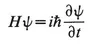
The wave function of a nonrelativistic spinless particle in one dimension evolves according to Schrödinger’s equation
e9780486137025_i0002.webp
(1.1)
e9780486137025_i0003.webp
(1.2)
Our interest is in the propagator or Green’s function G which satisfies the equation
e9780486137025_i0004.webp
(1.3)
in operator notation. In coordinate space this is written
e9780486137025_i0005.webp
(1.4)
The G’s are related by
e9780486137025_i0006.webp
(1.5)
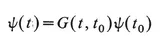
Knowing G means having a solution to the time dependent Schrödinger equation in the sense that if ψ(t0) is the state of the system at t0, ψ(t), given by
e9780486137025_i0007.webp
(1.6)
is the state at t. For time independent H an operator solution of (1.3) can immediately be written down:
e9780486137025_i0008.webp
(1.7)
where θ is the step function. Since H is assumed to be time independent we can, without loss of generality, take t0=0. Then for t>0 we have
e9780486137025_i0009.webp
(1.8)
where the argument 0 has been deleted.
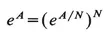
The path integral arises from the fact that
e9780486137025_i0010.webp
(1.9)
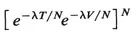
Letting λ = it/
e9780486137025_img_8463.gif
yields
e9780486137025_i0011.webp
(1.10)
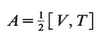
with the product in the brackets taken N times. Now we make use of a fundamental fact about the exponential of two operators, namely
e9780486137025_i0012.webp
(1.11)
This is proved easily enough,b and in a power series expansion the coefficient of the λ2/N2 term is
e9780486137025_i0013.webp
In subsequent manipulations we assume that the O(1/N2) term is well behaved, that it stays bounded when applied to states, and so on. For reasonable potentials this assumption is justified; more is said on this topic in the appendix.
What we are now aiming for is to replace the term
e9780486137025_i0014.webp
(1.12)
by the term
e9780486137025_i0015.webp
(1.13)
For real numbers (rather than operators) this replacement is a reflection of a fundamental fact about the exponential. The expression
e9780486137025_i0016.webp
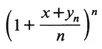
converges to ex despite the presence of yn so long as yn→0 as n→∞. (A proof of this assertion can be had by taking large enough n that |yn| <δ and by using the bound
e9780486137025_i0017.webp
and assuming n large enough that |(x-δ)/n| < 1.)
For operators a bit of care is required, and the trick is to express the diff...

Table of contents

  1. Title Page
  2. Copyright Page
  3. Dedication
  4. Preface
  5. Table of Contents
  6. PART ONE - Introduction
  7. PART TWO - Selected Applications of the Path Integral
  8. Author Index
  9. Subject Index
  10. Supplements