The first great Russian writer to emerge from the ranks of the proletariat, Maxim Gorky (1868–1936) was born into poverty and orphaned at an early age. Entirely self-taught, he experienced firsthand the suffering, injustice, and despair which permeate his tales. Speaking for the social outcast, the downtrodden, and the oppressed, he vividly depicted the miserable loves of the lowest classes who raged in protest against an uncaring society. His sensitivity and candor won him a devoted following.
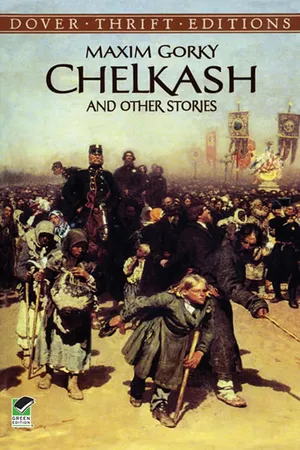
Three of Gorky's best known appear in this collection — the title story, in which a thieving vagrant takes on a young, unwilling apprentice; "Makar Chudra," the story of an ill-fated, tempestuous romance between a pair of gypsy lovers; and "Twenty-six Men and a Girl," widely regarded as Gorky's best short story, in which a wretched crew of pretzel-makers, laboring in a damp and grimy cellar, destroy their only source of joy.
Student and general readers alike will value this affordable collection of powerful tales by one of Russia's best-loved authors and greatest portrayer of the "lower depths."
- 64 pages
- English
- ePUB (mobile friendly)
- Available on iOS & Android
eBook - ePub
Chelkash and Other Stories
About this book
Trusted by 375,005 students
Access to over 1.5 million titles for a fair monthly price.
Study more efficiently using our study tools.
Information
CHELKASH
THE BLUE southern sky, darkened by dust, bore a leaden hue; the hot sun, looking down onto the greenish sea as if through a fine grey veil, was barely reflected in the water, which was chopped by the strokes of boats’ oars, ships’ propellers, the sharp keels of Turkish feluccas and of other vessels that ploughed backwards and forwards in the congested port. The granite-fettered waves, borne down by the immense weights that glided over their crests, beat against the ships’ sides and against the shore, growling and foaming, befouled with all sorts of junk.
The clang of anchor chains, the clash of the buffers of the railway cars that were bringing up freight, the metallic wail of iron sheets slipping onto the cobble-stones, the muted sounds of wood striking wood, of rambling carts, of ships’ sirens rising to a shrill, piercing shriek and dropping to a muffled roar, and the loud voices of the dock labourers, the seamen and the military Customs guards—all mingled in the deafening music of the working day, and quivering and undulating, hovered low in the sky over the port. And from the land, rising to meet them, came wave after wave of other sounds, now muffled and rumbling, causing everything around to vibrate, and now shrill and shrieking, rending the dusty, sultry air.
The granite, the iron, the timber, the cobble-stones in the port, the ships and the men, all breathed the mighty sounds of this fervent hymn to Mercury. But the human voices, scarcely audible in this tumult, were feeble and comical; and the very men who had originally produced these mighty sounds were comical and pitiful to look at. Their grimy, ragged, nimble bodies, bent under the weight of the merchandise they carried on their backs, flitted to and fro amidst clouds of dust and a welter of heat and sound. They looked insignificant compared with the steel giants, the mountains of merchandise, the rattling railway cars and everything else around them which they themselves had created. The things they themselves had created had enslaved them and robbed them of their personality.
The giant steamers, lying with steam up, shrieked and hissed and heaved deep sighs; and every sound they emitted seemed to breathe scorn and contempt for the grey, dusty, human figures that were creeping along their decks, filling the deep holds with the products of their slavish labour. The long files of dock labourers carrying on their backs hundreds of tons of grain to fill the iron bellies of the ships in order that they themselves might earn a few pounds of this grain to fill their own stomachs, looked so droll that they brought tears to one’s eyes. The contrast between these tattered, perspiring men, benumbed with weariness, turmoil and heat, and the mighty machines glistening in the sun, the machines which these very men had made, and which, after all is said and done, were set in motion not by steam, but by the blood and sinew of those who had created them—this contrast constituted an entire poem of cruel irony.
The overwhelming noise, the dust which irritated one’s nostrils and blinded one’s eyes, the baking and exhausting heat, and everything else around, created an atmosphere of tense impatience that was ready to burst out in a terrific upheaval, an explosion that would clear the air and make it possible to breathe freely and easily—after which silence would reign over the earth, and this dusty, deafening, irritating and infuriating tumult would pass away, and the town, the sea and the sky would be tranquil, serene and magnificent....
A bell struck twelve in slow regular strokes. When the last brassy vibrations died away, the savage music of labour sounded softer and a moment later sank to a muffled, discontented murmur. Human voices and the splash of the sea became more audible. It was dinner time.
I
When the dock labourers stopped work and scattered over the port in noisy chattering groups to buy the victuals that the market women were selling, and had squatted down on the cobble-stones in shady corners to eat their dinner, Grishka Chelkash turned up, an old timer, well-known to the people in the port, a confirmed drunkard, and a skilful, daring thief. He was barefooted; his legs were encased in a pair of threadbare corduroy trousers; he wore no hat, and his dirty cotton blouse with a torn collar, which exposed the brown skin drawn tightly over his lean collar bones. His matted, black, grey-streaked hair and his sharp crinkled, rapacious face showed that he had only just got up from sleep. A straw was entangled in his brown moustache, another was sticking to the bristle on his left cheek, and he had a freshly plucked linden twig stuck behind one ear. Tall, gaunt, slightly round-shouldered, he strode slowly over the cobble-stones, wrinkling his hawk-like nose and casting his keen, grey, flashing eyes around, looking for somebody among the dock labourers. Now and again his long, thick, brown moustache twitched like the whiskers of a cat, and his hands, held behind his back, rubbed against each other, while his long, crooked, grasping fingers nervously intertwined. Even here, among the hundreds of rough hoboes like himself, he at once became conspicuous by his resemblance to the hawk of the steppe, by his rapacious leanness, and by his deliberate gait, outwardly calm and even, but internally agitated and alert, like the flight of the bird of prey that he reminded one of.
When he drew level with a group of bare-footed dockers who were sitting in the shade of a pile of coal-laden baskets, a thickset lad, whose stupid face was disfigured by scarlet blotches and his neck badly scratched—evidently the results of a recent scrap—got up to meet him. Walking by the side of Chelkash, he said in an undertone:
“The sailors are missing two bales of cloth.... They’re searching for them.”
“Well?” asked Chelkash, looking the lad up and down.
“What do you mean, well? I say they are searching for them. That’s all.”
“What? Have they been asking for me to go and help in the search?”
Chelkash smiled and looked in the direction of the warehouse of the Volunteer Fleet. 1
“Go to hell!”
The lad turned to go back, but Chelkash stopped him with the exclamation:
“Hey! You do look a sight! Who messed up your shop front like this?” And then he enquired: “Have you seen Mishka about here anywhere?”
“Haven’t seen him for a long time!” retorted the other, leaving Chelkash to rejoin his mates.
Chelkash proceeded on his way, greeted by everybody as an old acquaintance; but today he was obviously out of sorts, and instead of replying with his customary banter, he snarled in answer to the questions put to him.
Suddenly a Customs guard appeared from behind a pile of merchandise, a dark-green, dusty, and truculently erect figure. He stood in front of Chelkash, defiantly barring his way, clutched the hilt of his dirk with his left hand and put out his right to take Chelkash by the collar.
“Halt! Where are you going?” he demanded.
Chelkash stepped back a pace, raised his eyes to the guard’s good-natured but shrewd face and smiled drily.
The Customs guard tried to pull a stern face; he puffed out his round, red cheeks, twitched his brows and rolled his eyes ferociously, but he succeeded only in looking comical.
“How many times have I told you not to go prowling around these docks. I said I’d smash your ribs in if I caught you! But here you are again!” he shouted.
“How do you do, Semyonich! We haven’t met for a long time!” Chelkash answered serenely, proferring his hand.
“It wouldn’t break my heart if I didn’t see you for a century! Clear out of here!”
Nevertheless, Semyonich shook the proferred hand.
“Tell me,” continued Chelkash, retaining Semyonich’s hand in his tenacious fingers and familiarly shaking his hand. “Have you seen Mishka anywhere around here?”
“Who’s Mishka? I don’t know any Mishka! You’d better clear out, brother, or else the warehouse guard will see you, and he’ll....”
“That red-haired chap I worked with on the Kostroma last time,” persisted Chelkash.
“The one you go thieving together, you mean, don’t you? They took that Mishka of yours to the hospital. He met with an accident and broke his leg. Now go along, brother, while I’m asking you quietly, otherwise I’ll give you one in the neck!”
“There! And you say you don’t know Mishka! You do know him after all! What are you so wild about, Semyonich?”
“Now then, now then! Don’t try to get round me! Clear out of here, I tell you!”
The guard was getting angry, and looking round from one side to another, he tried to tear his hand out of Chelkash’s close grip. But Chelkash calmly gazed at the guard from under his thick eyebrows and keeping a tight hold on his hand went on to say:
“Don’t hustle me! I’ll have my say and then go away. Well now, tell me, how’re you getting on? How’s the wife, and the children? Are they well?” With flashing eyes, and teeth bared in an ironic smile, he added: “I’ve been wanting to pay you a visit for a long time, but I’ve been too busy ... drinking....”
“Now, now! None of that! None of your jokes, you skinny devil! I’ll give it to you hot if you don’t look out! ... What! Do you intend to go robbing in the streets and houses now?”
“Whatever for? There’s plenty of stuff lying about here. Plenty I tell you, Semyonich! I hear you’ve swiped another two bales of cloth! Take care, Semyonich! See you don’t get caught!”
Semyonich trembled with indignation, foamed at the mouth, and tried to say something. Chelkash released his hand and calmly made for the dark gates in long, regular strides. The guard kept close on his heels, swearing like a trooper.
Chelkash brightened up and whistled a merry tune through his teeth. With his hands in his trouser pockets he strode along unhurriedly, throwing biting quips and jests to right and left and getting paid in his own coin.
“Hey, Grishka! Look how the bosses are taking care of you!” shouted a dock labourer from a crowd of men who were sprawling on the ground, resting after dinner.
“I’ve no boots on, so Semyonich is seeing that I don’t step onto something sharp and hurt my foot,” answered Chelkash.
They reached the gates. Two soldiers ran their hands down Chelkash’s clothes and then gently pushed him into the street.
Chelkash crossed the road and sat down on the curbstone opposite a tavern. A file of loaded carts came rattling out of the dock gates. Another, of empty carts, came from the opposite direction, their drivers bumping on the seats. The docks belched forth a howling thunder and clouds of biting dust. . . .
Chelkash felt in his element amidst this frenzied bustle. Solid gains, requiring little labour but much skill, smiled in prospect for him. He was confident of his skill, and wrinkling his eyes he pictured to himself the spree he would have next morning when his pockets were filled with bank notes. . . . He thought of his chum, Mishka; he would have been very useful to him that night if he had not broken his leg. He swore to himself as doubt crossed his mind as to whether he would be able to manage alone, without Mishka. He wondered what the weather would be like at night, and looked at the sky. He lowered his eyes and glanced down the street.
A half a dozen paces away, on the cobbles, leaning back against the curb, sat a young lad in a coarse blue homespun blouse and trousers of the same material, bast shoes on his feet, and a dilapidated brown cap on his head. Beside him lay a small knapsack and a scythe without a haft, wrapped in straw and carefully tied with string. The lad was broad-shouldered, thickset, fair-haired, and had a sunburnt weather-beaten face and large blue eyes, which looked at Chelkash trustfully and good-naturedly.
Chelkash bared his teeth, poked his tongue out, and pulling a horrible face, stared at the lad with wide-open eyes.
The lad blinked in perplexity at first, but soon he burst out laughing and shouted between his chuckles: “Aren’t you funny!” And then, scarcely rising from the ground, he shifted awkwardly over to Chelkash, dragging his knapsack through the dust and rattling the heel of his scythe over the cobble-stones.
“Been on the booze, eh, brother?” he asked Chelkash, tugging at the latter’s trousers.
“Yes, baby, something like that!” confessed Chelkash with a smile. He at once took a fancy to this sturdy, good-natured lad with the bright childish eyes. “You’ve been out haymaking, eh?” he enquired.
“Yes! ... But it was plenty of work and little pay. I made nothing by it. And the people! Hundreds of them! Those people from the famine districts came pouring in and knocked the price down. The job was hardly worth taking. In the Kuban they paid only sixty kopecks. Something awful! ... And they say that before they used to pay three, four and five rubles!”
“Before! ... Before they used to pay three rubles just to look at a Russian! I used to do this job myself about ten years ago. I would go to a stanitsa2 and say—I’m a Russian! And they’d look me up and down, feel my arms, shake their heads in wonder and say: ‘Here, take three rubles!’ And then they’d give you food and drink, and invite you to stay as long as you like!”
The lad listened to what Chelkash was saying with mouth wide open and amazement and admiration written on his round, tanned face; but soon he realized that the hobo was pulling his leg, and, smacking his lips, he burst into a hearty laugh. Chelkash kept a straight face, hiding his smile under his moustache.
“I’m a boob! You talk as if it was all true, and I listen to it and believe it.... But, still, so help me God, things were...
Table of contents
- Title Page
- Copyright Page
- Note
- Table of Contents
- CHELKASH
- MAKAR CHUDRA
- TWENTY-SIX MEN AND A GIRL
Frequently asked questions
Yes, you can cancel anytime from the Subscription tab in your account settings on the Perlego website. Your subscription will stay active until the end of your current billing period. Learn how to cancel your subscription
No, books cannot be downloaded as external files, such as PDFs, for use outside of Perlego. However, you can download books within the Perlego app for offline reading on mobile or tablet. Learn how to download books offline
Perlego offers two plans: Essential and Complete
- Essential is ideal for learners and professionals who enjoy exploring a wide range of subjects. Access the Essential Library with 800,000+ trusted titles and best-sellers across business, personal growth, and the humanities. Includes unlimited reading time and Standard Read Aloud voice.
- Complete: Perfect for advanced learners and researchers needing full, unrestricted access. Unlock 1.5M+ books across hundreds of subjects, including academic and specialized titles. The Complete Plan also includes advanced features like Premium Read Aloud and Research Assistant.
We are an online textbook subscription service, where you can get access to an entire online library for less than the price of a single book per month. With over 1.5 million books across 990+ topics, we’ve got you covered! Learn about our mission
Look out for the read-aloud symbol on your next book to see if you can listen to it. The read-aloud tool reads text aloud for you, highlighting the text as it is being read. You can pause it, speed it up and slow it down. Learn more about Read Aloud
Yes! You can use the Perlego app on both iOS and Android devices to read anytime, anywhere — even offline. Perfect for commutes or when you’re on the go.
Please note we cannot support devices running on iOS 13 and Android 7 or earlier. Learn more about using the app
Please note we cannot support devices running on iOS 13 and Android 7 or earlier. Learn more about using the app
Yes, you can access Chelkash and Other Stories by Maxim Gorky in PDF and/or ePUB format, as well as other popular books in Literature & Classics. We have over 1.5 million books available in our catalogue for you to explore.