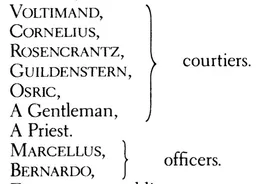
CLAUDIUS, King of Denmark.
HAMLET, son to the late, and nephew to the present king.
POLONIUS, Lord Chamberlain.
HORATIO, friend to Hamlet.
LAERTES, son to Polonius.
FRANCISCO, a soldier.
REYNALDO, servant to Polonius.
Players.
Two Clowns, grave-diggers.
FORTINBRAS, Prince of Norway.
A Captain.
English Ambassadors.
GERTRUDE, Queen of Denmark, and mother to Hamlet. OPHELIA, daughter to Polonius.
Ghost of Hamlet’s Father.
SCENE: Denmark.
SCENE I. Elsinore. A platform before the castle.
FRANCISCO at his post. Enter to him BERNARDO.
BER. Who’s there?
FRAN. Nay, answer me. Stand and unfold yourself.
BER. Long live the King!
FRAN. Bernardo?
BER. He.
FRAN. You come most carefully upon your hour.
BER. ‘Tis now struck twelve. Get thee to bed, Francisco.
FRAN. For this relief much thanks. ‘Tis bitter cold,
BER. Have you had quiet guard?
FRAN. Not a mouse stirring.
BER. Well, good night.
If you do meet Horatio and Marcellus,
The rivals1 of my watch, bid them make haste.
FRAN. I think I hear them. Stand, ho! Who is there?
Enter HORATIO and MARCELLUS.
HOR. Friends to this ground.
MAR. And liegemen to the Dane.
FRAN. Give you good night.
MAR. O, farewell, honest soldier.
FRAN. Bernardo hath my place.
[Exit.
MAR. Holla, Bernardo!
BER. Say,
HOR. A piece of him.
BER. Welcome, Horatio. Welcome, good Marcellus.
MAR. What, has this thing appear’d again tonight?
BER. I have seen nothing.
MAR. Horatio says ’tis but our fantasy,
And will not let belief take hold of him
Touching this dreaded sight, twice seen of us.
Therefore I have entreated him along
With us to watch the minutes of this night,
That if again this apparition come
He may approve our eyes2 and speak to it.
HOR. Tush, tush, ’twill not appear.
BER. Sit down awhile,
And let us once again assail your ears,
That are so fortified against our story,
What we have two nights seen.
HOR. Well, sit we down,
And let us hear Bernardo speak of this.
BER. Last night of all,
When yond same star that’s westward from the pole3
Had made his course to illume that part of heaven
Where now it burns, Marcellus and myself,
The bell then beating one—
Enter GHOST.
MAR. Peace, break thee off. Look where it comes again.
BER. In the same figure like the King that’s dead.
MAR. Thou art a scholar; speak to it, Horatio.
BER. Looks it not like the King? Mark it, Horatio.
HOR. Most like. It harrows me with fear and wonder.
BER. It would be spoke to.
MAR. Question it, Horatio.
HOR. What art thou that usurp’st this time of night,
Together with that fair and warlike form
In which the majesty of buried Denmark
Did sometimes4 march? By heaven I charge thee, speak!
MAR. It is offended.
BER. See, it stalks away.
HOR. Stay! speak, speak! I charge thee, speak!
[Exit GHOST.
MAR. ’Tis gone, and will not answer.
BER. How now, Horatio? You tremble and look pale.
Is not this something more than fantasy?
What think you on’t?
HOR. Before my God, I might not this believe
Without the sensible and true avouch
Of mine own eyes.
MAR. Is it not like the King?
HOR. As thou art to thyself.
Such was the very armour he had on
When he the ambitious Norway combated;
So frown’d he once, when, in an angry parle, 5
He smote the sledded Polacks on the ice.
‘Tis strange.
MAR. Thus twice before, and jump6 at this dead hour,
With martial stalk hath he gone by our watch.
HOR. In what particular thought to work I know not;
But, in the gross and scope7 of my opinion,
This bodes some strange eruption to our state.
MAR. Good now, sit down, and tell me, he that knows,
why this same strict and most observant watch
So nightly toils the subject of the land,8
And why such daily cast9 of brazen cannon,
And foreign mart10 for implements of war,
Why such impress11 of shipwrights, whose sore task
Does not divide the Sunday from the week.
What might be toward, that this sweaty haste
Doth make the night joint-labourer with the day,
Who is’t that can inform me?
HOR. That can I—
At least the whisper goes so. Our last King,
Whose image even but now appear’d to us,
Was, as you know, by Fortinbras of Norway,
Thereto prick’d on by a most emulate12 pride,
Dared to the combat; in which our valiant Hamlet—
For so this side of our known world esteem’d him—
Did slay this Fortinbras; who by a seal’d compact...