Contents
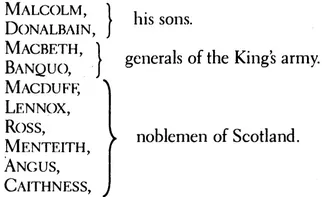
Dramatis Personæ
Act I
Scene I
Scene II
Scene III
Scene IV
Scene V
Scene VI
Scene VII
Act II
Scene I
Scene II
Scene III
Scene IV
Act III
Scene I
Scene II
Scene III
Scene IV
Scene V
Scene VI
Act IV
Scene I
Scene II
Scene III
Act V
Scene I
Scene II
Scene III
Scene IV
Scene V
Scene VI
Scene VII
Scene VIII
FLEANCE, son to Banquo.
SIWARD, Earl of Northumberland, general of the English forces.
YOUNG SIWARD, his son.
SEYTON, an officer attending on Macbeth.
BOY, son to Macduff.
An English Doctor.
A Scotch Doctor.
A Sergeant.
A Porter.
An Old Man.
Lady MACBETH.
Lady MACDUFF.
Gentlewoman attending on Lady Macbeth.
HECATE.
Three Witches.
Apparitions.
SCENE: Scotland; England.
SCENE I. A desert place.
Thunder and lightning. Enter three Witches.
FIRST WITCH.
When shall we three meet again In thunder, lightning, or in rain?
SEC. WITCH. When the hurlyburly’s done,
When the battles lost and won.
THIRD WITCH.
That will be ere the set of sun.
FIRST WITCH.
SEC. WITCH.
THIRD WITCH.
There to meet with Macbeth.
FIRST WITCH.
ALL.
Paddock2 calls:—anon! Fair is foul, and foul is fair.
Hover through the fog and filthy air.
[Exeunt.
SCENE II. A camp near Forres.
Alarum within. Enter DUNCAN, MALCOLM, DONALBAIN, LENNOX, with Attendants, meeting a bleeding Sergeant.
DUN.
What bloody man is that? He can report,
As seemeth by his plight, of the revolt
The newest state.
MAL.
This is the sergeant
Who like a good and hardy soldier fought
‘Gainst my captivity. Hail, brave friend!
Say to the king the knowledge of the broil
As thou didst leave it.
SER.
Doubtful it stood;
As two spent swimmers, that do cling together
And choke their art. The merciless Macdonwald—
Worthy to be a rebel, for to that
The multiplying villanies of nature
Do swarm upon him—from the western isles
Of kerns and gallowglasses3 is supplied;
And fortune, on his damned quarrel smiling,
Show’d like a rebel’s whore: but all’s too weak:
For brave Macbeth—well he deserves that name—
Disdaining fortune, with his brandish’d steel,
Which smoked with bloody execution,
Like valour’s minion carved out his passage
Till he faced the slave;
Which ne’er shook hands, nor bade farewell to him,
Till he unseam’d him from the nave to the chaps,4
And fix’d his head upon our battlements.
DUN.
O valiant cousin! worthy gentleman!
SER.
As whence the sun ‘gins his reflection Shipwrecking storms and direful thunders break,
So from that spring whence comfort seem’d to come
Discomfort swells. Mark, king of Scotland, mark:
No sooner justice had, with valour arm’d,
Compell’d these skipping kerns to trust their heels,
But the Norweyan lord, surveying vantage, 5
With furbish’d arms and new supplies of men,
Began a fresh assault.
DUN.
Dismay’d not this
Our captains, Macbeth and Banquo?
SER.
Yes;
As sparrows eagles, or the hare the lion.
If I say sooth, I must report they were
As cannons overcharged with double cracks;
So they
Doubly redoubled strokes upon the foe:
Except they meant to bathe in reeking wounds,
Or memorize another Golgotha,6
I cannot tell—
But I am faint; my gashes cry for help.
DUN.
So well thy words become thee as thy wounds;
They smack of honour both. Go get him surgeons.
[Exit Sergeant, attended.
Who comes here?
Enter ROSS.
MAL.
The worthy thane of ROSS.
LEN.
What a haste looks through his eyes! So should he look That seems to speak things strange.
ROSS.
DUN.
Whence camest thou, worthy thane?
ROSS.
From Fife, great king;
Where the Norweyan banners flout the sky
And fan our people cold.
Norway himself, with terrible numbers,
Assisted by that most disloyal traitor
The thane of Cawdor, began a dismal7 conflict;
Till that Bellona‘s8 bridegroom, lapp’d in proof,9
Confronted him with self-comparisons,10
Point against point rebellious, arm ’gainst arm,
Curbing his lavish spirit: and, to conclude,
The victory fell on us.
DUN.
ROSS.
That now
Sweno, the Norways’ king, craves composition;11
Nor would we deign him burial of his men
Till he disbursed, at Saint Colme’s inch,1...