"Music is your own experience, your thoughts, your wisdom. If you don't live it, it won't come out of your horn." — Charlie Parker
"What is jazz? The rhythm — the feeling." — Coleman Hawkins
"The best sound usually comes the first time you do something. If it's spontaneous, it's going to be rough, not clean, but it's going to have the spirit which is the essence of jazz." — Dave Brubeck
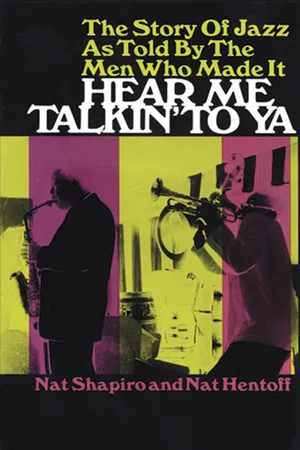
Here, in their own words, such famous jazz musicians as Louis Armstrong, King Oliver, Fletcher Henderson, Bunk Johnson, Duke Ellington, Fats Waller, Clarence Williams, Jo Jones, Jelly Roll Morton, Mezz Mezzrow, Billie Holiday, and many others recall the birth, growth, and changes in jazz over the years. From its beginnings at the turn of the twentieth century in the red-light district in New Orleans (or Storyville, as it came to be known), to Chicago's Downtown section and the Original Dixieland Jazz Band and Chicago's South Side to jam sessions in Kansas City to Harlem during the Depression years, the West Coast and modern developments, the story of jazz is vividly and colorfully documented in hundreds of personal interviews, letters, tape recorded and telephone conversations, and excerpts from previously printed articles that appeared in books and magazines.
There is no more fascinating and lively history of jazz than this firsthand telling by the men who made it. It should be read and re-read by all jazz enthusiasts, musicians, students of music and culture, students of American history, and other readers. "A lively book bearing the stamp of honesty and naturalness." — Library Journal. "A work of considerable substance." — The New Yorker. "Some of the quotations are a bit racy but they give the book a wonderful flavor." — San Francisco Chronicle.
eBook - ePub
Hear Me Talkin' to Ya
The Story Of Jazz As Told By The Men Who Made It
- 464 pages
- English
- ePUB (mobile friendly)
- Available on iOS & Android
eBook - ePub
About this book
Trusted by 375,005 students
Access to over 1.5 million titles for a fair monthly price.
Study more efficiently using our study tools.
Information
Subtopic
African American HistoryPART I
“Way Down Yonder in New Orleans”
1
It was always a musical town—especially The District —Storyville.
DANNY BARKER
One of my pleasantest memories as a kid growing up in New Orleans was how a bunch of us kids, playing, would suddenly hear sounds. It was like a phenomenon, like the Aurora Borealis—maybe. The sounds of men playing would be so clear, but we wouldn’t be sure where they were coming from. So we’d start trotting, start running—“It’s this way!” “It’s that way!”—And, sometimes, after running for a while, you’d find you’d be nowhere near that music. But that music could come on you any time like that. The city was full of the sounds of music….
CLARENCE WILLIAMS
Yes, New Orleans was always a musical town—a happy town. Why, on Mardi Gras and Christmas all the houses were open and there were dances all over. It was “open house” everywhere, and you could walk in almost any door and have a drink and eat and join the party.
DANNY BARKER
There were countless places of enjoyment that employed musicians, not including private affairs, balls, soirees, banquets, marriages, deaths, christenings, Catholic communions, confirmations, picnics at the lake front, country hay rides, and advertisements of business concerns. During the carnival season (Mardi Gras) any little insignificant affair was sure to have some kind of music and each section would engage their neighborhood favorite. It might be Joe Oliver, who lived around the corner; or Cheeky Sherman, on somebody’s piano; or Sandpaper George; or Hudson, on toilet pipe, now called the bazooka; or Picou, on the kazoo, a kazoo inserted into an old E-flat clarinet, which he fingered as he blew.
The colored and white bands battled (or bucked), frequently from opposite lake-front camps. It was the custom to have picnics and family outings on Sundays during the summer at places like Spanish Fort, West End, Milenberg, Birch Town, and Seabrook.
The city was split by Canal Street, with one part of the people uptown and the Creoles downtown. When people would come into New Orleans, like gamblers and workers from Memphis, and they’d say “Let’s go down to Frenchtown,” that meant you went below Canal Street. Storyville was below Canal Street on the outer part.
But the people I knew called all that was in Storyville “The District.” I never heard it called Storyville. It got called that when somebody up here in the North read about it. It was never Storyville to me. It was always The District—the red light district.
LOUIS ARMSTRONG
There was so much good music that was played in Scoryville—they talked about it and its musicians so much until the word District being used so much wouldn’t sound so good … Storyville has been discussed in colleges and some of the largest universities in the world … If not all over the world … I’ll bet right now most of the youngsters and hot club fans who hear the name Storyville hasn’t the least idea that it consisted of some of the biggest prostitutes in the world … Standing in their doorways nightly in their fine and beautiful negligees—faintly calling to the boys as they passed their cribs.
Storyville was kind of divided—I’d say—about middle ways of the City of New Orleans … Canal Street was the dividing line between the uptown and the downtown section … And right behind Canal Street was Storyville … And right off Canal Street was the famous Basin Street which was also connected with Storyville … And somewheres in or near Storyville was a famous gambling joint called Twenty-Five … That was the place where all the big-time pimps and hustlers would congregate and play “Cotch” (that’s a game they played with three cards shuffled and dealt from the bottom of the deck) … And you could win or lose a whole gang of money … These pimps and hustlers, et cetera, would spend most of their time at Twenty-Five until their girls would finish turning tricks in their cribs … Then they would meet them and check up on the night’s take … Lot of the prostitutes lived in different sections of the city and would come down to Storyville just like they had a job … There were different shifts for them … Sometime—two prostitutes would share the rent in the same crib together … One would work in the day and the other would beat out that night shift … And business was so good in those days with the fleet of sailors and the crews from those big ships that come in the Mississippi River from all over the world—kept them very very busy.
ALPHONSE PICOU
Those were happy days, man, happy days. Buy a keg of beer for one dollar and a bag full of food for another and have a cowein. These boys don’t have fun nowadays. Talking ’bout wild and wooly! There were two thousand registered girls and must have been ten thousand unregistered. And all crazy about clarinet-blowers !
DANNY BARKER
New Orleans, until the ‘twenties, was the safest haven in the Americas for the world’s most vicious characters. There was a charge, that a person could be arrested for, called “D and S” (dangerous and suspicious) whereby the police had the power to arrest anyone who could not walk to the ’phone booth to call his or her employer and prove that they earned an honest livelihood, or anyone who looked crafty, slick, or sinister.
Most arrests were Negroes who frequented barrooms and gambling joints during working hours.
As for the big sporting houses in The District, they were for whites. It was before my time, but they tell me that a mulatto passing for white could get in. And there were farmers and sugar men and riverboat men all through Louisiana who were mulattoes. So, if you looked white or Spanish, you went in. Lulu White and the Countess Willie Piazza were themselves reputed to be Creole.
JELLY ROLL MORTON
So, in the year of 1902, when I was about seventeen years old, I happened to invade one of the sections where the birth of jazz originated from.
The Tenderloin District in New Orleans was considered second to France, meaning the second greatest in the world, with extensions for blocks and blocks on the north side of Canal Street.
Every place in New Orleans had a gambling house, and I don’t know of any time that the racetracks were ever closed—a hundred days of races at City Park, then they would be at the Fair Grounds for another hundred days—and so they would go on continuously for three hundred and sixty-five days a year.
I’m telling you this Tenderloin District was like something that nobody has ever seen before or since. The doors were taken off the saloons there from one year to the next. Hundreds of men were passing through the streets day and night. The chippies in their little-girl dresses were standing in the crib doors singing the blues.
The streets were crowded with men. Police were always in sight, never less than two together, which guaranteed the safety of all concerned. Lights of all colors were glittering and glaring. Music was pouring into the streets from every house….
Some very happy, some very sad, some with the desire to end it all by poison, some planning a big outing, a dance, or some other kind of enjoyment. Some were real ladies in spite of their downfall and some were habitual drunkards and some were dope fiends as follows: opium, heroin, cocaine, laudanum, morphine, et cetera. I was personally sent to Chinatown many times with a sealed note and a small amount of money and would bring back several cards of hop. There was no slipping and dodging. All you had to do was walk in to be served.
They had everything in The District from the highest class to the lowest—creep joints where they’d put the feelers on a guy’s clothes, cribs that rented for about five dollars a day and had just about room enough for a bed, small-time houses where the price was from fifty cents to a dollar and they put on naked dances, circuses, and jive. Then, of course, we had the mansions where everything was of the highest class. These houses were filled up with the most expensive furniture and paintings. Three of them had mirror parlors where you couldn’t find the door for the mirrors, the one at Lulu White’s costing thirty thousand dollars. Mirrors stood at the foot and head of all the beds. It was in these mansions that the best of the piano players worked.
SPENCER WILLIAMS
All along this street of pleasure there were the dance halls, honky-tonks, and cabarets, and each one had its music. My old friend, Tony Jackson, who composed Pretty Baby and Some Sweet Day, used to play piano at a house run by Miss Antonia Gonzales, who sang and played the cornet. The largest of the cabarets on Basin Street was the Mahogany Hall, owned by my aunt, Miss Lulu White, and when my mother died, I went to live with her and became her adopted son. I’d go to sleep to the sound of the mechanical piano playing ragtime tunes, and when I woke up in the morning it would still be playing. The saloons in those days never had the doors closed, and the hinges were all rusty and dusty. Little boys and grownups would walk along the avenues, swaying and whistling jazz tunes.
BUNK JOHNSON
That was the Crescent City in them days, full of bars, honky-tonks, and barrel houses. A barrel house was just a piano in a hall. There was always a piano player working. When I was a kid, I’d go into a barrel house and play ’long with them piano players ’til early in the mornin’. We used to play nuthin’ but the blues.
I knew Mamie Desdoumes real well. Played many a concert with her singing those same blues. She was pretty good-looking, quite fair, with a nice head of hair. She was a hustlin’ woman. A blues-singing poor gal. Used to play pretty passable piano around them dance halls on Perdido Street.
When Hattie Rogers or Lulu White would put it out that Mamie was going to be singing in their place, the white men would turn out in bunches and them whores would clean up.
LOUIS ARMSTRONG
Lulu White was a famous woman of the sporting world in Storyville … She had a big house on Basin Street called Mahogany Hall … The song was written after her house had gotten so famous…. Rich men came there from all parts of the world to dig those beautiful Creole prostitutes … And pay big money … Lulu White was colored…. Around the corner from Lulu White was the famous Cabaret of Tom Anderson … All the race-horse men went there during their stay and the racing season in New Orleans … In those days a band who played for those places didn’t need to worry about salaries … Their tips were so great until they did not even have to touch their nightly gappings … Most of the places paid off the musicians every night after the job was over instead of the weekly deal … That was because those places were threatened to be closed any minute. So the musicians and the performers didn’t take any chances.
MAHOGANY HALL “SOUVENIR” BOOKLET
The NEW Mahogany Hall
A picture of which appears on the cover of this souvenir was erected specially for Miss Lulu White at a cost of $40,000. The house is built of marble and is four story; containing five parlors, all handsomely furnished, and fifteen bedrooms. Each room has a bath with hot and cold water and extension closets.
The elevator, which was built for two, is of the latest style. The entire house is steam heated and is the handsomest house of its kind. It is the only one where you can get three shots for your money—
The shot upstairs,
The shot downstairs,
And the shot in the room….
The shot downstairs,
And the shot in the room….
This famous West Indian octoroon first saw the light of day thirty-one years ago. Arriving in this country at a rather tender age, and having been fortunately gifted with a good education it did not take long for her to find out what the other sex was in search of.
In describing Miss Lulu, as she is most familiarly called, it would not be amiss to say that besides possessing an elegant form she has beautiful black hair and blue eyes, which have justly gained for her the title of the “Queen of the Demi-Monde.”
Her establishment, which is situated in the central part of the city, is unquestionably the most elaborately furnished house in the city of New Orleans, and without a doubt one of the most elegant places in this or any other country.
She has made a feature of boarding none but the fairest of girls—those gifted with nature’s best charms, and would, under no circumstances, have any but that class in her house.
As an entertainer Miss Lulu stands foremost, having made a life-long study of music and literature. She is well read and one that can interest anybody and make a visit to her place a continued round of pleasure.
ADVERTISEMENT NEW ORLEANS BLUE BOOK
COUNTESS WILLIE PIAZZA
Is one place in the Tenderloin District you can’t very well afford to miss. The Countess Piazza has made it a study to try to make everyone jovial who visits her house. If you have the “blues,” the Countess and her girls can cure them. She has, without a doubt, the most handsome and intelligent octoroons in the United States. You should see them; they are all entertainers.
If there is anything new in the singing and dancing line that you would like to see while in Storyville, Piazza’s is the place to visit, especially when one is out hopping with friends—the women in particular.
The Countess wishes it to be known that while her mansion is peerless in every respect, she only serves the “amber fluid.”
“Just ask for Willie Piazza.”
PHONE 4832 MAIN
317 N. Basin
PHONE 4832 MAIN
317 N. Basin
DANNY BARKER
There were all kinds of characters and all kinds of places in The District. I’ve been keeping a scrapbook, based on what I remember and on what other musicians have told me. Here are some of the things from my book:
Definitions of Different Types of Joints
Whore house—managed by a larceny-hearted landlady, strictly business.
Brothel—juice joint with rooms, and a bunk or a cot near.
Sporting house—lots of stimulants, women, music. An old queer or cripple serves.
Crib—Two or three stars venture for themselves, future landladies.
House of assignation—women pull shifts and report where they are needed.
Clip joint—While one jives you, another creeps or crawls in and rifles your pockets.
And here are some sporting women and the nicknames of a few well-known Crescent City characters:
Albertine McKay, former sweetheart of Lee Collins. She marched him around with a .38 special loaded with dum-dum bullets.
Daisy Parker, Louis Armstrong’s moll, who greeted him with a brickbat.
Kidneyfoot Rella, who is said to have spit in Black Benny’s face as he lay dead in his coffin.
Also—Flamin’ Mamie, Crying Emma, Bucktown Bessie, Dirty Dog, Steel Arm Johnny, Mary Meathouse, Gold Tooth Gussie, Big Butt Annie, Naked Mouf Mattie, Bird Leg Nora, Bang Zang, Boxcar Shorty, Sneaky Pete, Titanic, Coke Eye Laura, Yellow Gal, Black Sis, Boar Hog, Yard Dog, Bodidily, Roody Doody, Big Bull Cora, Piggy, Big Piggy, Stingaree, Bull Frog Sonny, Toot Nan, Knock on the Wall, Sore Dick, Sugar Pie, Cherry Red, Buck Tooth Rena, Bad Blood, Copper Wire, Snaggle Mouf Mary, Linker-Top, Topsy, Scratch, Joe the Pimp, Onery Bob, Tee Tee, Tee Nome, Tee Share, Tee Boy, Raw Head, Smoke Stack, Stack O Dollars, Pupsy, Boogers, Copper Cent, Street Rabbit, Boo Boo, Big Boo Boo, Fast Black, Eight Ball, Lily the Crip, Tenderloin Thelma, Three Finger Annie, Charlie Bow Wow, Good Lord the Lifter, Peachanno, Cold Blooded Carrie, Miss Thing, Jack the Bear.
CLARENCE WILLIAMS
Those places were really something to see—those sportin’ houses. They had the most beautiful parlors, with cut glass, and draperies, and rugs, and expensive furniture. They were just like millionaires’ houses. And the girls would come down dressed in the finest of evening gowns, just like they were going to the opera. They were just beautiful. Their hair-dos were just so, and I’m telling you that Ziegfeld didn’t have any more beautiful women than those. Some of them looked Spanish, and some were Creoles, some brown-skins, some chocolate-brown. But they all had to have that figure.
Places like that were for rich people, mostly white. Oh, once in a while a sailor might come, but generally only the wealthiest would come. Why, do you know that a bottle of beer was a dollar? The customers would buy champagne mostly and would always insist on giving the musicians money. When the piano player would get tired, there would be a player piano that you put a quarter in and we’d make money then too. Those houses hired nothing but the best, but only piano players, and maybe a girl to sing. And there was no loud playin’ either. It was sweet, just like a hotel.
Of course, those houses were so impressive that lots of people would be scared to go in. But, in the other part of the section, there were cabarets and dance halls and lots of hustlers. There were places like the Red Onion, the Keystone, and Spanola’s, which was one of the roughest. Spanola’s was on Basin Street, a place where the roustabouts and the lowest of people went. There a man could meet a gal, then do his business without any fuss at all.
Talk about those jam sessions you have today! Why, you should have seen the sessions we had then. ’Round about four A.M., the girls would ge...
Table of contents
- Title Page
- Copyright Page
- Acknowledgments
- Contributors
- Introduction
- Table of Contents
- PART I - “Way Down Yonder in New Orleans”
- PART II - “Up a Lazy River”
- PART III - “Travelin’ Light”
- PART IV - “Undecided”
- Coda
- Index
- A CATALOG OF SELECTED DOVER BOOKS IN ALL FIELDS OF INTEREST
Frequently asked questions
Yes, you can cancel anytime from the Subscription tab in your account settings on the Perlego website. Your subscription will stay active until the end of your current billing period. Learn how to cancel your subscription
No, books cannot be downloaded as external files, such as PDFs, for use outside of Perlego. However, you can download books within the Perlego app for offline reading on mobile or tablet. Learn how to download books offline
Perlego offers two plans: Essential and Complete
- Essential is ideal for learners and professionals who enjoy exploring a wide range of subjects. Access the Essential Library with 800,000+ trusted titles and best-sellers across business, personal growth, and the humanities. Includes unlimited reading time and Standard Read Aloud voice.
- Complete: Perfect for advanced learners and researchers needing full, unrestricted access. Unlock 1.5M+ books across hundreds of subjects, including academic and specialized titles. The Complete Plan also includes advanced features like Premium Read Aloud and Research Assistant.
We are an online textbook subscription service, where you can get access to an entire online library for less than the price of a single book per month. With over 1.5 million books across 990+ topics, we’ve got you covered! Learn about our mission
Look out for the read-aloud symbol on your next book to see if you can listen to it. The read-aloud tool reads text aloud for you, highlighting the text as it is being read. You can pause it, speed it up and slow it down. Learn more about Read Aloud
Yes! You can use the Perlego app on both iOS and Android devices to read anytime, anywhere — even offline. Perfect for commutes or when you’re on the go.
Please note we cannot support devices running on iOS 13 and Android 7 or earlier. Learn more about using the app
Please note we cannot support devices running on iOS 13 and Android 7 or earlier. Learn more about using the app
Yes, you can access Hear Me Talkin' to Ya by Nat Shapiro,Nat Hentoff in PDF and/or ePUB format, as well as other popular books in Media & Performing Arts & African American History. We have over 1.5 million books available in our catalogue for you to explore.