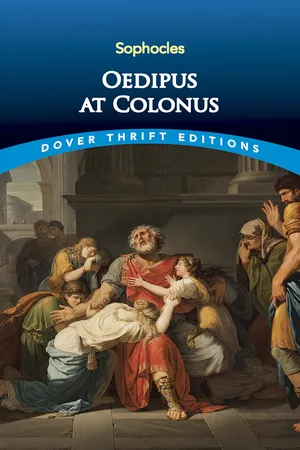
- 64 pages
- English
- ePUB (mobile friendly)
- Available on iOS & Android
eBook - ePub
Oedipus at Colonus
About this book
This outstanding drama of classical antiquity, part of the Cadmean trilogy that includes Oedipus Rex and Antigone, was first presented in 405 B.C. Thought to be among Sophocles' last works, it represents the great playwright's crowning achievement in depicting the painful quest for truth and self-knowledge that leads to spiritual triumph.
Blinded and disgraced, Oedipus dwells quietly in Thebes until the kingdom is roiled by discord attributed to his presence and the curse put upon him by the gods. The citizens banish their erstwhile sovereign to years of lonely exile. Finally, the aging king finds refuge in a sacred olive grove at Colonus, near Athens. In the meantime, Oedipus' two sons wage a struggle for control of Thebes. Secure in the protection of Theseus, ruler of Athens, and faithfully attended by his daughters Antigone and Ismene, Oedipus is a towering tragic figure whose final years comprise a moving portrayal of the perseverance of human dignity in the face of an incomprehensible and impersonal universe.
Students, teachers, and lovers of classical drama will welcome this inexpensive edition of an enduring literary and theatrical landmark.
Blinded and disgraced, Oedipus dwells quietly in Thebes until the kingdom is roiled by discord attributed to his presence and the curse put upon him by the gods. The citizens banish their erstwhile sovereign to years of lonely exile. Finally, the aging king finds refuge in a sacred olive grove at Colonus, near Athens. In the meantime, Oedipus' two sons wage a struggle for control of Thebes. Secure in the protection of Theseus, ruler of Athens, and faithfully attended by his daughters Antigone and Ismene, Oedipus is a towering tragic figure whose final years comprise a moving portrayal of the perseverance of human dignity in the face of an incomprehensible and impersonal universe.
Students, teachers, and lovers of classical drama will welcome this inexpensive edition of an enduring literary and theatrical landmark.
Frequently asked questions
Yes, you can cancel anytime from the Subscription tab in your account settings on the Perlego website. Your subscription will stay active until the end of your current billing period. Learn how to cancel your subscription.
At the moment all of our mobile-responsive ePub books are available to download via the app. Most of our PDFs are also available to download and we're working on making the final remaining ones downloadable now. Learn more here.
Perlego offers two plans: Essential and Complete
- Essential is ideal for learners and professionals who enjoy exploring a wide range of subjects. Access the Essential Library with 800,000+ trusted titles and best-sellers across business, personal growth, and the humanities. Includes unlimited reading time and Standard Read Aloud voice.
- Complete: Perfect for advanced learners and researchers needing full, unrestricted access. Unlock 1.4M+ books across hundreds of subjects, including academic and specialized titles. The Complete Plan also includes advanced features like Premium Read Aloud and Research Assistant.
We are an online textbook subscription service, where you can get access to an entire online library for less than the price of a single book per month. With over 1 million books across 1000+ topics, weâve got you covered! Learn more here.
Look out for the read-aloud symbol on your next book to see if you can listen to it. The read-aloud tool reads text aloud for you, highlighting the text as it is being read. You can pause it, speed it up and slow it down. Learn more here.
Yes! You can use the Perlego app on both iOS or Android devices to read anytime, anywhere â even offline. Perfect for commutes or when youâre on the go.
Please note we cannot support devices running on iOS 13 and Android 7 or earlier. Learn more about using the app.
Yes, you can access Oedipus at Colonus by Sophocles in PDF and/or ePUB format, as well as other popular books in Literature & Ancient & Classical Drama. We have over one million books available in our catalogue for you to explore.
Information
Oedipus at Colonus
SceneâColonus, before the Sacred Grove of the Erinyes.
[Enter ĆDIPUS and ANTIGONE.]
ĆDIPUS
Antigone, child of a blind old man,
What lands are these, or what the folk whose gates
We have attained? Who shall receive to-day
With stinted alms the wanderer Ćdipus?â
Asking but little; than that little still
Obtaining less; and yet enough for me.
For my afflictions and the weight of years
And something, too, of my own dignity
Teach me contentment. If you see, my child,
Some resting-place, either by sacred grove
Or secular dwelling, stay me and set me down,
That we may find out in what place we are;
For strangers from inhabitants to learn
We are come hither; and what we hear, to do it.
What lands are these, or what the folk whose gates
We have attained? Who shall receive to-day
With stinted alms the wanderer Ćdipus?â
Asking but little; than that little still
Obtaining less; and yet enough for me.
For my afflictions and the weight of years
And something, too, of my own dignity
Teach me contentment. If you see, my child,
Some resting-place, either by sacred grove
Or secular dwelling, stay me and set me down,
That we may find out in what place we are;
For strangers from inhabitants to learn
We are come hither; and what we hear, to do it.
ANTIGONE
Towers are there, 0 my father, Ćdipus,
Covering a city, I perceive, afar;
This place, as I suppose, is consecrate;
It blooms with laurel, olive and the vine;1
Thick-flying nightingales within it warble;
Here stretch thy limbs, upon this rough-hewn stone;
For thou art aged to have come so far.
Covering a city, I perceive, afar;
This place, as I suppose, is consecrate;
It blooms with laurel, olive and the vine;1
Thick-flying nightingales within it warble;
Here stretch thy limbs, upon this rough-hewn stone;
For thou art aged to have come so far.
ĆDIPUS
Seat me and guard me still; for I am blind.
ANTIGONE
I knowâthat is an old taleâtell not me.
ĆDIPUS
Well, can you teach me whither we are come?
ANTIGONE
To Athens, that I know; but not the quarter.
ĆDIPUS
So much we heard from every passenger.
ANTIGONE
But shall I go and ask what place it is?
ĆDIPUS
Why yes, my child; if it seems hospitable.
ANTIGONE
O yes, there are some dwellings.âThereâs no need,
I think: for hereâs a man, I see, close to us.
ĆDIPUS
What, moving and approaching hitherward?
ANTIGONE
Yes, here, I mean, at hand. Say what is needful;
This is the man.
This is the man.
[Enter a Stranger, an inhabitant of Colonus.]
ĆDIPUS
Stranger, this maiden tells me
(Whose eyesight serves both for herself and me).
Of your approach, an apt intelligencer
Of things we cannot guessâ
(Whose eyesight serves both for herself and me).
Of your approach, an apt intelligencer
Of things we cannot guessâ
STRANGER
Ere you ask further
Come from that seat; you trespass on a place
No foot may desecrate.
Come from that seat; you trespass on a place
No foot may desecrate.
ĆDIPUS
What is the place?
To what God dedicated?
STRANGER
It is kept
From touch or dwelling: the dread Goddesses
Hold it, the daughters of the Earth and Gloom.
From touch or dwelling: the dread Goddesses
Hold it, the daughters of the Earth and Gloom.
ĆDIPUS
Who? By what solemn name denominate
Might I invoke them?
STRANGER
By the natives here
They would be called the All-seeing Favourers;
Other fit names elsewhere.
They would be called the All-seeing Favourers;
Other fit names elsewhere.
ĆDIPUS
May they receive
With mercy me their supplicant; and I
From this landâs harbour will go forth no more!
With mercy me their supplicant; and I
From this landâs harbour will go forth no more!
STRANGER
What does this mean?
ĆDIPUS
âTis my misfortunesâ weird.
STRANGER
Truly I dare not turn him out, before
I tell the restâwithout authority.
ĆDIPUS
Sir, in Heavenâs name do not begrudge meâme
A wandererâwhat I crave of you to say!
STRANGER
Explain, and I will show I grudge you not.
ĆDIPUS
What ground is this we have been treading on?
STRANGER
You shall hear all I know. First the whole place is holy,
Inhabited by dread Poseidon;2 next
The Deity that brought fire abides in it,
Titan Prometheus;3 this same spot you press
They call the Brass-paved Causeway4 of the landâ
Rampart of Athens; the adjoining farms
Boast them Colonus5 mounted on his horse
For their chief patron, and the people all
Are called by and in common bear his name.
These are the facts, sir stranger; honoured not
So much in story, as cherished on the spot.
Inhabited by dread Poseidon;2 next
The Deity that brought fire abides in it,
Titan Prometheus;3 this same spot you press
They call the Brass-paved Causeway4 of the landâ
Rampart of Athens; the adjoining farms
Boast them Colonus5 mounted on his horse
For their chief patron, and the people all
Are called by and in common bear his name.
These are the facts, sir stranger; honoured not
So much in story, as cherished on the spot.
ĆDIPUS
Did you say any men lived hereabouts?
STRANGER
Yes truly, and that they bear this Heroâs name.
ĆDIPUS
Have they a chief, or lies it with the folk
To hold debate?
To hold debate?
STRANGER
These parts are in the rule
Of the king of the City.
ĆDIPUS
Who is he whose might
And counsel sway them?
STRANGER
Theseus is his name,
Old Ăgeusâ son.
Old Ăgeusâ son.
ĆDIPUS
Would one of you go fetch him?
STRANGER
What should one tell or move him to come here for?
ĆDIPUS
Say, to gain much by a small act of kindness.
STRANGER
And whereâs the service in a man thatâs blind?
ĆDIPUS
There will be eyes in all that I shall say.
STRANGER
Come, this you may, sir, and without offence;
(Since you are worshipful to look upon,
Saving Godâs hand;) stay there where I first found you,
While I go tell this to the burghers round,
(Here, not in the city;) they will soon decide
If you shall tarry, or depart once more. [Exit.
(Since you are worshipful to look upon,
Saving Godâs hand;) stay there where I first found you,
While I go tell this to the burghers round,
(Here, not in the city;) they will soon decide
If you shall tarry, or depart once more. [Exit.
ĆDIPUS
My daughter, has the stranger gone away?
ANTIGONE
Yes, he has gone. You may say anything
Securely, father; none are here but I.
ĆDIPUS
Queens, with stern faces! since of all this land
First in your sanctuary I seated me,
To Phoebus,6 as to me, turn no deaf ear,
Who, prophesying of those my many-woes,
Spake of this respite for me at the last
That when my journey ended, in a land
Where I should find asylum, at the shrine
Of awful Powers, and hospitality,
There I should round the goal of my life-sorrow,
There dwell, a blessing to my hostsâa curse
To those who sent m...
Who, prophesying of those my many-woes,
Spake of this respite for me at the last
That when my journey ended, in a land
Where I should find asylum, at the shrine
Of awful Powers, and hospitality,
There I should round the goal of my life-sorrow,
There dwell, a blessing to my hostsâa curse
To those who sent m...
Table of contents
- Title Page
- Copyright Page
- Table of Contents
- Note
- Persons Represented
- Oedipus at Colonus