eBook - ePub
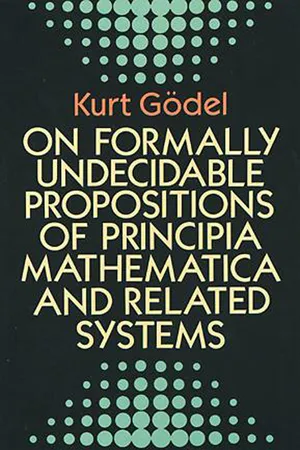
On Formally Undecidable Propositions of Principia Mathematica and Related Systems
- 80 pages
- English
- ePUB (mobile friendly)
- Available on iOS & Android
eBook - ePub
On Formally Undecidable Propositions of Principia Mathematica and Related Systems
About this book
In 1931, a young Austrian mathematician published an epoch-making paper containing one of the most revolutionary ideas in logic since Aristotle. Kurt Giidel maintained, and offered detailed proof, that in any arithmetic system, even in elementary parts of arithmetic, there are propositions which cannot be proved or disproved within the system. It is thus uncertain that the basic axioms of arithmetic will not give rise to contradictions. The repercussions of this discovery are still being felt and debated in 20th-century mathematics.
The present volume reprints the first English translation of Giidel's far-reaching work. Not only does it make the argument more intelligible, but the introduction contributed by Professor R. B. Braithwaite (Cambridge University}, an excellent work of scholarship in its own right, illuminates it by paraphrasing the major part of the argument.
This Dover edition thus makes widely available a superb edition of a classic work of original thought, one that will be of profound interest to mathematicians, logicians and anyone interested in the history of attempts to establish axioms that would provide a rigorous basis for all mathematics. Translated by B. Meltzer, University of Edinburgh. Preface. Introduction by R. B. Braithwaite.
The present volume reprints the first English translation of Giidel's far-reaching work. Not only does it make the argument more intelligible, but the introduction contributed by Professor R. B. Braithwaite (Cambridge University}, an excellent work of scholarship in its own right, illuminates it by paraphrasing the major part of the argument.
This Dover edition thus makes widely available a superb edition of a classic work of original thought, one that will be of profound interest to mathematicians, logicians and anyone interested in the history of attempts to establish axioms that would provide a rigorous basis for all mathematics. Translated by B. Meltzer, University of Edinburgh. Preface. Introduction by R. B. Braithwaite.
Frequently asked questions
Yes, you can cancel anytime from the Subscription tab in your account settings on the Perlego website. Your subscription will stay active until the end of your current billing period. Learn how to cancel your subscription.
At the moment all of our mobile-responsive ePub books are available to download via the app. Most of our PDFs are also available to download and we're working on making the final remaining ones downloadable now. Learn more here.
Perlego offers two plans: Essential and Complete
- Essential is ideal for learners and professionals who enjoy exploring a wide range of subjects. Access the Essential Library with 800,000+ trusted titles and best-sellers across business, personal growth, and the humanities. Includes unlimited reading time and Standard Read Aloud voice.
- Complete: Perfect for advanced learners and researchers needing full, unrestricted access. Unlock 1.4M+ books across hundreds of subjects, including academic and specialized titles. The Complete Plan also includes advanced features like Premium Read Aloud and Research Assistant.
We are an online textbook subscription service, where you can get access to an entire online library for less than the price of a single book per month. With over 1 million books across 1000+ topics, we’ve got you covered! Learn more here.
Look out for the read-aloud symbol on your next book to see if you can listen to it. The read-aloud tool reads text aloud for you, highlighting the text as it is being read. You can pause it, speed it up and slow it down. Learn more here.
Yes! You can use the Perlego app on both iOS or Android devices to read anytime, anywhere — even offline. Perfect for commutes or when you’re on the go.
Please note we cannot support devices running on iOS 13 and Android 7 or earlier. Learn more about using the app.
Yes, you can access On Formally Undecidable Propositions of Principia Mathematica and Related Systems by Kurt Gödel in PDF and/or ePUB format, as well as other popular books in Mathematics & Logic in Mathematics. We have over one million books available in our catalogue for you to explore.
Information
ON FORMALLY UNDECIDABLE PROPOSITIONS OF PRINCIPIA MATHEMATICA AND RELATED SYSTEMS I1
1
The development of mathematics in the direction of greater exactness has—as is well known—led to large tracts of it becoming formalized, so that proofs can be carried out according to a few mechanical rules. The most comprehensive formal systems yet set up are, on the one hand, the system of Principia Mathematica (PM)2 and, on the other, the axiom system for set theory of Zermelo-Fraenkel (later extended by J. v. Neumann).3 These two systems are so extensive that all methods of proof used in mathematics today have been formalized in them, i.e. reduced to a few axioms and rules of inference. It may therefore be surmised that these axioms and rules of inference are also sufficient to decide all mathematical questions which can in any way at all be expressed formally in the systems concerned. It is shown below that this is not the case, and that in both the systems mentioned there are in fact relatively simple problems in the theory of ordinary whole numbers4 which cannot be decided from the axioms. This situation is not due in some way to the special nature of the systems set up, but holds for a very extensive class of formal systems, including, in particular, all those arising from the addition of a finite number of axioms to the two systems mentioned,5 provided that thereby no false propositions of the kind described in footnote 4 become provable.
Before going into details, we shall first indicate the main lines of the proof, naturally without laying claim to exactness. The formulae of a formal system—we restrict ourselves here to the system PM—are, looked at from outside, finite series of basic signs (variables, logical constants and brackets or separation points), and it is easy to state precisely just which series of basic signs are meaningful formulae and which are not.6 Proofs, from the formal standpoint, are likewise nothing but finite series of formulae (with certain specifiable characteristics). For metamathematical purposes it is naturally immaterial what objects are taken as basic signs, and we propose to use natural numbers 7 for them. Accordingly, then, a formula is a finite series of natural numbers,8 and a particular proof-schema is a finite series of finite series of natural numbers. Metamathematical concepts and propositions thereby become concepts and propositions concerning natural numbers, or series of them,9 and therefore at least partially expressible in the symbols of the system PM itself. In particular, it can be shown that the concepts, “formula”, “proof-schema”, “provable formula” are definable in the system PM, i.e. one can give10 a formul...
Table of contents
- Dover Books on Mathematics
- Title Page
- Copyright Page
- Table of Contents
- Dedication
- PREFACE
- INTRODUCTION
- NOTE
- ON FORMALLY UNDECIDABLE PROPOSITIONS OF PRINCIPIA MATHEMATICA AND RELATED SYSTEMS I