
Art Students' Anatomy
eBook - ePub

Art Students' Anatomy

  1. 159 pages
  2. English
  3. ePUB (mobile friendly)
  4. Available on iOS & Android
eBook - ePub

Art Students' Anatomy

About this book

For art students working with the human figure, this comprehensive study of the bones, muscles, and surface forms of the living body will be one of the most useful (and most used) additions they can make to their private libraries. More than 150 illustrations, mostly full-page photographs and labeled sketches of undraped male and female bodies, provide the reader with anatomical studies of unrivaled clarity and unquestioned accuracy.
After an introduction covering the proportions of the adult male, the adult female, and the infant at various ages, the author devotes 50 pages to the human skeletal system. Besides pictures and detailed drawings of the major bones of the body, he also includes x-rays showing the bone structure of the hand and foot and the movements of the shoulder, elbow, and knee joints.
A section on the muscular system follows, including reproductions of the remarkable Albinus engravings ("The most beautiful and among the most accurate anatomical figures ever published." — Charles Singer), 36 photographs and labeled sketches of living models, and seven drawings showing the attachments of muscles to the skeleton. The book concludes with a number of poses and action photographs illustrating surface anatomy in various actions such as dancing and throwing a ball.
This is one of the few and perhaps the best of those books that teach anatomy using chiefly living objects for their illustrative work. By doing so, it fills an urgent need, for most art students cannot afford living models or expensive courses in anatomy. Now, however, they can use this practical and inexpensive home-study course to achieve a clearer insight into the complicated mechanism of the human body, as simplified by Dr. Farris.
Frequently asked questions

Yes, you can cancel anytime from the Subscription tab in your account settings on the Perlego website. Your subscription will stay active until the end of your current billing period. Learn how to cancel your subscription.
No, books cannot be downloaded as external files, such as PDFs, for use outside of Perlego. However, you can download books within the Perlego app for offline reading on mobile or tablet. Learn more here.
Perlego offers two plans: Essential and Complete
  • Essential is ideal for learners and professionals who enjoy exploring a wide range of subjects. Access the Essential Library with 800,000+ trusted titles and best-sellers across business, personal growth, and the humanities. Includes unlimited reading time and Standard Read Aloud voice.
  • Complete: Perfect for advanced learners and researchers needing full, unrestricted access. Unlock 1.4M+ books across hundreds of subjects, including academic and specialized titles. The Complete Plan also includes advanced features like Premium Read Aloud and Research Assistant.
Both plans are available with monthly, semester, or annual billing cycles.
We are an online textbook subscription service, where you can get access to an entire online library for less than the price of a single book per month. With over 1 million books across 1000+ topics, we’ve got you covered! Learn more here.
Look out for the read-aloud symbol on your next book to see if you can listen to it. The read-aloud tool reads text aloud for you, highlighting the text as it is being read. You can pause it, speed it up and slow it down. Learn more here.
Yes! You can use the Perlego app on both iOS or Android devices to read anytime, anywhere — even offline. Perfect for commutes or when you’re on the go.
Please note we cannot support devices running on iOS 13 and Android 7 or earlier. Learn more about using the app.
Yes, you can access Art Students' Anatomy by Edmond J. Farris in PDF and/or ePUB format, as well as other popular books in Art & Art Techniques. We have over one million books available in our catalogue for you to explore.

Information

eBook ISBN
9780486158105
Topic
Art

CHAPTER I

LANDMARKS AND PROPORTIONS

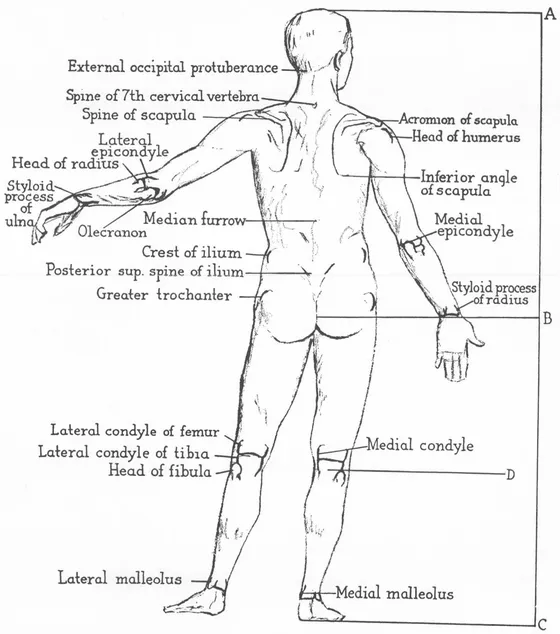
There are landmarks evident in various regions of the body essentially important to the artist. These landmarks, as indicated in the figure on the opposite page, deal primarily with bones which cause projections on the surface. The details concerning the landmarks will be considered later in the text.
Ā 
The human body is composed of the following parts:
The head (caput) includes the SKULL (cranium) and the FACE (facies). The face includes the mouth (os), nose (nasus), and eye (oculus).
The neck (collum) joins the head with the trunk. The sternocleidomastoid muscles, the throat (larynx), and the sternal parts of the clavicles are easily visible.
The trunk (truncus) is divided into the CHEST (thorax) and BELLY (abdomen). On the chest, one can distinguish the rib outline, the nipples of the mammary glands, and the lower border of the sternum, which serves as a line of separation between the thorax and abdomen. On the abdomen, the navel (umbilicus) is recognized as a depression at approximately the mid-abdomen. The inguinal ligament separates the trunk from the lower extremity. The BACK (dorsum) from the neck to the hip bones (coxae) is usually considered the hinder or posterior part of the trunk. The back of the neck is known as the nape (nucha).
Ā 
The upper extremity (extremitas superior) is divided into four portions: SHOULDER (omos), ARM (brachium), FOREARM (antibrachium), and the HAND (manu ), which includes the wrist (carpus).
Ā 
The lower extremity (extremitas inferior) is also divided into four parts: HIP (coxa), THIGH (femur), LEG (crus), and FooT (pes), which includes the ankle (tarsus).

PROPORTIONS IN THE ADULT MALE

The ā€œhead-lengthā€ is the usual unit of measurement.
The average body is 7½ heads in length.
The shoulders at the greatest width, measures about 2 heud-lengths.
The supra-sternal fossa to the tip of the middle finger measures ½ the height of the body.
Ā 
The body may be divided into two equal halves as in the diagramĀ·
AB = BC where B represents the pubic arch.
e9780486158105_i0003.webp
FIG. 2.—Posterior surface view showing landmarks and proportions.
The lower half (BC) may be subdivided into two equal halves:
BD = DC where D represents a point just below the knee.
The trunk (Fig. 1) may be divided into equal thirds as follows:
EF = FG = GB where E is the supra-sternal fossa
F is the xiphoid process of sternum
G is the navel
B is the pubic arch.

PROPORTIONS IN THE ADULT FEMALE

The body is 7½ head-lengths. The trunk is slightly greater in length than that of the male, while the length of the lower limbs is slightly shorter. The pelvis is broader in the female, while the width of the shoulders is narrower.

PROPORTIONS IN THE INFANT

The proportions of the infant may be represented in head-lengths as follows:
Birth—1st year 4 head-lengths
4 years 5 head-lengths
9 years 6 head-lengths (see page 125)
15 years 7 head-lengths
(Adult 7½ head-lengths)

CHAPTER II

THE SKELETON AS A WHOLE

The skeleton forms the framework of the body. It includes bones, cartilages, and articulations which bind the bones together.

Functions of Bones.
  1. To afford surface for attachment of muscles.
  2. To afford protection.
  3. To serve as levers.
  4. To bear weight.
Shape of Bones. The bones, according to their shapes, are divided into four types:
  1. Long bone—Example, humerus.
  2. Short bone—Example, wrist bones.
  3. Flat bone—Example, scapula.
  4. Irregular—Example, vertebra.
Sex of Bones. The male bones are characterized by:
  1. Greater development of processes and ridges.
  2. Greater broadness.
  3. Greater size of the articular surfaces.
Number of Bones. It is impossible to state an exact number of bones for skeletons in general. No two skeletons are identical. However, two hundred separate bones (206) is the usual number of bones, of which one hundred and twenty-six...

Table of contents

  1. DOVER BOOKS ON ART INSTRUCTION
  2. Title Page
  3. Copyright Page
  4. Dedication
  5. PREFACE
  6. PREFACE—Second Edition
  7. Table of Contents
  8. INTRODUCTION TO ANATOMY
  9. CHAPTER I - LANDMARKS AND PROPORTIONS
  10. CHAPTER II - THE SKELETON AS A WHOLE
  11. CHAPTER III - THE SKELETAL SYSTEM
  12. CHAPTER IV - ARTICULATIONS AND MOVEMENTS
  13. CHAPTER V - BONY LANDMARKS ON THE HUMAN FIGURE
  14. CHAPTER VI - THE MUSCULAR SYSTEM
  15. CHAPTER VII - MUSCLES OF THE HEAD AND NECK
  16. CHAPTER VIII - MUSCULAR LANDMARKS OF THE HUMAN FIGURE
  17. CHAPTER IX - MUSCLES GROUPED ACCORDING TO THEIR PRINCIPAL ACTION
  18. CHAPTER X - SKIN, FASCIAE, AND FAT
  19. CHAPTER XI - SURFACE ANATOMY OF THE CHILD
  20. CHAPTER XII - POSES OF THE MALE AND FEMALE FIGURE
  21. CHAPTER XIII - ACTION PHOTOGRAPHS
  22. CHAPTER XIV - STUDENTS’ DRAWINGS
  23. CHAPTER XV - GLOSSARY OF ANATOMICAL WORDS AND COMMON MEANING
  24. A CATALOG OF SELECTED DOVER BOOKS IN ALL FIELDS OF INTEREST