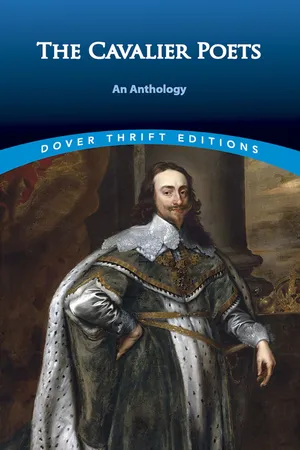
In the mid-seventeenth century, the poets associated with the court of Charles I of England, known as the Cavaliers, were strongly influenced by the classicism of Ben Jonson. Their verse, often concerned with the vagaries of love, is characteristically charming, witty, graceful, and elegant. This volume contains a rich sampling of more than 120 works by four Cavalier poets: Robert Herrick, Thomas Carew, Sir John Suckling, and Richard Lovelace.
Included are such well-known gems as Herrick's "To the Virgins to Make Much of Time," ("Gather ye rosebuds while ye may"), Carew's "A Cruel Mistress," Suckling's "Why so pale and wan, fond lover?" and many more. Gathered in this inexpensive volume, this garland of memorable verse will delight any student of English literature or lover of fine poetry.
- 96 pages
- English
- ePUB (mobile friendly)
- Available on iOS & Android
eBook - ePub
About this book
Information
ROBERT HERRICK
ROBERT DERRICK (1591–1674) was the eldest and perhaps the most pious of the “Sons of Ben.” Among other things, he is the master of the blithe lyric, bringing equal skill and joie de vivre to amorous songs, satiric couplets, pagan drinking rounds and devotional poetry (Herrick was ordained an Episcopal minister on April 24, 1623). His witty, breezy style has often been likened to that of the Roman poet Catullus. Compared to such contemporaries as John Donne and George Herbert, Herrick seems light and tripping, going out of his way to demonstrate no very complex philosophical thought or religious passion (though his devotional verses are suitably austere), and never writing a love poem that speaks profoundly or intimately of the beloved. An elegy for his father (“To the Reverend Shade of His Religious Father,” page 5) is overshadowed in both length and intensity of feeling by the sack poems (“His Farewell to Sack,” page 7; and “The Welcome to Sack,” page 11). And both seem bested by the gusts of lusty good humor in his brief, beautiful amorous poems. This is not to say, however, that Herrick was incapable of writing with feeling. There is an accumulated emotional weight in the many Julia poems that at times is resolved in lines of great tenderness. The devotional poem “A Thanksgiving to God, for His House” has the poet, who never claims saintliness, renouncing wealth and fame (somewhat hesitatingly) for the life of a country parson. With a proudly restrained melancholy and a somewhat mournful pace, but also with tenderness, the poet describes the parts of his house and vicarage farm, the animals, the garden vegetables and the other rural things that constitute his wages.
Herrick is also the standard-bearer of the life-style of the court in the last years of Charles I. His somewhat overblown panegyrics of the well-meaning but fatally incompetent king, and his praises of Charles’s military successes (which were comparatively few), now strike us as poignant.
In the period between Jonson and Dryden, Herrick is among the most important English lyric poets. By obstinately writing his brisk lyrics even during the bloody and finally cataclysmic civil war, Herrick preserved the intricacy, wit and wordplay of English Renaissance poetry. As well, he fostered a healthy atmosphere for good verse during this period, setting the example for many poets, not least the three following him in the present anthology.
On his ordination, Herrick was given the priory of Dean in Devonshire in the west of England. Here he lived, wrote and performed his holy offices busily and for the most part happily, never completely ceasing, however, to long for the citified pleasures of his native London. In 1647 he was expelled from the priory by the provisional government of the Protectorate for his outspoken support of Charles. With the ascendancy of Charles II in 1660 he was returned to the sleepy vicarage in Devon, where he died and was buried in 1674.
Note: in the following text, numbered footnotes are those of the present editor; starred and daggered footnotes are Herrick’s own.
The Argument of His Book1
I sing of brooks, of blossoms, birds, and bowers:
Of April, May, of June, and July-flowers.
I sing of may-poles, hock-carts, wassails, wakes,
Of bride-grooms, brides, and of their bridal-cakes.
I write of youth, of love, and have access
By these, to sing of cleanly-wantonness.
I sing of dews, of rains, and piece by piece
Of balm, of oil, of spice, and amber-greece.2
I sing of times trans-shifting; and I write
How roses first came red, and lillies white.
I write of groves, of twilights, and I sing
The Court of Mab, and of the Fairy-King.
I write of Hell; I sing (and ever shall)
Of Heaven, and hope to have it after all.
Of April, May, of June, and July-flowers.
I sing of may-poles, hock-carts, wassails, wakes,
Of bride-grooms, brides, and of their bridal-cakes.
I write of youth, of love, and have access
By these, to sing of cleanly-wantonness.
I sing of dews, of rains, and piece by piece
Of balm, of oil, of spice, and amber-greece.2
I sing of times trans-shifting; and I write
How roses first came red, and lillies white.
I write of groves, of twilights, and I sing
The Court of Mab, and of the Fairy-King.
I write of Hell; I sing (and ever shall)
Of Heaven, and hope to have it after all.
When He Would Have His Verses Read
In sober mornings, do not thou rehearse
The holy incantation of a verse;
But when that men have both well drunk, and fed,
Let my enchantments then be sung, or read.
When laurel spirts i’ th’ fire, and when the hearth
Smiles to itself, and gilds the roof with mirth;
When up the Thyrse3 is rais’d, and when the sound
Of sacred Orgies4 flies, a round, a round.
When the rose reigns and locks with ointments shine,
Let rigid Cato read these lines of mine.5
The holy incantation of a verse;
But when that men have both well drunk, and fed,
Let my enchantments then be sung, or read.
When laurel spirts i’ th’ fire, and when the hearth
Smiles to itself, and gilds the roof with mirth;
When up the Thyrse3 is rais’d, and when the sound
Of sacred Orgies4 flies, a round, a round.
When the rose reigns and locks with ointments shine,
Let rigid Cato read these lines of mine.5
Upon the Loss of His Mistresses
I have lost, and lately, these
Many dainty mistresses:
Stately Julia, prime of all;
Sappho next, a principal;
Smooth Anthea, for a skin
White, and heaven-like crystalline;
Sweet Electra, and the choice
Myrrha, for the lute and voice;
Next, Corinna, for her wit,
And the graceful use of it,
With Perilla. All are gone;
Only Herrick’s left alone,
For to number sorrow by
Their departures hence, and die.
Many dainty mistresses:
Stately Julia, prime of all;
Sappho next, a principal;
Smooth Anthea, for a skin
White, and heaven-like crystalline;
Sweet Electra, and the choice
Myrrha, for the lute and voice;
Next, Corinna, for her wit,
And the graceful use of it,
With Perilla. All are gone;
Only Herrick’s left alone,
For to number sorrow by
Their departures hence, and die.
The Vine
I dream’d this mortal part of mine
Was metamorphos’d to a vine;
Which crawling one and every way,
Enthrall’d my dainty Lucia.
Me thought, her long small legs & thighs
I with my tendrils did surprise;
Her belly, buttocks, and her waist,
By my soft nerv’lets were embrac’d:6
Was metamorphos’d to a vine;
Which crawling one and every way,
Enthrall’d my dainty Lucia.
Me thought, her long small legs & thighs
I with my tendrils did surprise;
Her belly, buttocks, and her waist,
By my soft nerv’lets were embrac’d:6

So that my Lucia seem’d to me
Young Bacchus ravish’d by his tree.
My curls about her neck did crawl,
And arms and hands they did enthrall:
So that she could not freely stir,
(All parts there made one prisoner).
But when I crept with leaves to hide
Those parts, which maids keep unespied,
Such fleeting pleasures there I took,
That with the fancy I awook;
And found (Ah me!) this flesh of mine
More like a stock, than like a vine.
Young Bacchus ravish’d by his tree.
My curls about her neck did crawl,
And arms and hands they did enthrall:
So that she could not freely stir,
(All parts there made one prisoner).
But when I crept with leaves to hide
Those parts, which maids keep unespied,
Such fleeting pleasures there I took,
That with the fancy I awook;
And found (Ah me!) this flesh of mine
More like a stock, than like a vine.
His Request to Julia
Julia, if I chance to die
Ere I print my poetry;
I most humbly thee desire
To commit it to the fire:
Better ’twere my ...
Ere I print my poetry;
I most humbly thee desire
To commit it to the fire:
Better ’twere my ...
Table of contents
- Dover Thrift Editions Fiction
- Title Page
- DOVER THRIFT EDITIONS
- Table of Contents
- Copyright Page
- Note
- ROBERT HERRICK
- THOMAS CAREW
- SIR JOHN SUCKLING
- RICHARD LOVELACE
- Index of First Lines
Trusted by 375,005 students
Access to over 1.5 million titles for a fair monthly price.
Study more efficiently using our study tools.
Frequently asked questions
Yes, you can cancel anytime from the Subscription tab in your account settings on the Perlego website. Your subscription will stay active until the end of your current billing period. Learn how to cancel your subscription
No, books cannot be downloaded as external files, such as PDFs, for use outside of Perlego. However, you can download books within the Perlego app for offline reading on mobile or tablet. Learn how to download books offline
Perlego offers two plans: Essential and Complete
- Essential is ideal for learners and professionals who enjoy exploring a wide range of subjects. Access the Essential Library with 800,000+ trusted titles and best-sellers across business, personal growth, and the humanities. Includes unlimited reading time and Standard Read Aloud voice.
- Complete: Perfect for advanced learners and researchers needing full, unrestricted access. Unlock 1.5M+ books across hundreds of subjects, including academic and specialized titles. The Complete Plan also includes advanced features like Premium Read Aloud and Research Assistant.
We are an online textbook subscription service, where you can get access to an entire online library for less than the price of a single book per month. With over 1.5 million books across 990+ topics, we’ve got you covered! Learn about our mission
Look out for the read-aloud symbol on your next book to see if you can listen to it. The read-aloud tool reads text aloud for you, highlighting the text as it is being read. You can pause it, speed it up and slow it down. Learn more about Read Aloud
Yes! You can use the Perlego app on both iOS and Android devices to read anytime, anywhere — even offline. Perfect for commutes or when you’re on the go.
Please note we cannot support devices running on iOS 13 and Android 7 or earlier. Learn more about using the app
Please note we cannot support devices running on iOS 13 and Android 7 or earlier. Learn more about using the app
Yes, you can access The Cavalier Poets by Thomas Crofts in PDF and/or ePUB format, as well as other popular books in Literature & European Poetry. We have over 1.5 million books available in our catalogue for you to explore.