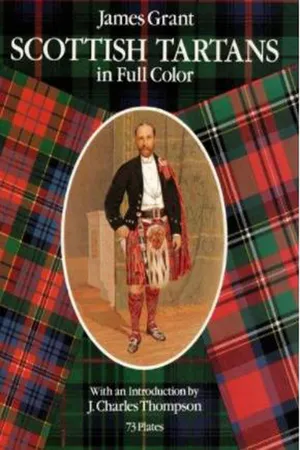
The tartans of 72 Highland clans are presented in full-page, full-color, large-format illustrations. With a new introduction to tartans by J. Charles Thompson, Fellow of the Scottish Tartan Society and a noted authority in the field. A must for costume, textile and fashion designers and historians, and an eye-filling pleasure for all.
- 80 pages
- English
- ePUB (mobile friendly)
- Available on iOS & Android
eBook - ePub
Scottish Tartans in Full Color
About this book
Information
INTRODUCTION
GRANT’S “TARTAN” BOOK OF 1886
IN 1886 W & A. K. Johnston of Edinburgh published The Tartans of the Clans of Scotland by James Grant, ‘author of “The Romance of War,” “Old and New Edinburgh,” etc.’ In spite of its title this book was not really about tartans Rather it dealt with the clans and their histories, with illustrations of a good many tartans. These were the first printed illustrations of tartans ever published; the earlier books had used illustrations colored by hand or drawn with a complicated contraption of parallel ruling pens. Grant says in his preface that those books “are now rarely to be met with . . . and at greatly enhanced prices.” The same is now true, of course, of Grant.
Apparently Johnston’s had developed the illustrations and went to a currently popular writer for the text. Grant must have had quite a reputation in his time, but one can just imagine how his title “The Romance of War” would go over today!
There have been many such “tartan” books since, and their titles can be confusingly similar Grant’s was called The Tartans of the Clans of Scotland, and a recent one was called The Tartans of the Scottish Clans. To keep such similar titles straight, they are usually referred to by author, with dates of those out of print. So the present book is usually called “Grant, 1886.”
THE TEXT
Besides the seventy-three illustrations, Grant’s book has three introductory chapters and, with the tartan of each clan, a clan history A few of the tartans are not related to clans. The Rob Roy tartan and the Prince Charles Edward Stewart are accompanied by romanticized accounts of the respective gentlemen. Grant notes that the Prince Charles Edward tartan, which is first reported in his text, “is nowise different from the Stewart (or Stuart), excepting that the broad red stripe in the latter is very much contracted.”
The Hunting Stewart tartan is also first reported in Grant with the following comment, quoted here in its entirety:
Although we have failed to trace the history of this tartan, or fix the date of its introduction, as it has long been a favourite with the people of Scotland, we thought it right to preserve in this work a record of one of the most beautiful tartans associated with the Royal Stewarts.
All of this material shows a typical Victorian inclination to cite previous authors with little or no attempt to evaluate their statements Thus the text of Grant’s work would be of minimal value as a reprint.
There is no need for an exhaustive review of the introductory chapters or of the historical notes on each clan, but briefly: Chapter I, “Celtic Scotland,” divides Highland Scotland at the time of Agricola’s invasion (A.D. 81) into “twenty-one aboriginal tribes,” from “I. The Ottadini” to “XXI. The Epidii,” with detailed notes on the “topographical position” of each This information is attributed to “Dr James Browne, whose authorities were the Maps of Ptolemy, and Richard of Cirencester, a monk of the 14th century”
Ptolemy’s maps were reasonably contemporary with Agricola’s invasion, but he included only a general depiction of North Britain. So all these details must be attributed to a monk, writing more than a thousand years after the event. Yet Grant gives this detailed geography without comment—at third hand. Modern analysis cannot afford to be so uncritical
Chapter II is titled “Clanship and Chiefs—Dress and Arms.” Barely a page of this—a large page, however, in fine print—is on dress and arms, and only four short paragraphs deal with tartan The whole chapter continues the tendency toward uncritical citation of previous writers, including the remarkable conclusion that the kilt antedates “the great belted plaid of the 16th and 17th centuries.” The chronology that is now generally accepted makes the kilt a development from the plaid with the pleats sewn in, so that the top half of the plaid above the belt became a detachable garment.
As for Chapter III, “Some Characteristics of the Highlanders,” it perpetuates the romantic view of the “genuine sportsman,” loving his “vast stores of legendary poetry” and the bagpipe, that “most ancient musical instrument.” His “fidelity to his chief,” as a “skilled swordsman” who spoke the “Gaelic . . . language in which there is no word to express slavery,” is also noted. The “legendary poetr...
Table of contents
- Title Page
- Copyright Page
- Table of Contents
- INTRODUCTION
- DOVER PICTORIAL ARCHIVE SERIES
Trusted by 375,005 students
Access to over 1.5 million titles for a fair monthly price.
Study more efficiently using our study tools.
Frequently asked questions
Yes, you can cancel anytime from the Subscription tab in your account settings on the Perlego website. Your subscription will stay active until the end of your current billing period. Learn how to cancel your subscription
No, books cannot be downloaded as external files, such as PDFs, for use outside of Perlego. However, you can download books within the Perlego app for offline reading on mobile or tablet. Learn how to download books offline
Perlego offers two plans: Essential and Complete
- Essential is ideal for learners and professionals who enjoy exploring a wide range of subjects. Access the Essential Library with 800,000+ trusted titles and best-sellers across business, personal growth, and the humanities. Includes unlimited reading time and Standard Read Aloud voice.
- Complete: Perfect for advanced learners and researchers needing full, unrestricted access. Unlock 1.5M+ books across hundreds of subjects, including academic and specialized titles. The Complete Plan also includes advanced features like Premium Read Aloud and Research Assistant.
We are an online textbook subscription service, where you can get access to an entire online library for less than the price of a single book per month. With over 1.5 million books across 990+ topics, we’ve got you covered! Learn about our mission
Look out for the read-aloud symbol on your next book to see if you can listen to it. The read-aloud tool reads text aloud for you, highlighting the text as it is being read. You can pause it, speed it up and slow it down. Learn more about Read Aloud
Yes! You can use the Perlego app on both iOS and Android devices to read anytime, anywhere — even offline. Perfect for commutes or when you’re on the go.
Please note we cannot support devices running on iOS 13 and Android 7 or earlier. Learn more about using the app
Please note we cannot support devices running on iOS 13 and Android 7 or earlier. Learn more about using the app
Yes, you can access Scottish Tartans in Full Color by James Grant in PDF and/or ePUB format, as well as other popular books in History & Fashion Design. We have over 1.5 million books available in our catalogue for you to explore.