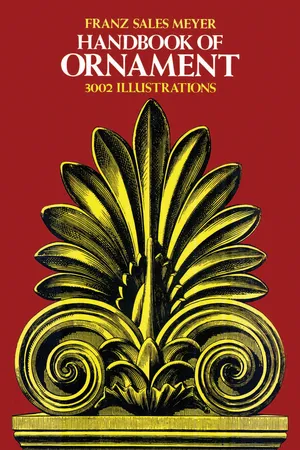
Republished unabridged from the final comprehensive edition, this work contains the largest single-volume collection of classical art motifs ever compiled. It reproduces material from Greek and Roman, medieval European, Islamic, Renaissance, baroque, and early nineteenth-century art, architecture, and design — in all, presenting artists, crafters, and students with more than 3,000 designs.
Featured design elements include networks, Gothic tracery, geometric designs, akanthos leaves, lotus ornamentation, animal ornamentation, grotesque figures, fret bands, chains, interlacements, rosettes, undulations, spirals, link borders, cresting borders, finials, crockets, gargoyles, foliations, panels, repeated ornaments, and hundreds of other elements. Other plates show decorated pottery vases, religious utensils, weapons, furniture, lamps, jewelry, and other artifacts, in addition to heraldic motifs and ornamental letters.
- 576 pages
- English
- ePUB (mobile friendly)
- Available on iOS & Android
eBook - ePub
Handbook of Ornament
About this book
Information
Topic
DesignSubtopic
Decorative ArtsDIVISION III.
DECORATED OBJECTS.
A. Vases, &c.
B. Metal Objects.
C. Furniture.
D. Frames, &c.
E. Jewelry.
F. Heraldry.
G. Writing, Printing, &c.
B. Metal Objects.
C. Furniture.
D. Frames, &c.
E. Jewelry.
F. Heraldry.
G. Writing, Printing, &c.
PREFATORY REMARKS.
The third division of the Handbook is entitled “Decorated Objects”. It is intended, firstly, to show in what manner and on what principles Decoration is applied to objects, (thus complementing the work of the second division); and secondly, it will pass a little beyond the strict limits of Aisthetics, and enter on the sphere of Tectonics, in order to present a view of the construction, profiling and general plan of objects of art, e. g. Vases, Utensils, Furniture, &c.
These considerations, and the wish to be as comprehensive as possible, have necessitated the inclusion of some objects which are not decorated. This inclusion will increase the bulk of the Book; but the selection of objects will be restricted, as much as possible, to those which illustrate the Principles of Decoration.
A.
VASES.
Vases, with which this division opens, are one of the most interesting and important of its groups. Gottfried Semper, who has treated Keramics brilliantly in his epoch-making work “Der Stil”, says in the introduction to the chapter on this subject: “The products of Keramic art were held in unusually high esteem by all peoples and in all periods. They had attained a religious symbolical significance long before the times of monumental edifices, which latter, indeed, were greatly influenced by the former; directly, in that Keramic works served for the construction and ornamentation of the monuments; indirectly, because architecture took up principles of beauty and style and even finished forms which had already been developed in Keramic work, and had first been fixed by the art potters of pre-architectural times”.... “They are the oldest and most eloquent documents of history. Show us the pottery which a nation has produced, and we can in general tell what manner of nation it was and what height of culture it had attained!” Professor Gmelin, who, in his essay: “Die Urformen und Gestaltungsprinzipien der Töpferei” and in his work: “Die Elemente der Gefässbildnerei”, has attempted with much success to popularise Semper’s theories, says: “A bit of Darwinism is here unfolded in the sphere of industry: the way in which the development of man has been influenced by climate, the character of the soil, food, &c., finds its parallel in Keramics in the formation of vessels as conditioned by the joint causes of aim, material, and technique”.
How far Pottery goes back to prehistoric times, is proved by the calculations made from the alluvial deposits of the Nile valley, and the geological conditions on the coasts of Scandinavia, which give us the respectable age of 10 000 to 12 000 years for the pottery discovered in those spots. The circumstance that, besides satisfying the needs of daily life, Pottery was used in religious and funeral rites, more especially the custom of placing vessels in the grave of the departed, of enclosing the ashes of the dead in urns before committing them to the earth, has at any rate preserved to us certain kinds of pottery, of which, otherwise, only sherds and fragments had remained.
By Keramics we understand not only earthen-ware, but the design and making of vessels in general. Next to the various clays, glass, and metals, which have the first claim on our attention, stone, wood, and ivory, along with other less common materials, are the substances generally used. Each of these Materials imparts its own character to the vessels made of it; the corresponding technique will limit or modify the Form. A metal vessel requires form and decoration different from one of glass or porcelain; the profile of a clay vase cannot be made in marble without much modification. On the other hand the Purpose, for which the vessel is intended, will influence the choice of the Material; so that a reciprocal interaction arises, which stimulates to the study of Keramics, and makes it charming and instructive.
That the majority of the examples in this group of pottery have been taken from the Antique, is due to the fact that this epoch offers a general picture complete in itself; and that it is chiefly in the Greek style that the above-mentioned reciprocal interaction, regularity of form, and tectonic principle are, on the average, most clearly expressed. That, on the other hand, we have brought the constructions of other countries and periods into suitable connexion with the Antique, arises from our wish to meet the wants and requirements of our time in a greater degree than can be done by monographs of Greek Keramics alone, such as we possess in a large number of special wocks5.
In view, of the immense importance of Antique Keramics and of Clay as a material in general: it may be well to offer here a few general remarks on this subject, reserving our observations on other materials and styles till the elucidation of the plates in question. Pottery is generally made on the potter’s wheel. In Egypt, India, and Mesopotamia, the use of this important implement of civilisation goes back to the very earliest times. The mural paintings of Beni Hassan, which have been referred to the 19th century B. C., show that pottery was then already known; while Germany did not use pottery before the Roman period; and America, previous to the arrival of Europeans, was only acquainted with the formation of pots by hand, in spite of the great achievements of the Peruvians. The formation of pottery by hand, is still in use in many countries. To this class belongs the building-up with zonal or spiral strips, and the moulding over plaited moulds or gourds which are then destroyed in the firing. Wooden and stone moulds were used in early times; and also in modern times in connection with the wheel. At the outset, people contented themselves with drying the clay; afterwards drying was followed by firing. An intermediate stage is to fire beneath a covering of cow-dung, the air being excluded; when the smoke penetrates into the clay, and colours it gray or black. Originally only smoothed and polished, the vessels were afterwards rendered more impervious to liquids by being painted with a Varnish, such as is seen on Greek vases; and by the discovery of the tin and lead Glazes, such as are found on the so-called “majolica ware”. The porosity, of many oriental vessels, is intentional, in order that the contents may be kept cool by the process of evaporation on the surface of the vessel. Of the chemical composition of these ancient Varnishes, we are not so well informed as we could wish.
Antique pottery is found in all places where ancient civilisation penetrated; but the principal sources are: Greece, Sicily, and Italy, particularly Campania and Etruria. To this latter circumstance is ascribed the erroneous use of the name “Etruscan”, in the last century, as a collective name for antique pottery in general. Athens, Corinth, and Chalcis, were the chief factories of pottery in Greece; and Tarentum and Cumae in Italy, where pottery established itself after the decay of Greek art. Apart from prehistoric products, it can be proved that Greek vase-painting begins historically in the 7th century B. C.; attained its golden age about 400 B. C.; and decayed with the invasion by the Romans about 200 B. C. According to peculiarities of form and finish, we distinguish different periods, the leading characteristics of which are as follows:—
- The geometrical style: clay natural colour, yellowish-grey, rough; decoration brown, in bands, rings, zigzag lines, checks and other simple patterns, borrowed from the technique of weaving and wood carving, sometimes in connection with representations of domestic animals, teams, &c., in rhythmic sequence, (compare Plate 194. 2 and 3).
- The Asiatic style: clay natural color, yellowish, impregnated and smoothed; decoration dark brown, dark red, and white, with fantastic winged creatures, lions, panthers, geese, sphinxes, mostly arranged in zones. The intervening spaces, between the animals, are filled with rosettes, flowers, &c. The Zonal decoration is often replaced by Scales, (compare Plate 194. 4).
- The Black Figure style: clay reddish-yellow, coloured with oxide of iron; decoration black, pure white being used for the carnations of female figures, horses, &c. The conception of the figures is frequently archaic, drawn in uncoloured compartments bordered by ornamental bands. The lines of drapery, &c. are scratched through the black colour, to the clay.
- The Red Figure style: clay red, very smooth: the entire vessel, with the exception of the ornaments and figures, coated black; the black sometimes having a greenish shimmer. White only occasionally found, for grey hair and the like. The tendency to simplification is predominant in respect of both ornament and figures; usually with only one figure or with simple groups of figures; outlines are painted-in with the pencil.
- The Painted style: clay as in No. 4; the vessels frequently of colossal size (they are then not intended for practical use, as may be inferred from their having no bottom); the numerous red figures on the black ground are placed one over the other, with the addition of architectural de...
Table of contents
- Title Page
- Copyright Page
- AUTHOR’S PREFACE.
- PREFACE TO THE FOURTH EDITION.
- INTRODUCTION.
- Table of Contents
- DIVISION I. - THE ELEMENTS OF DECORATION.
- DIVISION II. - ORNAMENT APPLIED TO FEATURES.
- DIVISION III. - DECORATED OBJECTS.
- INDEX.
- A CATALOG OF SELECTED DOVER BOOKS IN ALL FIELDS OF INTEREST
Trusted by 375,005 students
Access to over 1.5 million titles for a fair monthly price.
Study more efficiently using our study tools.
Frequently asked questions
Yes, you can cancel anytime from the Subscription tab in your account settings on the Perlego website. Your subscription will stay active until the end of your current billing period. Learn how to cancel your subscription
No, books cannot be downloaded as external files, such as PDFs, for use outside of Perlego. However, you can download books within the Perlego app for offline reading on mobile or tablet. Learn how to download books offline
Perlego offers two plans: Essential and Complete
- Essential is ideal for learners and professionals who enjoy exploring a wide range of subjects. Access the Essential Library with 800,000+ trusted titles and best-sellers across business, personal growth, and the humanities. Includes unlimited reading time and Standard Read Aloud voice.
- Complete: Perfect for advanced learners and researchers needing full, unrestricted access. Unlock 1.5M+ books across hundreds of subjects, including academic and specialized titles. The Complete Plan also includes advanced features like Premium Read Aloud and Research Assistant.
We are an online textbook subscription service, where you can get access to an entire online library for less than the price of a single book per month. With over 1.5 million books across 990+ topics, we’ve got you covered! Learn about our mission
Look out for the read-aloud symbol on your next book to see if you can listen to it. The read-aloud tool reads text aloud for you, highlighting the text as it is being read. You can pause it, speed it up and slow it down. Learn more about Read Aloud
Yes! You can use the Perlego app on both iOS and Android devices to read anytime, anywhere — even offline. Perfect for commutes or when you’re on the go.
Please note we cannot support devices running on iOS 13 and Android 7 or earlier. Learn more about using the app
Please note we cannot support devices running on iOS 13 and Android 7 or earlier. Learn more about using the app
Yes, you can access Handbook of Ornament by Franz Sales Meyer in PDF and/or ePUB format, as well as other popular books in Design & Decorative Arts. We have over 1.5 million books available in our catalogue for you to explore.