![]()
THE WOODCUT IN GREAT BRITAIN
THE present volume is intended to supplement the survey I was privileged to make eight years ago in a Special STUDIO publication dealing with “ Modern Woodcuts by British and French Artists.” The advance of the wood-block in artistic favour since that time has been extraordinary in range and importance. In every country where art is alive the wood-block has been taken more and more into service for original design conditioned by the nature and expressive capacity of the material itself, a condition little regarded, if at all, by the splendidly fertile illustrators of the nineteenth century for whom the wood was merely the basis of a reproductive process. It is not my purpose, however, to trace again the causes that gradually emancipated the wood-block from its long slavery to the facsimile engravers, with their marvellously skilful yet stereotyped craftsmanship, even though the names of Dalziel, Swain and Linton gave it a sterling stamp. The story, with its lessons and inspirations from the examples of the early Italian and German engravers, of such master designers for the woodcut as Dürer and Holbein, and no less of the creative Bewick, Blake and Calvert, is an interesting one, while blazoned on its English chapters are the honoured names of Charles Ricketts, Charles Shannon, Sturge Moore, Lucien Pissarro, Reginald Savage, William Strang, William Nicholson, Sydney Lee and Gordon Craig. Phases of the story may be read in the volume above-mentioned, and of course in the authoritative pages of Ricketts, Craig and Campbell Dodgson. But for the full relation you may turn to the important and valuable book, “The Modern Woodcut: A Study of the Evolution of the Craft,” in which Mr. Herbert Furst has, with much sound erudition and independent critical analysis, linked the modern ramifications of zylography in many countries with the various phases of its use for original expression, for translation, and for reproduction, from its recorded beginnings and through the centuries. Then, thanks to the Print-Collectors Club, you may read, in a delightfully concise and illuminating lecture on “ Woodcuts and Wood-engravings,” the changes to modern conditions discussed with fresh and well-considered views by Mr. Noel Rooke, who is not only himself an accomplished engraver, but, owing to his masterly teaching, the cause of much excellent wood-engraving in others.
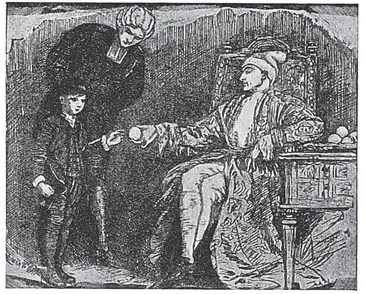
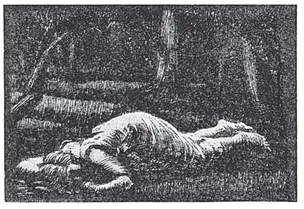
FROM THE ORIGINAL BLOCK OF THE UNPUBLISHED WOODCUT FOR THACKERAY’S “ ESMOND ”
(In the Collection of Harold Hartley, Esq.)
* Initial letter designed by Percy Smith for Lamb’s “ Child Angel.”
GREAT BRITAIN
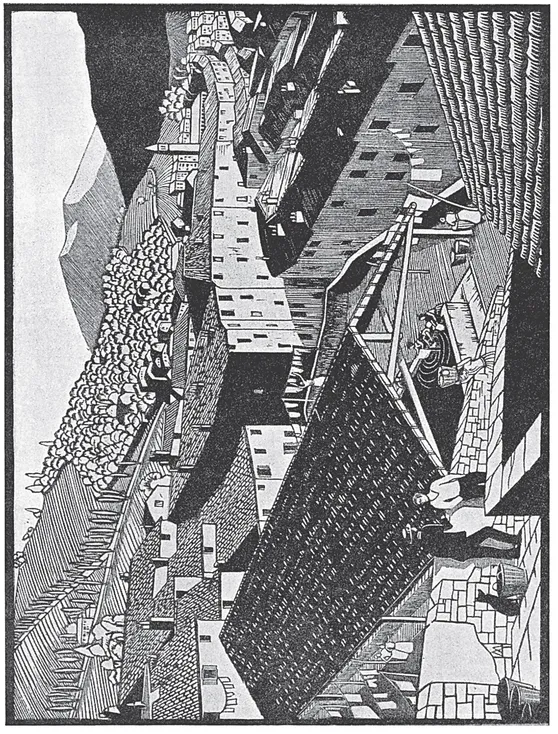
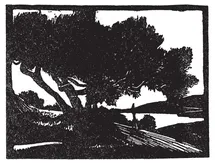
“ WASH HOUSES HYERES ”
(By courtesy of The St. George’s Gallery )
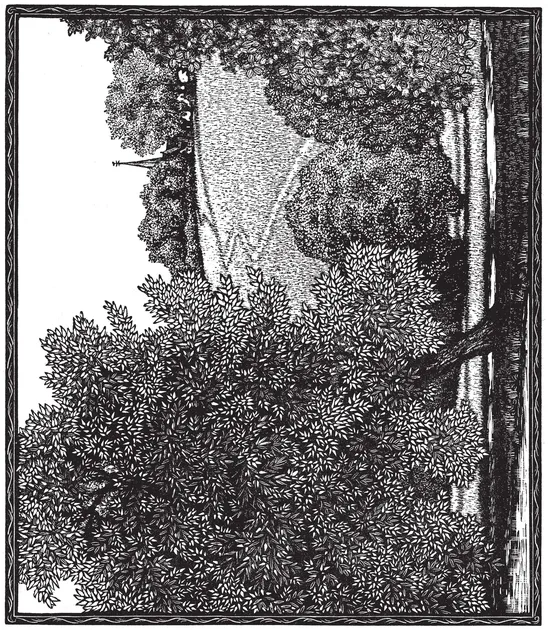
“ SAINT CATHERINE ON THE HILL ”
Before we turn our pages and look at the multifarious productions of the wood-engravers at home and abroad under contemporary conditions, it will be interesting for comparison to look at an example (p. 1) of the facsimile engraving for which the wood-block was exclusively used in that efflorescent period of book-illustration which covered at least a couple of decades of the last century, though we are accustomed to call it simply “ the ‘Sixties.” This is from an unpublished block engraved by Swain to reproduce a pen-drawing by Frederick Walker, and as it is seen here, the block shows the picture the reverse way of the impression for which it had been inked. It represents an incident in the third chapter of Thackeray’s“Esmond,” the first meeting of little Harry Esmond with Lord Castlewood. “Mr. Holt, the priest, took the child by the hand, and brought him to this nobleman, a grand languid nobleman in a great cap and flowered morning gown, sucking oranges. He patted Harry on the head and gave him an orange.” As Marks tells us in his life of the artist, Walker had undertaken to illustrate “Esmond,” but made only one drawing for it, and of this all trace had been lost until that indefatigable collector, Mr. Harold Hartley, in his untiring pursuit of the illustrations of the ‘Sixties, discovered this block. When we compare Du Maurier’s more literal rendering of the same incident with Walker’s—the noble lord is actually patting the child’s head after having given him an orange—it is easy to see why Du Maurier was preferred for the work; he had less concern with a pretty little picture, but more with the characteristics and actualities of the scene. And Swain’s cross-hatching was as busy in both, his aim being to reproduce the pen-drawing as accurately as he could with the black line of unimaginative convention, an aim which is quite opposed to the spirit of the modern woodcut, in which the wood, having regained its freedom of speech, has something of its own to suggest to the artist in the matter of the design and the print.
“ THE PRINCESS LOST ”(By courtesy of The Redfern Gallery)
(No. 1). BY GWENDOLEN RAVERAT,
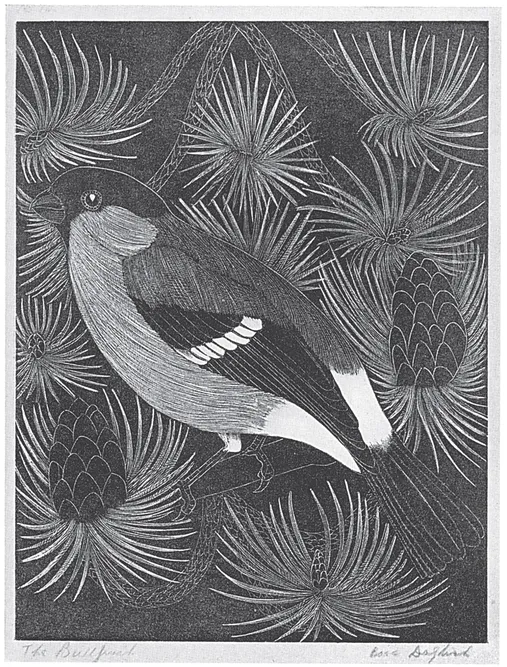
“ THE BULLFINCH ” (By courtesy of The Redfern Gallery)
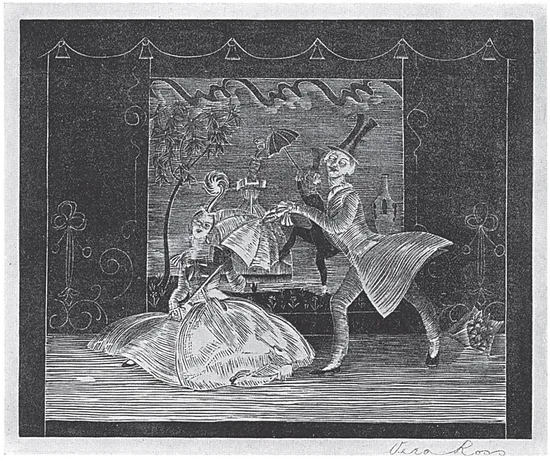
“LE RENDEZ-VOUS D’AMOUR.”
(By courtesy of The Redfern Gallery)
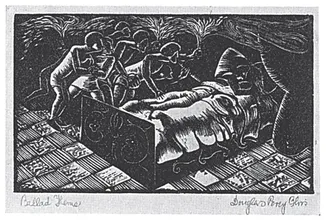
BY DOUGLAS PERCY BLISS (By courtesy of The St. George’s Gallery)
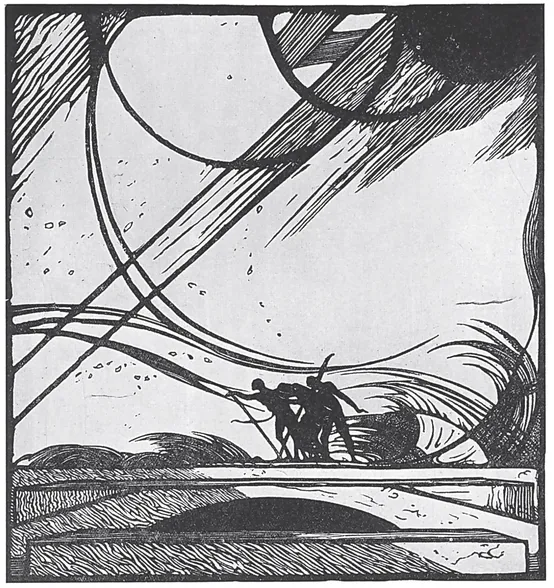
“THE STORM.” KING LEAR A DESIGN FOR SCENE II ACT III.
(By courtesy of The St. George’s Gallery)
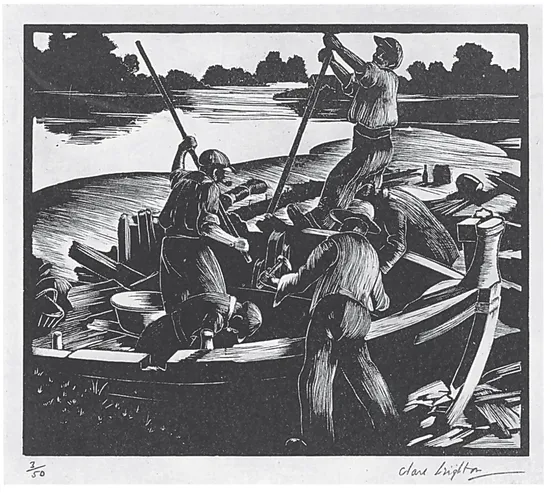
“ BREAKING UP THE OLD BARGE
(By courtesy of The St. George’s Gallery)
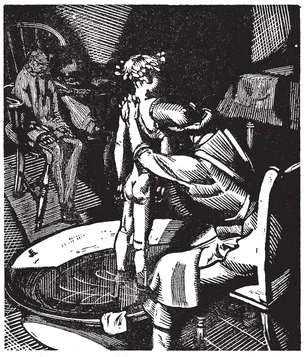
“FRIDAY NIGHT”
(By courtesy of The St. George’s Gallery)
Wood-engraving and wood-cutting are different methods of approach towards a relief or surface print, yet any image impressed on paper with ink from a w...