"For the optical engineer it is an indispensable work." — Journal, Optical Society of America
"As a practical guide this book has no rival." — Transactions, Optical Society
"A noteworthy contribution," — Nature (London)
Part I covers allordinary ray-tracing methods, together with the complete theory of primary aberrations and as much of higher aberration as is needed for the design of telescopes, low-power microscopes and simple optical systems. Chapters: Fundamental Equations, Spherical Aberration, Physical Aspect of Optical Images, Chromatic Aberration, Design of Achromatic Object-Glasses, The Optical Sine Theorem, Trigonometric Tracing of Oblique Pencils, General Theory of Perfect Optical Systems, and Ordinary Eyepieces.
Part II extends the coverage to the systematic study and design of practically all types of optical systems, with special attention to high-power microscope objectives and anastigmatic photographic objectives. Edited and completed from the author s manuscript by Rudolf Kingslake, Director of Optical Design, Eastman Kodak Company. Chapters: Additional Solutions by the Thin-Lens Method , Optical Path Differences, Optical Path Differences at an Axiallmage Point, Optical Tolerances, Chromatic Aberration as an Optical Path Difference, The Matching Principle and the Design of Microscope Objectives, Primary Aberrations of Oblique Pencils, Analytical Solutions for Simple Systems with Remote Stop, Symmetrical Photographic Objectives, and Unsymmetrical Photographic Objectives.
- 544 pages
- English
- ePUB (mobile friendly)
- Available on iOS & Android
eBook - ePub
Applied Optics and Optical Design, Part One
About this book
Information
CHAPTER I
FUNDAMENTAL EQUATIONS
SPHERICAL surfaces (including the plane as part of a spherical surface of infinite radius) are the only ones which can be produced by the optical grinding and polishing process with a sufficient approach to the necessary accuracy. Very slight departures from the spherical form, amounting at most to a few wave-lengths in depth, can indeed be secured by the process of ‘figuring’ ; such small amounts can be taken care of in our computations by allowing for the slight departure from strictly spherical form by approximate corrections. We therefore limit ourselves in our general formulae to exact spherical surfaces.
A spherical surface is the simplest of all possible, curved surfaces, for it is perfectly defined by its radius and by the location of its centre. A radius drawn from the centre through any point of a spherical surface stands at right angles to the tangent-plane in that point and is therefore the normal of the surface. As by the laws of reflection and refraction both the reflected and the refracted ray lie in the plane defined by the incident ray and the normal at the point of incidence (‘incidence-normal’) we can at once conclude that the plane of reflection and refraction in the case of spherical surfaces always contains the centre of the sphere and can thus be determined with the greatest ease.
In all ordinary optical instruments we have another vast simplification by reason of the centring of all the surfaces. It is intended, and usually achieved with sufficient accuracy, that the centres of curvature of all the component spherical surfaces shall lie on one and the same straight line, the optical axis of the instrument. That evidently means that any ray which originally cut the optical axis and therefore entered the system in a plane containing the optical axis will permanently remain in the same plane, and can therefore be traced right through the whole system by plane geometry or trigonometry. As this saves us the decidedly considerable trouble of determining a new incidence plane separately for each successive surface it will be one of the chief aims of our theoretical discussions to develop computing methods which avoid as far as possible the complication of tracing ‘skew-rays’.
LAWS OF REFLECTION AND REFRACTION
By the law of reflection the reflected ray lies in the plane defined by the incident ray and the incidence-normal and forms the same angle with the latter as the incident ray ; but as the two rays lie on opposite sides of the normal, the angles have the opposite clock-sense and we express this by giving them the opposite sign : we therefore state the law of reflection as
(I)

By the law of refraction the refracted ray also lies in the plane defined by the incident ray and the normal of the refracting surface, but on the other side of both the surface and the normal : hence the angle of refraction has the same clock-sense or sign as the angle of incidence, and if N is the refractive index of the medium containing the incident ray, N′ that of the medium containing the refracted ray, the law of refraction states that
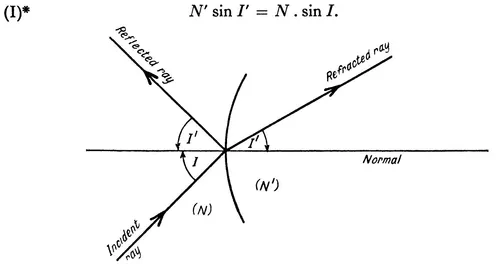
FIG. 1.
Small corresponding changes of I and I′ are frequently of interest, and are found with sufficient accuracy by differentiating (I)* with the result or

and this equation will be included under (I)*.
When angles become very small their sines become equal to the angles themselves expressed in radians, hence the law of refraction for ‘paraxial’ rays which enter a refracting surface at very small angles with the incidence-normal becomes, using small letters for ‘paraxial’ angles,
(I)*p

Comparing the two fundamental laws, we at once see that we may treat the law of reflection mathematically as a particular case of the law of refraction, resulting from putting N = – N′, for this gives
N′ sin I′= – N′ sin I, or sin I′= – sin I,
which with the necessarily acute angles can only be if I′ = – I. This is a very important deduction because it enables us to apply practically all our refraction-formulae to problems of reflection by simply putting N′= – N or N′/N = – 1.
THE FUNDAMENTAL FORMULAE AND SIGN-CONVENTIONS
It has been shown above that any problem of refraction at a spherical surface can be reduced to one of plane trigonometry by first finding the plane containing the ray to be traced and the centre of curvature.
In the diagram, Fig. 2, let the paper represent this incidence-plane, OP the ray to be traced through the refracting surface, and let the latter cut the incidence-plane in the circle AP with C as centre. Let ACB be a straight line pa...
Table of contents
- Title Page
- Copyright Page
- PREFACE
- Table of Contents
- INTRODUCTION
- CHAPTER I - FUNDAMENTAL EQUATIONS
- CHAPTER II - SPHERICAL ABERRATION
- CHAPTER III - PHYSICAL ASPECT OF OPTICAL IMAGES
- CHAPTER IV - CHROMATIC ABERRATION
- CHAPTER V - DESIGN OF ACHROMATIC OBJECT-GLASSES
- CHAPTER VI - EXTRA-AXIAL IMAGE-POINTS
- CHAPTER VII - THE OPTICAL SINE THEOREM
- CHAPTER VIII - TRIGONOMETRICAL TRACING OF OBLIQUE PENCILS
- CHAPTER IX - GENERAL THEORY OF PERFECT OPTICAL SYSTEMS
- CHAPTER X - ORDINARY EYEPIECES
- APPENDIX
- INDEX
Trusted by 375,005 students
Access to over 1.5 million titles for a fair monthly price.
Study more efficiently using our study tools.
Frequently asked questions
Yes, you can cancel anytime from the Subscription tab in your account settings on the Perlego website. Your subscription will stay active until the end of your current billing period. Learn how to cancel your subscription
No, books cannot be downloaded as external files, such as PDFs, for use outside of Perlego. However, you can download books within the Perlego app for offline reading on mobile or tablet. Learn how to download books offline
Perlego offers two plans: Essential and Complete
- Essential is ideal for learners and professionals who enjoy exploring a wide range of subjects. Access the Essential Library with 800,000+ trusted titles and best-sellers across business, personal growth, and the humanities. Includes unlimited reading time and Standard Read Aloud voice.
- Complete: Perfect for advanced learners and researchers needing full, unrestricted access. Unlock 1.5M+ books across hundreds of subjects, including academic and specialized titles. The Complete Plan also includes advanced features like Premium Read Aloud and Research Assistant.
We are an online textbook subscription service, where you can get access to an entire online library for less than the price of a single book per month. With over 1.5 million books across 990+ topics, we’ve got you covered! Learn about our mission
Look out for the read-aloud symbol on your next book to see if you can listen to it. The read-aloud tool reads text aloud for you, highlighting the text as it is being read. You can pause it, speed it up and slow it down. Learn more about Read Aloud
Yes! You can use the Perlego app on both iOS and Android devices to read anytime, anywhere — even offline. Perfect for commutes or when you’re on the go.
Please note we cannot support devices running on iOS 13 and Android 7 or earlier. Learn more about using the app
Please note we cannot support devices running on iOS 13 and Android 7 or earlier. Learn more about using the app
Yes, you can access Applied Optics and Optical Design, Part One by A. E. Conrady in PDF and/or ePUB format, as well as other popular books in Physical Sciences & Physics. We have over 1.5 million books available in our catalogue for you to explore.