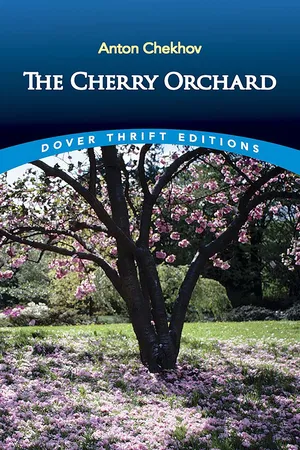
The Cherry Orchard was first produced by the Moscow Art Theatre on Chekhov's last birthday, January 17, 1904. Since that time it has become one of the most critically admired and performed plays in the Western world, a high comedy whose principal theme, the passing of the old semifeudal order, is symbolized in the sale of the cherry orchard owned by Madame Ranevsky.
The play also functions as a magnificent showcase for Chekhov's acute observations of his characters' foibles and for quizzical ruminations on the approaching dissolution of the world of the Russian aristocracy and life as it was lived on their great country estates. While the subject and the characters of the work are, in a sense, timeless, the dramatic technique of the play was a Chekhovian innovation. In this and other plays he developed the concept of "indirect action," in which the dramatic action takes place off stage and the significance of the play revolves around the reactions of the characters to those unseen events.
Reprinted from a standard edition, this inexpensive well-made volume invites any lover of theater or great literature to enter the world of Madame Ranevsky, Anya, Gayef, Lopakhin, Firs, and the other memorable characters whose hopes, fears, loves, and general humanity are so brilliantly depicted in this landmark of world drama.
- 64 pages
- English
- ePUB (mobile friendly)
- Available on iOS & Android
eBook - ePub
The Cherry Orchard
About this book
Information
Act I
A room which is still called the nursery. One door leads to ANYA’S room. Dawn, the sun will soon rise. It is already May, the cherry trees are in blossom, but it is cold in the garden and there is a morning frost. The windows are closed.
Enter DUNYASHA with a candle, and LOPAKHIN with a book in his hand.
LOPAKHIN. Here’s the train, thank heaven. What is the time?
DUNYASHA. Near two. [Putting the candle out.] It is light already.
LOPAKHIN. How late is the train? Two hours at least. [Yawning and stretching.] A fine mess I have made of it. I came to meet them at the station and then I went and fell asleep, as I sat in my chair. What trouble! Why did you not rouse me?
DUNYASHA. I thought that you had gone. [She listens.] I think they are coming.
LOPAKHIN [listening]. No; they have got to get the baggage and the rest. [A pause.] Madame Ranévsky has been five years abroad. I wonder what she is like now. What a fine character she is! So easy and simple. I remember when I was only fifteen my old father (he used to keep a shop here in the village then) struck me in the face with his fist and my nose bled. We were out in the courtyard, and he had been drinking. Madame Ranévsky, I remember it like yesterday, still a slender young girl, brought me to the wash-hand stand, here, in this very room, in the nursery. ‘Don’t cry, little peasant,’ she said, ‘it’ll be all right for your wedding.’ [A pause.] ‘Little peasant!’ ... My father, it is true, was a peasant, and here am I in a white waistcoat and brown boots; a silk purse out of a sow’s ear; just turned rich, with plenty of money, but still a peasant of the peasants. [Turning over the pages of the book.] Here’s this book that I was reading without any attention and fell asleep.
DUNYASHA. The dogs never slept all night, they knew that their master and mistress were coming.
LOPAKHIN. What’s the matter with you, Dunyásha? You’re all ... DUNYASHA. My hands are trembling, I feel quite faint.
LOPAKHIN. You are too refined, Dunyásha, that’s what it is. You dress yourself like a young lady, and look at your hair! You ought not to do it; you ought to remember your place.
[Enter EPHIKHODOF with a nosegay. He is dressed in a short jacket and brightly polished boots which squeak noisily. As he comes in he drops the nosegay.]
EPHIKHODOF [picking it up]. The gardener has sent this; he says it is to go in the dining-room. [Handing it to DUNYASHA.]
LOPAKHIN. And bring me some quass.
DUNYASHA. Yes, sir.
[Exit DUNYASHA.]
EPHIKHODOF There’s a frost this morning, three degrees, and the cherry trees all in blossom. I can’t say I think much of our climate; [sighing] that is impossible. Our climate is not adapted to contribute; and I should like to add, with your permission, that only two days ago I bought myself a new pair of boots, and I venture to assure you they do squeak beyond all bearing. What am I to grease them with?
LOPAKHIN. Get out; I’m tired of you.
EPHIKHODOF. Every day some misfortune happens to me; but do I grumble? No; I am used to it; I can afford to smile. [Enter DUNYASHA, and hands a glass of quass to LOPAKHIN.] I must be going. [He knocks against a chair, which falls to the ground.] There you are! [In a voice of triumph.] You see, if I may venture on the expression, the sort of incidents inter alia. It really is astonishing!
[Exit EPHIKHODOF.]
DUNYASHA. To tell you the truth, Yermolái Alexéyitch, Ephikhódof has made me a proposal.
LOPAKHIN. Hmph!
DUNYASHA. I hardly know what to do. He is such a well-behaved young man, only so often when he talks one doesn’t know what he means. It is all so nice and full of good feeling, but you can’t make out what it means. I fancy I am rather fond of him. He adores me passionately. He is a most unfortunate man; every day something seems to happen to him. They call him ‘Twenty-two misfortunes,’ that’s his nickname.
LOPAKHIN [listening]. There, surely that is them coming!
DUNYASHA. They’re coming! Oh, what is the matter with me? I am all turning cold.
LOPAKHIN. Yes, there they are, and no mistake. Let’s go and meet them.
Will she know me again, I wonder? It is five years since we met. DUNYASHA. I am going to faint! ... I am going to faint!
[Two carriages are heard driving up to the house. LOPAKHIN and DUNYASHA exeunt quickly. The stage remains empty. A hubbub begins in the neighbouring rooms. FIRS walks hastily across the stage, leaning on a walking-stick. He has been to meet them at the station. He is wearing an old-fashioned livery and a tall hat; he mumbles something to himself but not a word is audible. The noise behind the scenes grows louder and louder. A voice says: ‘Let’s go this way.’
[Enter MADAME RANEVSKY, ANYA, CHARLOTTE, leading a little dog on a chain, all dressed in travelling dresses; BARBARA in greatcoat with a kerchief over her head, GAYEF, SIMEONOF-PISHTCHIK, LOPAKHIN, DUNYASHA, carrying parcel and umbrella, servants with luggage, all cross the stage.]
ANYA. Come through this way. Do you remember what room this is, mamma?
MADAME RANEVSKY [joyfully through her tears]. The nursery.
BARBARA. How cold it is. My hands are simply frozen. [To MADAME RANEVSKY. ] Your two rooms, the white room and the violet room, are just the same as they were, mamma.
MADAME RANEVSKY. My nursery, my dear, beautiful nursery! This is where I used to sleep when I was a little girl. [Crying.] I am like a little girl still. [Kissing GAYEF and BARBARA and then GAYEF again.] Barbara has not altered a bit, she is just like a nun, and I knew Dunyásha at once. [Kissing DUNYASHA.]
GAYEE Your train was two hours late. What do you think of that? There’s punctuality for you!
CHARLOTTE [to SIMEONOF-PISHTCHIK]. My little dog eats nuts.
PISHTCHIK [astonished]. You don’t say so! Well, I never!
[Exeunt all but ANYA and DUNYASHA.]
DUNYASHA. At last you’ve come!
[She takes off ANYA’s overcoat and hat.]
ANYA. I have not slept for four nights on the journey. I am frozen to death.
DUNYASHA. It was Lent when you went away. There was snow on the ground, it was freezing; but now! Oh, my dear! [Laughing and kissing her.] How I have waited for you, my joy, my light! Oh, I must tell you something at once, I cannot wait another minute.
ANYA [without interest]. What, again?
DUNYASHA. Ephikhódof, the clerk, proposed to me in Easter week.
ANYA. Same old story.... [Putting her hair straight.] All my hairpins have dropped out. [She is very tired, staggering with fatigue.]
DUNYASHA. I hardly know what to think of it. He loves me! oh, how he loves me!
ANYA [looking into her bedroom, affectionately]. My room, my windows, just as if I had never gone away! I am at home again! When I wake up in the morning I shall run out into the garden.... Oh, if only I could get to sleep! I have not slept the whole journey from Paris, I was so nervous and anxious.
DUNYASHA. Monsieur Trophímof arrived the day before yesterday.
ANYA [joyfully]. Peter?
DUNYASHA. He is sleeping outside in the bath-house; he is living there. He was afraid he might be in the way. [Looking at her watch. ] I’d like to go and wake him, only Mamzelle Barbara told me not to. ‘Mind you don’t wake him,’ she said.
[Enter BARBARA with bunch of keys hanging from her girdle. ]
BARBARA. Dunyásha, go and get some coffee, quick. Mamma wants some coffee.
DUNYASHA. In a minute.
[Exit DUNYASHA.]
BARBARA. Well, thank heaven, you have come. Here you are at home again. [Caressing her.] My little darling is back! My pretty one is back!
ANYA. What I’ve had to go through!
BARBARA. I can believe you.
ANYA. I left here in Holy Week. How cold it was! Charlotte would talk the whole way and keep doing conjuring tricks. What on earth made you tie Charlotte round my neck?
BARBARA. Well, you couldn’t travel alone, my pet. At seventeen!
ANYA. When we got to Paris, it was so cold! there was snow on the ground. I can’t talk French a bit. Mamma was on the fifth floor of a big house. When I arrived there were a lot of Frenchmen with her, and ladies, and an old Catholic priest with a book, and it was very uncomfortable and full of tobacco smoke. I suddenly felt so sorry for mamma, oh, so sorry! I took her head in my arms and squeezed it and could not let it go, and then mamma kept kissing me and crying.
BARBARA [crying]. Don’t go on, don’t go on!
ANYA. She’s sold her villa near Mentone already. She’s nothing left, absolutely nothing; and I hadn’t a farthing either. We only just managed to ge...
Table of contents
- Title Page
- Copyright Page
- Note
- Table of Contents
- Characters
- Act I
- Act II
- Act III
- Act IV
- DOVER · THRIFT · EDITIONS
Trusted by 375,005 students
Access to over 1.5 million titles for a fair monthly price.
Study more efficiently using our study tools.
Frequently asked questions
Yes, you can cancel anytime from the Subscription tab in your account settings on the Perlego website. Your subscription will stay active until the end of your current billing period. Learn how to cancel your subscription
No, books cannot be downloaded as external files, such as PDFs, for use outside of Perlego. However, you can download books within the Perlego app for offline reading on mobile or tablet. Learn how to download books offline
Perlego offers two plans: Essential and Complete
- Essential is ideal for learners and professionals who enjoy exploring a wide range of subjects. Access the Essential Library with 800,000+ trusted titles and best-sellers across business, personal growth, and the humanities. Includes unlimited reading time and Standard Read Aloud voice.
- Complete: Perfect for advanced learners and researchers needing full, unrestricted access. Unlock 1.5M+ books across hundreds of subjects, including academic and specialized titles. The Complete Plan also includes advanced features like Premium Read Aloud and Research Assistant.
We are an online textbook subscription service, where you can get access to an entire online library for less than the price of a single book per month. With over 1.5 million books across 990+ topics, we’ve got you covered! Learn about our mission
Look out for the read-aloud symbol on your next book to see if you can listen to it. The read-aloud tool reads text aloud for you, highlighting the text as it is being read. You can pause it, speed it up and slow it down. Learn more about Read Aloud
Yes! You can use the Perlego app on both iOS and Android devices to read anytime, anywhere — even offline. Perfect for commutes or when you’re on the go.
Please note we cannot support devices running on iOS 13 and Android 7 or earlier. Learn more about using the app
Please note we cannot support devices running on iOS 13 and Android 7 or earlier. Learn more about using the app
Yes, you can access The Cherry Orchard by Anton Chekhov in PDF and/or ePUB format, as well as other popular books in Literature & Drama. We have over 1.5 million books available in our catalogue for you to explore.