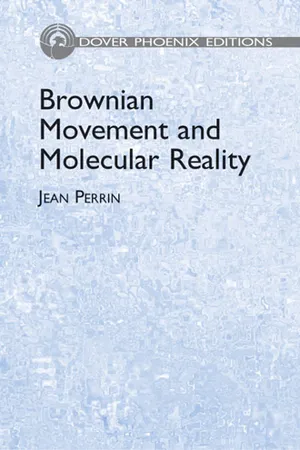
How do we know that molecules really exist? An important clue came from Brownian movement, a concept developed in 1827 by botanist Robert Brown, who noticed that tiny objects like pollen grains shook and moved erratically when viewed under a microscope. Nearly 80 years later, in 1905, Albert Einstein explained this "Brownian motion" as the result of bombardment by molecules. Einstein offered a quantitative explanation by mathematically estimating the average distance covered by the particles over time as a result of molecular bombardment. Four years later, Jean Baptiste Perrin wrote Brownian Movement and Molecular Reality, a work that explains his painstaking measurements of the displacements of particles of a resin suspended in water — experiments that yielded average displacements in excellent accord with Einstein's theoretical prediction.
The studies of Einstein and Perrin provided some of the first concrete evidence for the existence of molecules. Perrin, whose name is familiar to all who employ his methods for calculations in molecular dynamics, received the 1926 Nobel Prize in physics. In this classic paper, he introduced the concept of Avogadro's number, along with other groundbreaking work. Originally published in the French journal Annates de chimie et de physique, it was translated into English by Frederick Soddy to enduring influence and acclaim.
- 112 pages
- English
- ePUB (mobile friendly)
- Available on iOS & Android
eBook - ePub
Brownian Movement and Molecular Reality
About this book
Information
BROWNIAN MOVEMENT AND MOLECULAR REALITY.
(Professeur de Chimie Physique, Faculté des Sciences,
Université de Paris.)
Université de Paris.)
TRANSLATED FROM THE
ANNALES DE CHIMIE ET DE PHYSIQUE, 8me SERIES,
September 1909,
September 1909,
BY F. SODDY, M.A., F.R.S.
I.
1. The first indication of the phenomenon.—When we consider a fluid mass in equilibrium, for example some water in a glass, all the parts of the mass appear completely motionless to us. If we put into it an object of greater density it falls and, if it is spherical, it falls exactly vertically. The fall, it is true, is the slower the smaller the object; but, so long as it is visible, it falls and always ends by reaching the bottom of the vessel. When at the bottom, as is well known, it does not tend again to rise, and this is one way of enunciating Carnot’s principle (impossibility of perpetual motion of the second sort).
These familiar ideas, however, only hold good for the scale of size to which our organism is accustomed, and the simple use of the microscope suffices to impress on us new ones which substitute a kinetic for the old static conception of the fluid state.
Indeed it would be difficult to examine for long preparations in a liquid medium without observing that all the particles situated in the liquid instead of assuming a regular movement of fall or ascent, according to their density, are, on the contrary, animated with a perfectly irregular movement. They go and come, stop, start again, mount, descend, remount again, without in the least tending toward immobility. This is the Brownian movement, so named in memory of the naturalist Brown, who described it in 1827 (very shortly after the discovery of the achromatic objective), then proved that the movement was not due to living animalculæ, and recognised that the particles in suspension are agitated the more briskly the smaller they are.
2. Projection of the Brownian movement—This phenomenon can be made visible to a whole audience by projection, but this is difficult, and it may be useful to detail the precautions which have enabled me to arrive at a satisfactory result. The image of an electric arc (or better, of the sun) is formed in the preparation, the greater part of the non-luminous heat rays being stopped by means of a cell full of water. The rays, reflected by the particles in suspension, traverse, as for direct observation, an immersion objective and an eyepiece of high magnification, and are then turned horizontally by a total-reflection prism so as to form the image of the granules on a screen of ground glass (ruled in squares by preference, so as to have reference marks), on the farther side of which the audience is. The light is thus better utilised than with an ordinary screen which would diffuse a large part of it in directions where there were no observers. The magnification can be usefully raised to 8,000 or 10,000 diameters.
But it is necessary above all to procure an appropriate emulsion. In the few trials of projection which have been made up till now, the diameter of the granules employed was of the order of a micron, and their image is visible only with difficulty beyond 3 metres (at least with the light of the arc) whether immersion or lateral illumination is used. Smaller granules are still less visible, and one is led to this, at first sight, paradoxical conclusion, that it is better to project large granules than small ones. It is true that their movement is less, but it is still quite sufficient for its essential characteristics to be easily recognised.
It is still necessary to know how to prepare particles having a diameter of several microns, and we shall see soon that this is equally desirable in regard to certain points in the experimental study proper of the Brownian movement. I shall indicate later (No. 32) how I have succeeded in obtaining large, perfectly spherical granules of gamboge and mastic. With such granules the Brownian movement can still be perceived at a distance of 8 or 10 metres from the screen in a hall which has been made absolutely dark.
3. Persistance of the phenomenon in absence of all causes external to the fluid. Its explanation by the movements of molecules.—The singular phenomenon discovered by Brown did not attract much attention. It remained, moreover, for a long time ignored by the majority of physicists, and it may be supposed that those who had heard of it thought it analogous to the movement of the dust particles, which can be seen dancing in a ray of sunlight, under the influence of feeble currents of air which set up small differences of pressure or temperature. When we reflect that this apparent explanation was able to satisfy even thoughtful minds, we ought the more to admire the acuteness of those physicists, who have recognised in this, supposed insignificant, phenomenon a fundamental property of matter.
Besides, as happens most frequently when it is sought to unravel the genesis of a great directing idea, it is difficult to fix precisely how the hypothesis, which ascribes the Brownian movement to molecular agitation, first appeared and how it was developed.
The first name which calls for reference in this respect is, perhaps, that of Wiener, who declared at the conclusion of his observations, that the movement could not be due to convection currents, that it was necessary to seek for the, cause of it in the liquid itself, and who, finally, almost at the commencement of the development of the kinetic theory of heat, divined that molecular movements were able to give the explanation of the phenomenon 1.
Some years later Fathers Delsaulx and Carbonnelle published in the Royal Microscopical Society and in the Revue des Questions scientifiques, from 1877 to 1880, various Notes on the Thermodynamical Origin of the Brownian Movement2. In a note by Father Delsaulx, for example, one may read : “the agitation of small corpuscles in suspension in liquids truly constitutes a general phenomenon,” that it is “henceforth natural to ascribe a phenomenon having this universality to some general property of matter,” and that “in this train of ideas, the internal movements of translation which constitute the calorific state of gases, vapours and liquids, can very well account for the facts established by experiment.”
In another Note, by Father Carbonnelle, one, again, may read this: “In the case of a surface having a certain area, the molecular collisions of the liquid which cause the pressure, would not produce any perturbation of the suspended particles, because these, as a whole, urge the particles equally in all directions. But if the surface is of area less than is necessary to ensure the compensation of irregularities, there is no longer any ground for considering the mean pressure; the inequal pressures, continually varying from place to place, must be recognised, as the law of large numbers no longer leads to uniformity; and the resultant will not now be zero but will change continually in intensity and direction. Further, the inequalities will become more and more apparent the smaller the body is supposed to be, and in consequence the oscillations will at the same time become more and more brisk ......”
These remarkable reflections unfortunately remained as little known as those of Wiener. Besides it does not appear that they were accompanied by an experimental trial sufficient to dispel the superficial explanation indicated a moment ago; in consequence, the proposed theory did not impress itself on those who had become acquainted with it.
On the contrary, it was established by the work of M. Gouy (1888), not only that the hypothesis of molecular agitation gave an admissible explanation of the Brownian movement, but that no other cause of the movement could be imagined, which especially increased the significance of the hypothesis 3. This work immediately evoked a considerable response, and it is only from this time that the Brownian movement took a place among the important problems of general physics.
In the first place, M. Gouy observed that the Brownian movement is not due to vibrations transmitted to the liquid under examination, since it persists equally, for example, at night on a sub-soil in the country as during the day near a populous street where heavy vehicles pass. Neither is it due to the convection currents existing in fluids where thermal equilibrium has not been attained, for it does not appreciably change when plenty of time is given for equilibrium to be reached. Any comparison between Brownian movement and the agitation of dust-particles dancing in the sunlight must therefore be set aside. In addition, in the latter case, it is easy to see that the neighbouring dust-particles move in general in the same sense, roughly tracing out the form of the common current which bears them along, whereas the most striking feature of the Brownian movement is the absolute indepe...
Table of contents
- Title Page
- Copyright Page
- Table of Contents
- BROWNIAN MOVEMENT AND MOLECULAR REALITY.
- DOVER PHOENIX EDITIONS
Trusted by 375,005 students
Access to over 1.5 million titles for a fair monthly price.
Study more efficiently using our study tools.
Frequently asked questions
Yes, you can cancel anytime from the Subscription tab in your account settings on the Perlego website. Your subscription will stay active until the end of your current billing period. Learn how to cancel your subscription
No, books cannot be downloaded as external files, such as PDFs, for use outside of Perlego. However, you can download books within the Perlego app for offline reading on mobile or tablet. Learn how to download books offline
Perlego offers two plans: Essential and Complete
- Essential is ideal for learners and professionals who enjoy exploring a wide range of subjects. Access the Essential Library with 800,000+ trusted titles and best-sellers across business, personal growth, and the humanities. Includes unlimited reading time and Standard Read Aloud voice.
- Complete: Perfect for advanced learners and researchers needing full, unrestricted access. Unlock 1.5M+ books across hundreds of subjects, including academic and specialized titles. The Complete Plan also includes advanced features like Premium Read Aloud and Research Assistant.
We are an online textbook subscription service, where you can get access to an entire online library for less than the price of a single book per month. With over 1.5 million books across 990+ topics, we’ve got you covered! Learn about our mission
Look out for the read-aloud symbol on your next book to see if you can listen to it. The read-aloud tool reads text aloud for you, highlighting the text as it is being read. You can pause it, speed it up and slow it down. Learn more about Read Aloud
Yes! You can use the Perlego app on both iOS and Android devices to read anytime, anywhere — even offline. Perfect for commutes or when you’re on the go.
Please note we cannot support devices running on iOS 13 and Android 7 or earlier. Learn more about using the app
Please note we cannot support devices running on iOS 13 and Android 7 or earlier. Learn more about using the app
Yes, you can access Brownian Movement and Molecular Reality by Jean Perrin, F. Soddy in PDF and/or ePUB format, as well as other popular books in Physical Sciences & Physics. We have over 1.5 million books available in our catalogue for you to explore.