An introduction to the themes of mathematical analysis, this text is geared toward advanced undergraduate and graduate students. It assumes a familiarity with basic real analysis, metric space theory, linear algebra, and minimal knowledge of measures and Lebesgue integration, all of which are surveyed in the first chapter. Subsequent chapters explore the basic results of linear functional analysis: Stone-Weierstrass, Hahn-Banach, uniform boundedness and open mapping theorems, dual spaces, and basic properties of operators. Additional topics include function spaces, the Tychonov and Alaoglu theorems, Hilbert spaces, elementary Fourier analysis, and compact self-adjoint operators applied to Sturm-Liouville theory. "The author has a delightfully lively style which makes the book very readable," noted the Edinburgh Mathematical Society, "and there are numerous interesting and instructive problems."
This section covers concisely those portions of metric space theory needed in elementary functional analysis, as well as some very elementary theory of topological spaces. The latter are not really needed outside §16, where they are essential; in §6, where they also occur, none of the interest is lost if the reader prefers to substitute ‘metric space’ for ‘topological space’ wherever the latter occurs.
1.1 A metric on a set X is a non-negative real-valued function don X × X obeying the rules:
The number d(x, y) is called the distance from x to y. A pair (X, d), where d is a metric on X, is called a metric space. Often one suppresses mention of d and speaks of ‘the metric space X’. We sometimes use the same symbol d for the metric on different spaces.
A set of the form {x ∈ X: d(a, x)
r}f where a ∈ X and r> 0, is a closed ball (of radius r, round a); replacing
by gives the corresponding open ball. We sometimes denote these by B(a, r) and U(a, r) respectively. (Some authors use the word ‘sphere’ which will be used in this book to mean a set {x ∈ X: d(a, x) = r}.)
The real line R and the complex plane C are metric spaces under the usual metric d(x, y) = | x – y |. More generally Rn (and Cn, which can be thought of for this purpose as R2n) are metric spaces under the Euclidean metric
where x = (x1,..., xn), y = (y1, ..., yn); the reader probably knows this but it follows from results proved later.
1.2 We now define the basic topological concepts in a metric space (X, d). A subset N of X is a neighbourhood of a point a ∈ X (and a is an interior point of N) if N contains some ball round a. A sequence {xn} in Xconverges to a point a ∈ X – one writes xn → a as n → ∞ – if given ∈ > 0 there exists n0 such that d(xn, a)<∈ whenever n
n0, that is, if d(xn, a) → 0 as n → ∞; equivalently, if given any neighbourhood N of a there exists n0 such that xn ∈ N for n
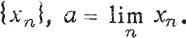
n0 (we say that xn is eventually in N). A sequence can converge to at most one point a, called the limit of
A point a is a closure point of a subset A if each neighbourhood of a meets A. A set is open if each of its points is an interior point; closed if it contains all its closure points. The interior int(A) of A is the set of interior points of A, the closureA– of A is the set of closure points of A. The boundary of A is A– ~ int(A) and consists of those points each of whose neighbourhoods meets both A and X ~ A. A subset A is dense in X if A– = X.
Let f be a map from a metric space X to a metric space Y, and let a ∈ X; then f is continuous ata if for each neighbourhood N of f(a) there exists a neighbour...
Table of contents
Cover
Title Page
Copyright Page
Contents
Introduction
1 Preliminaries
2 Normed spaces – basic properties and examples
3 Basic theory of operators and functionals
4 Hilbert spaces and related topics
5 Dual spaces
6 Infinite products and related topics
7 Operators
Appendix
References and suggested reading
Index of symbols
Index
Frequently asked questions
Yes, you can cancel anytime from the Subscription tab in your account settings on the Perlego website. Your subscription will stay active until the end of your current billing period. Learn how to cancel your subscription
No, books cannot be downloaded as external files, such as PDFs, for use outside of Perlego. However, you can download books within the Perlego app for offline reading on mobile or tablet. Learn how to download books offline
Perlego offers two plans: Essential and Complete
Essential is ideal for learners and professionals who enjoy exploring a wide range of subjects. Access the Essential Library with 800,000+ trusted titles and best-sellers across business, personal growth, and the humanities. Includes unlimited reading time and Standard Read Aloud voice.
Complete: Perfect for advanced learners and researchers needing full, unrestricted access. Unlock 1.4M+ books across hundreds of subjects, including academic and specialized titles. The Complete Plan also includes advanced features like Premium Read Aloud and Research Assistant.
Both plans are available with monthly, semester, or annual billing cycles.
We are an online textbook subscription service, where you can get access to an entire online library for less than the price of a single book per month. With over 1 million books across 990+ topics, we’ve got you covered! Learn about our mission
Look out for the read-aloud symbol on your next book to see if you can listen to it. The read-aloud tool reads text aloud for you, highlighting the text as it is being read. You can pause it, speed it up and slow it down. Learn more about Read Aloud
Yes! You can use the Perlego app on both iOS and Android devices to read anytime, anywhere — even offline. Perfect for commutes or when you’re on the go. Please note we cannot support devices running on iOS 13 and Android 7 or earlier. Learn more about using the app
Yes, you can access Basic Methods of Linear Functional Analysis by John D. Pryce in PDF and/or ePUB format, as well as other popular books in Mathematics & Functional Analysis. We have over one million books available in our catalogue for you to explore.