![]()
1. ANCIENT CONCEPTIONS CONCERNING THE MOTIONS OF THE SUN, MOON, PLANETS AND STARS
The movements of heavenly bodies began to be studied long, long ago. During many centuries before our time ancient peoples observed the positions and movements of celestial objects in the sky and strived to notice regularities in these motions. The stimulus that guided them was primarily practical necessity. It was only by observing the heavenly bodies that one could find his bearings in the desert or at sea; or could measure time and predict the season of the year. The demands of trade and agriculture and the migrations of nomads all required observations of the stars. Thus it was that urgent practical demands engendered astronomy, the science of celestial objects.
The apparent motions of heavenly bodies across the sky were well known even in very ancient times.
Watching the starry sky at night one gets the impression of a dome-shaped celestial sphere in rotation about the earth making a single circuit every 24 hours. This diurnal rotation of the firmament is repeated regularly, from day to day, without any apparent change.
The stars in the sky appear firmly fixed in place with respect to each other. Hence the name fixed stars. Ages ago astronomers had already compiled permanent maps of different constellations and of the entire stellar sky.
All heavenly bodies without exception participate in the diurnal rotation about the earth. But if a given body retains its relative position among the stars it is called a fixed star. In contrast, when we speak of an object moving across the sky we have in mind not its diurnal motion but its movement with respect to the fixed stars.
Antiquity knew of seven bodies that moved among the stars. They were called planets (which in Greek meant “wanderers”). Two points should be noted in this respect. First, these included five bodies that were far brighter that the stars, and the names given them by the ancient Romans—Mercury, Venus, Mars, Jupiter, and Saturn—remain to this day. Secondly, in ancient times, the planets included the sun and moon too for they likewise were in motion among the stars.
The moon’s motion is easiest to notice because this body moves faster than the other objects. The moon moves from west to east and makes a complete circuit across the sky in only a little over 27 days (which amounts to a speed of 12–13 degrees per 24 hours or 0°.5 an hour). One needs only two nights to notice that the moon has changed its position relative to the stars. Observations show that the moon’s movement across the sky is not uniform, on some sections it moves faster, on others slower.
The sun’s movement among the stars cannot be registered directly since the latter are not visible in the day-time, but such movement can be detected from observations of the stars. Note some star in the western part of the sky soon after sunset and then try to locate it a few days later at the same hour. You will find that it has moved down closer to the sun. In another few days it will disappear altogether below the horizon, and its place will be taken by another star lying to the west. This new star will gradually approach the sun and continue as the first, etc. This shows that the sun changes its position relative to the stars. Way back in ancient times daily observations were made of the positions of the stars on the celestial sphere. These observations permitted of a rather accurate study of the sun’s path across the sky. It was found that the sun, and the moon too, moves among the stars from west to east, describing a complete circuit in roughly 365 and a quarter days, that is, in one year. The annual path of the sun among the stars remains constant from year to year and is known as the ecliptic. In a single day the sun moves eastward along the ecliptic approximately one degree (or 360° per year). The sun’s movement, again like that of the moon, is not uniform throughout the year. In winter it moves faster than in summer. For example, between June 1 and June 30 it covers 27 °.5, while between December 1 and 30 it does 29 °.5.
The picture of the apparent motions of the planets is more complicated. A common feature that the planets have is that they always move close to the ecliptic. The planets fall into two groups: the inferior planets and the superior planets.1
In the first group belong Mercury and Venus, in the second, all the others. Characteristic of Mercury and Venus is that they oscillate about the sun as about a certain mean position. At first the planet moves among the stars more rapidly than the sun and passes it; then, having moved to the farthest point east of the sun, the planet begins to move more slowly than the sun, which overtakes it. After lagging behind a certain distance to the west, the planet again begins moving faster than the sun, and the cycle is repeated. For Venus, the maximum solar distance is about 40°, while for Mercury it is an average of 23° (varying from 18 to 28°). For this reason, these planets are visible only in the morning in the east shortly before sunrise and in the evening in the west just a little after sunset.
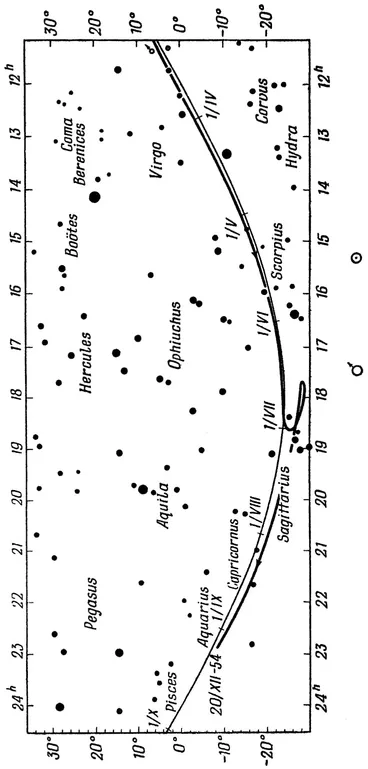
Fig.1. The apparent paths of Mars (
) from October 10,1953, to December 20, 1954, and the sun (
) between March and October
The period of apparent oscillations of Mercury about the sun is 116 days, for Venus it comes out to one year and 217 days.
The superior planets describe characteristic loops in the sky.
The overall motion of the planets among the stars is from west to east like the sun and moon (this is called direct motion). However, there are times when the rate of apparent motion of a planet diminishes, the planet comes to a halt, and then begins to move from east to west (retrograde motion). Each planet has its own period of retrograde motion with a subsequent reversal of direction to direct motion from west to east. The result is a peculiar type of loop that the planet describes in the sky (Fig. 1). Mars describes a loop every 780 days, Jupiter every 399 days, Saturn every 378 days.
These are the movements of the stars and planets on the sky as viewed from the earth. But what are the real movements of the stars, sun, moon and planets in space?
The first attempts to explain the observed motions of celestial bodies, to build a theory of their motions that could predict the location of a given body in the sky at a given instant were made by learned men in ancient Greece. Their starting point was a stationary earth with the sun, moon, planets and stars revolving about it.
The ancient Greeks contrasted “terrestrial” and “celestial” phenomena and believed that the laws of the “heavens” should differ utterly from those of the “earth.” The ever recurring motions of celestial objects appeared to them a paragon of perfection, and since they regarded uniform motion along a circle the most perfect type of motion, it seemed to them an immutable fact that the moon, sun and planets should move in circles at a uniform rate. However, the apparent motions of these bodies hardly resemble uniform circular movements. The sun and moon have rates of motion that are not uniform, while the planets even describe intricate loops. Ancient Greek astronomy was thus confronted with the following problem: to give an explanation of the apparent movements of the planets based on uniform circular motion.
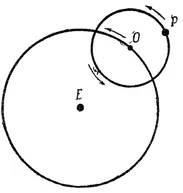
The most refined theory of the motions of heavenly bodies of that time was developed in the second century A.D. by the ancient Greek astronomer Claudius Ptolemy. He supposed the sun, moon and planets to be in uniform motion in circles that were called epicycles. In turn, the centre of each epicycle was in uniform motion along a larger circle, known as the deferent, with the motionless earth at its centre. In this scheme, the rate of motion of the planet V1 along the epicycle is greater than the rate of motion V0 of the centre of the epicycle along the deferent. During the interval when the planet P and the centre of the epicycle O are moving in a single direction, the observer on earth E sees direct motion. But if the planet is in motion between the centre of the epicycle and the earth, the motions of the planet and the centre of the epicycle are “deducted” one from the other, and, seeing that V1 > V0 , the planet will be in retrograde motion when viewed from the earth.
Fig. 2. An epicycle. The velocity of V1 is greater than that of V0
By selecting for the sun and the moon and each planet the ratios of deferent and epicycle radii, the orbital periods along epicycle and deferent, and the mutual inclinations of the planes of the deferent and epicycle, Ptolemy was able not only to explain the nonuniform apparent motion of these bodies across the sky and the retrograde movements of the planets, but even to compute rather accurately the paths of the planets, sun and moon across the heavens.
The Ptolemaic system and in general the teaching that made the earth a stationary body was unrivaled for fourteen centuries, from the second to the middle of sixteenth century. True, even before Ptolemy, the ancient Greek scholars Philolaus (fifth century B.C.) and Aristarchus of Samos (third century B.C.) and some others propounded the view that the earth is in motion in space and that, in addition, it rotates on its axis; on their view, the observed diurnal rotation of the celestial sphere and of all the stars is simply a reflection of the actual rotation of the earth. But these thinkers were unable to offer methods of precise calculations to prediet the planetary positions in the heavens and thus satisfy the practical demands of astronomy, and therefore their brilliant guesses did not become generally accepted.
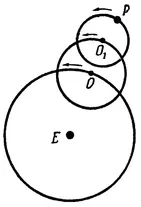
Fig. 3. A compounded epicycle
This long period of domination of the Ptolemaic system was of course due not only to the low level of science at that time. The point is that an earth-centred universe was ideally suited to religion. Since man is the “crowning achievement of God” it is natural that man’s abode—the earth—should be located at the centre. Thus it was that Ptolemy’s cosmology served religion. Quite natural then that the pagan priests accused Aristarchus of Samos of godlessness for his teaching of the earth’s motion, just as, eighteen centuries later, Christian churchmen fought furiously against the Copernican system.
But finally the Ptolemaic system came to an impasse, for as new observational data accumulated, more discrepancies were detected between observed planetary positions and those predicted by Ptolemy’s theory. To eliminate these divergences, it was assumed that the motion of each planet is to be described not by a single epicycle but by a whole system of epicycles (Fig.3). Each newly discovered irregularity in the motion of a planet was eliminated by the addition of more and more epicycles. Yet disparities between theory and observation remained.
This extremely unwieldy and obviously artificially compounded system of epicycles, on the one hand, and the lack of complete agreement between theory and observation, on the other, finally resulted in doubts cropping up as to its validity. The time came when astronomy ceased to “refine” Ptolemy’s system by adding more and more epicycles, and rejected it outright. This was the sixteenth century, when the great Polish astronomer Nicolaus Copernicus (1473–1543) created the first complete theory of the motion of the earth and planets about the sun. This is actually the starting point of our knowledge about the true motions of celestial bodies in space.
![]()
2. THE GEOMETRY OF PLANETARY MOTIONS FROM COPERNICUS TO KEPLER
Copernicus discarded the dogmatic assertion of a stationary earth that had dominated the minds of men for ages. According to his theory, the earth is in no way different from the planets in its motion in space about the sun and in its rotation round a certain imaginary line which we call the earth’s axis. The diurnal movements of the stars and all other heavenly bodies on the celestial sphere were correctly explained by Copernicus as the result not of their actual motions but of the rotation of the earth. The earth rotates, completing a circuit in 24 hours, while to a man on the earth’s surface who does n...