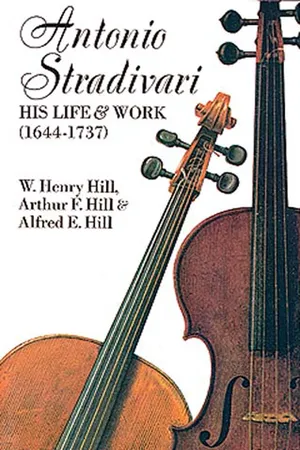
Leading appraisers of fine musical instruments agree that in the art of making violins, no one has ever gone beyond the achievement of Antonio Stradivari. The incomparable visual beauty of his instruments and the infinite variety and magnificence of tone of which they are capable have by this time passed into the realm of legend. Collectors have paid many thousands of dollars for one of Stradivari's violins. It is strange, but true, that only one book really delves into the life and art of this famous Italian craftsman. That is the book published in 1902 by the three Hill brothers of the London violin-making firm. Expert violin-makers and critics of superior violin craftsmanship, these men had unique opportunities to examine and compare almost all of the great examples of Italian violin-making.
The larger divisions of the book concern the ancestry of Stradivari; his violins, viols, and violoncellos; his aims in relation to tone; his materials; his varnish; his construction; his labels; the number of instruments he made; the growth of their reputation. Some of the topics discussed under these main headings are: Stradivari's apprenticeship to Amati; comparison of his work with that of Amati; the tone of the pre-1684 Stradivari violin; changes between 1684 and 1690; distinguishing characteristics of many existing violins, violas, and cellos, their specific location, etc.; erroneous views concerning Stradivari's material; his preference for the wood of certain trees in given years; the mystery of the ingredients of Stradivari's varnish; the effect of varnish on tone; the measurements of Stradivari's instruments; the time spent by Stradivari in making a violin; the years of greatest production; the largest number dating from one year; estimate of the total number made; an estimate of the actual sum he charged for an instrument; the introduction of Stradivari instruments into France and England; the first revelation of their supreme merit; and many other interesting topics.
Musicologists, violinists, makers of instruments, historians of culture, and those who count themselves simply as music lovers will find this to be an extremely interesting and informative account.
- 400 pages
- English
- ePUB (mobile friendly)
- Available on iOS & Android
eBook - ePub
About this book
Information
Subtopic
Classical MusicTable of contents
- Cover
- Title Page
- Copyright Page
- Dedication
- Introduction
- Preface
- Contents
- List of Plates
- List of Illustrations in the Text
- Introductory Note
- Chapter 1: The Ancestry of Antonio Stradivari
- Chapter 2: Stradivari’s Violins
- Chapter 3: Stradivari’s Violas
- Chapter 4: Stradivari’s Violoncellos
- Chapter 5: Stradivari’s Aims in Relation to Tone
- Chapter 6: Stradivari’s Material
- Chapter 7: stradivari’s Varnish
- Chapter 8: stradivari’s Construction
- Chapter 9: Stradivari’s Labels
- Chapter 10: The Number of Instruments Made by Stradivari
- Chapter 11: The Prices Paid for Stradivari Instruments and the growth of their Reputation
- Chapter 12: Stradivari’s Supposed Portrait
- Appendices
- Index
Trusted by 375,005 students
Access to over 1.5 million titles for a fair monthly price.
Study more efficiently using our study tools.
Frequently asked questions
Yes, you can cancel anytime from the Subscription tab in your account settings on the Perlego website. Your subscription will stay active until the end of your current billing period. Learn how to cancel your subscription
No, books cannot be downloaded as external files, such as PDFs, for use outside of Perlego. However, you can download books within the Perlego app for offline reading on mobile or tablet. Learn how to download books offline
Perlego offers two plans: Essential and Complete
- Essential is ideal for learners and professionals who enjoy exploring a wide range of subjects. Access the Essential Library with 800,000+ trusted titles and best-sellers across business, personal growth, and the humanities. Includes unlimited reading time and Standard Read Aloud voice.
- Complete: Perfect for advanced learners and researchers needing full, unrestricted access. Unlock 1.5M+ books across hundreds of subjects, including academic and specialized titles. The Complete Plan also includes advanced features like Premium Read Aloud and Research Assistant.
We are an online textbook subscription service, where you can get access to an entire online library for less than the price of a single book per month. With over 1.5 million books across 990+ topics, we’ve got you covered! Learn about our mission
Look out for the read-aloud symbol on your next book to see if you can listen to it. The read-aloud tool reads text aloud for you, highlighting the text as it is being read. You can pause it, speed it up and slow it down. Learn more about Read Aloud
Yes! You can use the Perlego app on both iOS and Android devices to read anytime, anywhere — even offline. Perfect for commutes or when you’re on the go.
Please note we cannot support devices running on iOS 13 and Android 7 or earlier. Learn more about using the app
Please note we cannot support devices running on iOS 13 and Android 7 or earlier. Learn more about using the app
Yes, you can access Antonio Stradivari by W. H. Hill,Francis A. Davis in PDF and/or ePUB format, as well as other popular books in Media & Performing Arts & Classical Music. We have over 1.5 million books available in our catalogue for you to explore.