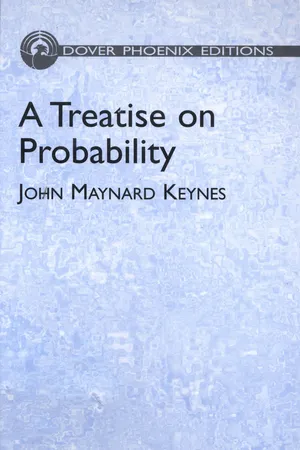
With this treatise, an insightful exploration of the probabilistic connection between philosophy and the history of science, John Maynard Keynes (1883–1946) breathed new life into studies of both disciplines. Originally published in 1921, the famous economist's most important mathematical work represented a significant contribution to the theory regarding the logical probability of propositions. Keynes effectively dismantled the classical theory of probability, launching what has since been termed the "logical-relationist" theory. In so doing, he explored the logical relationships between classifying a proposition as "highly probable" and as a "justifiable induction."
A Treatise on Probability argues that probability is a matter of logic, which renders it objective: a statement involving probability relations possesses a truth value independent of opinion. Keynes demonstrates that if a hypothesis has even the smallest finite probability, it can be transformed into certainty by a sufficient number of observations. This is his attempt to overcome Humean skepticism by asserting that theoretically grounded hypotheses need only exhibit finite probability to form the basis of science and rational action. Another key idea discussed in A Treatise on Probability is that probability relations constitute only a partially ordered set in the sense that two probabilities cannot necessarily always be compared. Keynes further maintains that probability is a basic concept that cannot be reduced to other concepts.
- 480 pages
- English
- ePUB (mobile friendly)
- Available on iOS & Android
eBook - ePub
A Treatise on Probability
About this book
Information
Table of contents
- Cover
- Title Page
- Copyright Page
- Contents
- Preface by the Author
- Part I: Fundamental Ideas
- Part II: Fundamental Theorems
- Part III: Induction and Analogy
- Part IV: Some Philosophical Applications of Probability
- Part V: The Foundations of Statistical Inference
- Bibliography
- Index
Trusted by 375,005 students
Access to over 1.5 million titles for a fair monthly price.
Study more efficiently using our study tools.
Frequently asked questions
Yes, you can cancel anytime from the Subscription tab in your account settings on the Perlego website. Your subscription will stay active until the end of your current billing period. Learn how to cancel your subscription
No, books cannot be downloaded as external files, such as PDFs, for use outside of Perlego. However, you can download books within the Perlego app for offline reading on mobile or tablet. Learn how to download books offline
Perlego offers two plans: Essential and Complete
- Essential is ideal for learners and professionals who enjoy exploring a wide range of subjects. Access the Essential Library with 800,000+ trusted titles and best-sellers across business, personal growth, and the humanities. Includes unlimited reading time and Standard Read Aloud voice.
- Complete: Perfect for advanced learners and researchers needing full, unrestricted access. Unlock 1.5M+ books across hundreds of subjects, including academic and specialized titles. The Complete Plan also includes advanced features like Premium Read Aloud and Research Assistant.
We are an online textbook subscription service, where you can get access to an entire online library for less than the price of a single book per month. With over 1.5 million books across 990+ topics, we’ve got you covered! Learn about our mission
Look out for the read-aloud symbol on your next book to see if you can listen to it. The read-aloud tool reads text aloud for you, highlighting the text as it is being read. You can pause it, speed it up and slow it down. Learn more about Read Aloud
Yes! You can use the Perlego app on both iOS and Android devices to read anytime, anywhere — even offline. Perfect for commutes or when you’re on the go.
Please note we cannot support devices running on iOS 13 and Android 7 or earlier. Learn more about using the app
Please note we cannot support devices running on iOS 13 and Android 7 or earlier. Learn more about using the app
Yes, you can access A Treatise on Probability by John Maynard Keynes in PDF and/or ePUB format, as well as other popular books in Mathematics & Probability & Statistics. We have over 1.5 million books available in our catalogue for you to explore.