![]()
The Blues Scale
When playing the works in this book,
you’ll be sure to notice more accidentals than you’re used to seeing in more traditional and classical piano music. This is due to the use of the “blues scale.” Simply put, the blues scale is a variation on the traditional scale—and what give blues music its character and flavor. Originating in African folk music, it evolved over time and was assimilated into a new musical language.
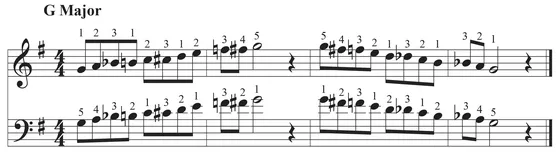
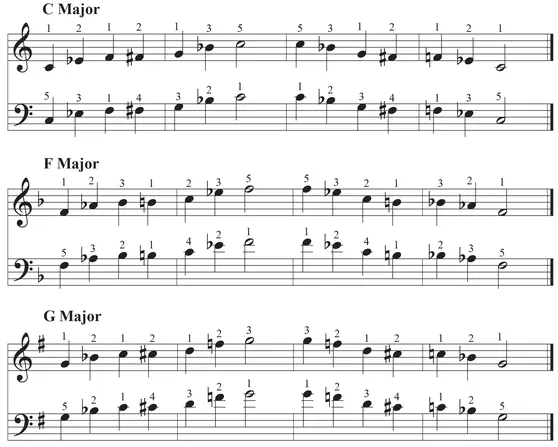
Although there are a few versions of the blues scale, they all involve altering three important steps of a traditional scale: the 3rd, 5th, and 7th. For example, in a C major scale, the E, G, and B would be altered:
Below are two versions of the blues scale: the “ten-note” and the “six-note.” The ten-note is specifically arranged for this edition in order to help performer’s fingers and ears (and eyes) prepare for the technical demands at hand. The six-note scale is the more popular and modern version, indispensable for future study and performance. These serve both as an excellent warm-up and introduction to the blues.
![]()
Blues Rhythms
In addition to special scales, blues music also has its own unique sense of rhythm. These beats have a playful nature that helps propel melodies, emphasize accents and speech patterns in lyrics, and create powerful accompaniments. The two aspects of rhythm essential to blues are syncopation and swinging eighths.
SYNCOPATION
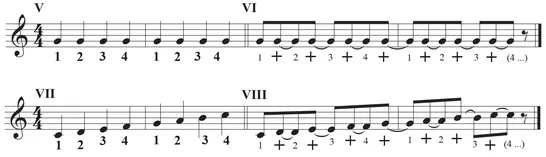
Technically, syncopation is an accent on an unexpected or weak beat. This can occur within a measure on a downbeat, or on any upbeat (e.g. the “and” in 1 and 2 and…). This shift of pulse creates a feeling of displacement, which could be described as “uplifting” or “suspended.” Compare examples I and II:
The first has clear accents (or “thumps”) on beats 1 and 3, since the longest note of a phrase (here half notes) would carry the most weight. By introducing the quarter note on the first beat, the gravity of the phrase shifts to beats 2 and 4. Keep in mind that the tempo doesn’t change, only the accents. It sounds clearer when played on a scale:
The same would apply to quarter notes. In these examples, they are introduced earlier and shifted to the left by an eighth note:
Syncopations are often notated in a way that can make them appear more complicated than they really are. Rather than writin...