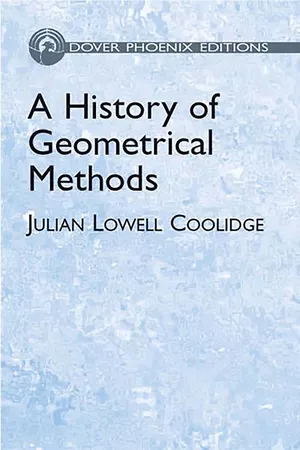
Full and authoritative, this history of the techniques for dealing with geometric questions begins with synthetic geometry and its origins in Babylonian and Egyptian mathematics; reviews the contributions of China, Japan, India, and Greece; and discusses the non-Euclidean geometries. Subsequent sections cover algebraic geometry, starting with the precursors and advancing to the great awakening with Descartes; and differential geometry, from the early work of Huygens and Newton to projective and absolute differential geometry. The author's emphasis on proofs and notations, his comparisons between older and newer methods, and his references to over 600 primary and secondary sources make this book an invaluable reference. 1940 edition.
- 480 pages
- English
- ePUB (mobile friendly)
- Available on iOS & Android
eBook - ePub
A History of Geometrical Methods
About this book
Information
Topic
MathématiquesSubtopic
GéométrieBOOK II
ALGEBRAIC GEOMETRY
CHAPTER I
THE BEGINNINGS OF ALGEBRAIC GEOMETRY 141
§ 1. The precursors.
THE opinion is currently held among mathematicians that analytic geometry sprang full-armed from the head of Descartes as did Athene from that of Zeus. ‘Proles sine matre creata’ is Chasles’ picturesque way of saying the same thing. There is much to be said in favour of this thesis, but the question is too important to be dismissed in four words, even four Latin words, and another opinion is certainly possible. The fact is that in inquiring into the origin of analytic geometry we run into a difficulty that lies at the bottom of a good proportion of our disputes in this Vale of Tears. What do we mean by our principal terms? Exactly what do we mean by the words ‘analytic geometry’? Till that is settled, it is futile to inquire as to who discovered it.
A very definite view on this important point is expressed in Gunther (q.v.). He based his reasoning on the axiom that there are three stages in the development of analytic geometry, and that anything which has not passed through all three does not deserve the name:
- The determination of a point by coordinates.
- The representation of a law by graphing the dependent variable against the independent one.
- The determination of the corresponding equation.
Now, says Gunther, wherever we find an example, of the third of these without the first two, we may recognize a stroke of genius on the part of the author, but not analytic geometry.
This opinion was very upsetting to the ever kindly Zeuthen, who held strongly to the thesis, which I personally defend, that analytic geometry was an invention of the Greeks. Instead of adopting the method beloved of truculent persons of abusing his adversary, he suggests that since the Greeks have gone so far in C) they must have passed through A) and B) without mentioning the fact.142 I cannot personally accept this compromising hypothesis. I see no reason to accept Gunther’s axiom. Shall we say that the Hindus did not invent our so-called Arabic numerals, because they did not first use Roman numerals, or other less convenient signs? My colleague Osgood used to point out that all the rules of trigonometry could be deduced from the differential equation
y′′+y = 0.
If we encountered any one who had learnt the subject in that way, should we deny his knowledge because he had not started by measuring triangles?
We certainly do not get far if we base the subject of analytic geometry on the location of points by coordinates. This is fundamental in both geometry and astronomy. The Egyptians were familiar with the technique of changing the scale of figures by means of ruled squares. Hipparchus originated the system of coordinates for points on the heavenly sphere. 143
The representation of a law by graphing the dependent variable against the independent one apparently originated with Nicole Oresme. He lived in the fourteenth century and was of an inquiring mind, writing a treatise on money. He has had various commentators, Curtze, Wieleitner1, and Gunther, who show a considerable divergence of view as to what he meant anyway, and my study of Oresme leaves me a good deal in the dark. In general he uses the word ‘forma’ to indicate a measurable object. As it is difficult to grasp directly the relations of various measures, these are illustrated graphically. This comes to graphing a dependent variable, latitudo, against an independent one, longitudo, which takes small increments. If the latitudo be constant, it is uniƒormis, otherwise, diƒƒormis: The points plotted are usually connected by a broken line. Curves appear in one or two cases, but there is no clear indication that he grasped the idea of a curvilinear graph. He did, however, grasp the idea that the variations themselves were ‘formae’, which could be graphed in their turn. Thus we find him using arithmetical series of the second order, that is to say, series whose differences are arithmetical, and using such terms as uniformiter, diƒƒormiter, diƒƒormis. I think we are safe in saying that he was far in advance of his time in his grasp of the general idea of a function and representing it graphically, but that analytic geometry in any accurate sense was beyond him.
One other claimant to the honour of discovering analytic geometry is brought forward in Morley (q.v.); this is Thomas Harriot. A number of his manuscripts were discovered in the British Museum, and it was believed that they contained the method of ...
Table of contents
- Title Page
- Copyright Page
- Dedication
- PREFACE
- Table of Contents
- BOOK I - SYNTHETIC GEOMETRY
- BOOK II - ALGEBRAIC GEOMETRY
- BOOK III - DIFFERENTIAL GEOMETRY
- EPILOGUE
- INDEX OF AUTHORS QUOTED
- SUBJECT INDEX
- DOVER PHOENIX EDITIONS
Trusted by 375,005 students
Access to over 1.5 million titles for a fair monthly price.
Study more efficiently using our study tools.
Frequently asked questions
Yes, you can cancel anytime from the Subscription tab in your account settings on the Perlego website. Your subscription will stay active until the end of your current billing period. Learn how to cancel your subscription
No, books cannot be downloaded as external files, such as PDFs, for use outside of Perlego. However, you can download books within the Perlego app for offline reading on mobile or tablet. Learn how to download books offline
Perlego offers two plans: Essential and Complete
- Essential is ideal for learners and professionals who enjoy exploring a wide range of subjects. Access the Essential Library with 800,000+ trusted titles and best-sellers across business, personal growth, and the humanities. Includes unlimited reading time and Standard Read Aloud voice.
- Complete: Perfect for advanced learners and researchers needing full, unrestricted access. Unlock 1.5M+ books across hundreds of subjects, including academic and specialized titles. The Complete Plan also includes advanced features like Premium Read Aloud and Research Assistant.
We are an online textbook subscription service, where you can get access to an entire online library for less than the price of a single book per month. With over 1.5 million books across 990+ topics, we’ve got you covered! Learn about our mission
Look out for the read-aloud symbol on your next book to see if you can listen to it. The read-aloud tool reads text aloud for you, highlighting the text as it is being read. You can pause it, speed it up and slow it down. Learn more about Read Aloud
Yes! You can use the Perlego app on both iOS and Android devices to read anytime, anywhere — even offline. Perfect for commutes or when you’re on the go.
Please note we cannot support devices running on iOS 13 and Android 7 or earlier. Learn more about using the app
Please note we cannot support devices running on iOS 13 and Android 7 or earlier. Learn more about using the app
Yes, you can access A History of Geometrical Methods by Julian Lowell Coolidge in PDF and/or ePUB format, as well as other popular books in Mathématiques & Géométrie. We have over 1.5 million books available in our catalogue for you to explore.