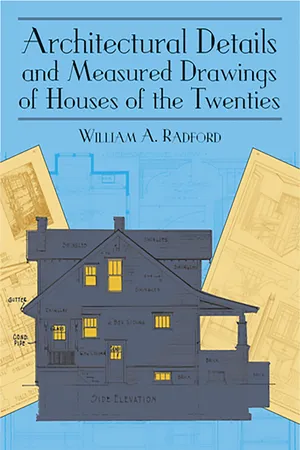
Provides details for frame houses, houses of brick, brick veneer, stucco, etc., as well as plans for barns, silos, ice houses, and other farm structures. Also includes plans for such interior features as built-in buffets and sideboards, kitchen cabinets, wardrobes, window seats, breakfast nooks, fireplaces, and more. 154 black-and-white illustrations.
SKETCH No. 1 shows a cross-section of a “balloon” frame taken from an actual example. It is a glaring violation of all the principles of good construction, fire-resistance and sanitation. It’s a fire trap, a vermin harbor, and is subject to a disastrous amount of ureequal settlement. At “A” is shown the original condition of the framework just after being built. At “B” is indicated, graphically, the dilapidated and deplorable condition of affairs, a year later, after the inevitable shrinkage-settlement has taken place. And it is to be especially noted that the faults shown are not the result of settlement itself, but rather the result of the difference in settlement of corresponding and adjacent parts. If an engineer were to design a foundation in such a manner as to be productive of the faults shown, he would, most assuredly, be considered an exceedingly poor engineer. And rightly so. Why, then, in the name of common justice, is not the builder who, day after day, continues to design and frame the timber superstructure in the manner shown, deserving of the same amount of condemnation as the discreditable engineer? Wherein is the difference between an incomptent designer of foundations and an incompetent designer of timber framing? As a matter of fact, the latter, in this particular case, is more to be censured than the former, for, in residence construction, seven cases out of ten the evils resulting from unequal settlement can be traced to the timber framework rather than to the foundation.
In the “balloon” framing, shown in Sketch No. 1, the exterior studding extends in one length from sill to rafter plate. Hence, the amount of shrinkable timber contributing to the total vertical settlement of the exterior wall is made up of the 4-inch sill and the 4-inch rafter-plate, equaling 8 inches in all. In like manner, the shrinkable bearing-timber in the interior partition is made up of the 10-inch girder, the two sets of 10-inch floor-joists, the two layers of 1-inch sub-flooring, the two 2-inch partition-soles, and the two 2-inch partitioning caps, totaling 40 inches. Hence, assuming an ultimate shrinkage of ½ inch to the foot, the exterior wall will settle 1/24th of 8 inches, or only
inch, while the interior partition will settle 1/24th of 40 inches, or 1
inches. And the difference of 1
inches is bound to cause trouble—floors sag, door frames are thrown out of square, plastering cracks, and the upper partition sometimes parts company with the ceiling overhead or, perhaps, pulls away from the floor and hangs suspended from the ceiling-joists. Trouble enough, surely! But that is not all. Damaging local settlement also takes place at the outer ends of the floor joists, often leaving a wide gap between the finish floor and baseboard, as shown exaggerated in the sketch. At the second floor line the total shrinkage of the 1-inch sub-fl...
Table of contents
FOREWORD
Title Page
Copyright Page
Table of Contents
Logical Methods in Architectural Drafting
Framing to Prevent Unequal Shrinkage-Settlement
INDEX TO ARCHITECTITRAL DETAILS - For Every Type of Building
Trusted by 375,005 students
Access to over 1.5 million titles for a fair monthly price.
Study more efficiently using our study tools.
Frequently asked questions
Yes, you can cancel anytime from the Subscription tab in your account settings on the Perlego website. Your subscription will stay active until the end of your current billing period. Learn how to cancel your subscription
No, books cannot be downloaded as external files, such as PDFs, for use outside of Perlego. However, you can download books within the Perlego app for offline reading on mobile or tablet. Learn how to download books offline
Perlego offers two plans: Essential and Complete
Essential is ideal for learners and professionals who enjoy exploring a wide range of subjects. Access the Essential Library with 800,000+ trusted titles and best-sellers across business, personal growth, and the humanities. Includes unlimited reading time and Standard Read Aloud voice.
Complete: Perfect for advanced learners and researchers needing full, unrestricted access. Unlock 1.5M+ books across hundreds of subjects, including academic and specialized titles. The Complete Plan also includes advanced features like Premium Read Aloud and Research Assistant.
Both plans are available with monthly, semester, or annual billing cycles.
We are an online textbook subscription service, where you can get access to an entire online library for less than the price of a single book per month. With over 1.5 million books across 990+ topics, we’ve got you covered! Learn about our mission
Look out for the read-aloud symbol on your next book to see if you can listen to it. The read-aloud tool reads text aloud for you, highlighting the text as it is being read. You can pause it, speed it up and slow it down. Learn more about Read Aloud
Yes! You can use the Perlego app on both iOS and Android devices to read anytime, anywhere — even offline. Perfect for commutes or when you’re on the go. Please note we cannot support devices running on iOS 13 and Android 7 or earlier. Learn more about using the app
Yes, you can access Architectural Details and Measured Drawings of Houses of the Twenties by William A. Radford ,William A. Radford in PDF and/or ePUB format, as well as other popular books in Architecture & History of Architecture. We have over 1.5 million books available in our catalogue for you to explore.