A practical guide to recognizing, identifying, and appreciating the finest American silverwork. Photographs and drawings of masterworks from leading collections show some of the finest work by Jacob Hurd, Jeremiah Dummer, Peter van Dyck, Edward Winslow, John Coney, Paul Revere, and other renowned silversmiths. 52 halftones, 14 black-and-white line illustrations.
So long as brass, so long as books endure, So long as neat wrought pieces thou’rt secure.
Thomas Flatman (1674).
BY THE MIDDLE OF THE SEVENTEENTH CENTURY, DETERMINED AND venturesome peoples, mainly of English and Dutch descent, had established permanent homes in the seaport villages which had sprung up along the Atlantic seaboard. The natural resources together with the geographic location of these villages and the heritage of their inhabitants largely determined their economic life. As the people of both nations had been bred in a seafaring tradition, it was natural that they should turn their attention to the pursuit of trade and commerce. The trade pattern established by Boston, the largest and most important colonial port during the seventeenth century, also characterized other ports. As early as 1670 merchant ships were to be found trading with the West Indies, the Portuguese islands, English and English-known continental ports as well as with the neighboring coastal towns. The result of this active commercial expansion was an influx of English, Dutch, French, Mexican, Portuguese and Spanish coin, which in a day of no banks created a security problem. Theft of money and plate, as silverware was then commonly known, is one of the crimes most frequently recorded in the surviving court records of that era. They continued despite such a harsh penalty as that imposed on Thomas Streatchley of Swansey who in 1681 was convicted of stealing plate valued at £3 18s. and was sentenced to fifteen stripes at the whipping post and a fine of £8. If the fine was not paid in one month, the complainant was free to sell the convicted man.
The difficulty of securing coins, and the even greater problem of proving ownership in the event of their being stolen or lost, created a place for the silversmith in the community. At a comparatively small cost he could melt the coins, forge and hammer them into objects for use or display, which by means of form, size, engraved decoration or maker’s mark, could be readily identified in event of loss or theft. How this worked is illustrated by the following advertisements in our early colonial newspapers:
Stollen on Saturday the 4 currant, from Mrs. Susanna Campbell, Widow in Boston, A Silver Tankard that holds about two Wine Quarts, has Sir Robert Robinson’s Coat of Arms engraven on the forepart of it, wherein are three ships, and the Motto in Latin. Whoever can give any true Intelligence of the same, so as that the Owner may have it again, shall be sufficiently rewarded. [Boston. News-Letter, Nov. 6/13, 1704.]
Taken out of the House of Mr. Edward Eastham who keeps the Fighting Cocks-Inn in New York, a Silver Quart Tankard, marked on the Handle
engraven, the Silversmith’s Mark is
Punch’d, and a cypher on the Lid of E S. The Person who is suspected to have taken it is of middle Stature, wore his own dark coloured Hair or a natural Wig, and a brown Coat with a small Cape, very much worn, and out at the Elbows. Three Pounds as a Reward to anyone that shall bring the said Tankard home, and no Questions asked. If left in secure Hands the Reward shall be paid on Receipt of the Tankard. If offered to be sold or pawn’d pray stop it. N.B. He passes by the name of John Coffin. [The New York Weekly Journal, May 24, 1736.]
The popularity of the silversmith’s craft was further increased as a result of the inflation caused in the early eighteenth century in the colonies by the emission of Bills of Credit. The following prices of silver taken from a memorandum, from the books of the Boston goldsmiths, Jacob Hurd and Thomas Edwards, covering the period 1700-1753, made in the latter year by Ezra Stiles, while a tutor at Yale, are very enlightening. In 1700 silver was valued at 7 shillings per ounce; by 1710 it had advanced to 8s.; 1714, 9s.; 1722, 14s.; 1733, 23s.; 1744, 34s.; 1749, 60s.; 1750, 56-50s.; 1751-53, 50s. As a result of such price fluctuation, the rich and cautious merchant, who hoped to preserve and increase his estate, was more apt to patronize the local silversmith than to send his coin abroad. Sending it abroad also involved risk of capture by the pirates and privateers who infested the waters.
The use of plate, both large and small, as pledge and even as payment for real estate is recorded in our colonial archives. In 1746 when Nathaniel Hempstead of New London sought to borrow money from his grandfather, the canny Joshua Hempstead records in his Diary that he lent him “so much Silver Money as his Silver Spoon weighs and took ye spoon for security.” Some years earlier, when the Deacons of the Reformed Church at Albany bought a piece of land adjoining the Church pasture, they paid the several grantors at the rate of 90 guilders each, in plate. This particular transaction affords an interesting commentary upon values as well as the source of raw material in 1700. Each grantor received a silver cup made of 6 heavy pieces of eight valued at 81 guilders by the Albany silversmith, Koenraet Ten Eyck, who was paid at the rate of 9 guilders per cup for the fashioning, making a total of 90 guilders. As a result of this economically created demand for plate and the survival of the mediaeval apprenticeship system, silver became the first of the arts to flourish in the New World.
The skill of the silversmith was based upon the apprenticeship system established in England in the thirteenth century and subject to well-defined regulation, especially during Elizabeth’s reign, by the Worshipful Company of Goldsmiths of the City of London; the Company was responsible, then as now, for maintaining the quality of manufactured wares of gold and silver as well as coin of the realm. Transplanted to the colonies, this system assured the artisan of successors and provided him with a supply of skilled labor. Under the terms of the indenture, made before a County Court, the apprentice was bound at the age of fourteen to serve a master craftsman for a period of seven years. In those days this was the only means of advancement in one’s chosen craft. In 1660 the Selectmen of Boston voted that no person could open a shop who was not twenty-one years of age and could not present evidence from town records of a full seven years’ service as an apprentice. The same ruling applied in New York City by 1675, following the taking-over of its government by the British. The indenture stipulated that the apprentice live in his Master’s house, serve him faithfully, obey his lawful commands, keep his secrets (trade) and protect his interests, promise not to absent himself from the Master’s house save with his permission, not to frequent ale houses, etc. The Master in turn was bound to provide sufficient meat, drink and washing in winter time fitting for an apprentice and to suffer the apprentice to attend the winter evening school, usually at his father’s expense, and to teach him the art or mystery of a Goldsmith, the popular name for a worker in the precious metals.
For the average impressionable young apprentice, the mysteries of the craft became a part of his daily life. He became familiar with all the steps in the fashioning of an object from the melting of the coins, the forging of the sheet, the raising of the form, the casting of small separate parts, assembling and soldering them, to the chasing, polishing and engraving of the finished object. This familiarity developed in him a feeling for the metal, the forms into which it could be worked, its appropriateness to its use, and a sense of balance and proportion.
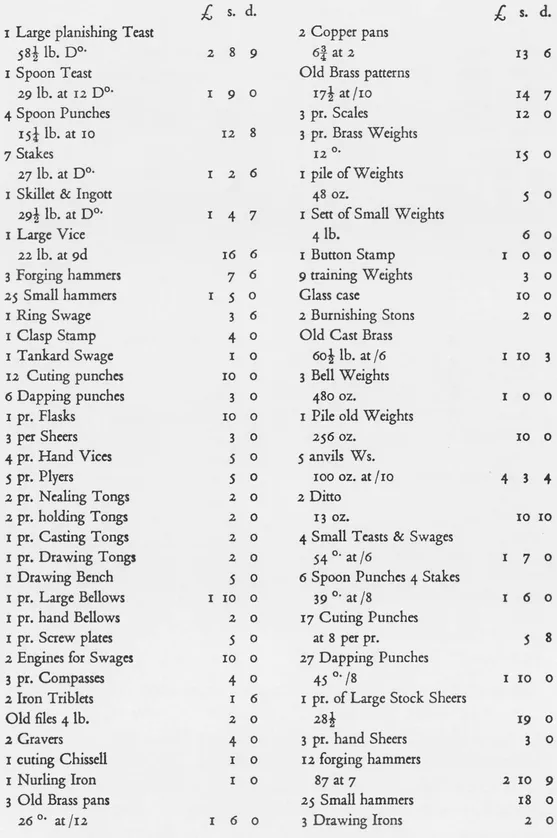
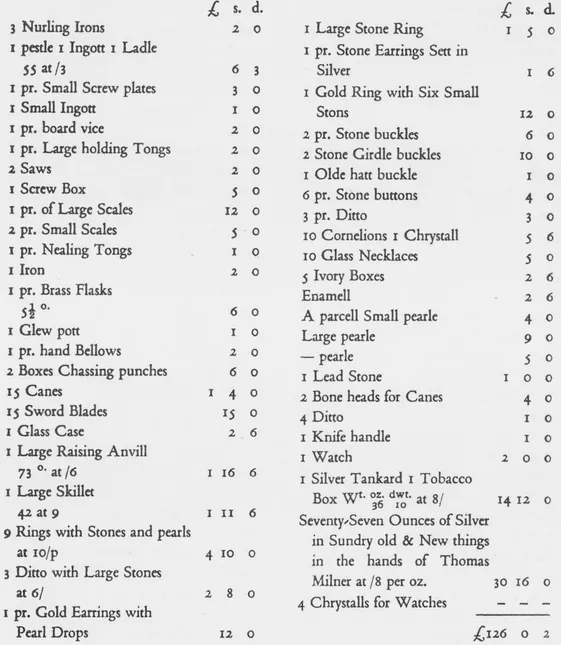
In those days before pattern books and specialization, the silversmith was not only a designer but also an artisan, skilled in the handling of a great variety of tools. One of the most interesting and revealing lists known to the writer occurs in the inventory of the estate of Richard Conyers, a London-trained goldsmith who was made a freeman of the Worshipful Company of Goldsmiths of the City of London in 1689, was elected to its Livery in 1694, and emigrated to Boston in the late seventeenth century.
The tools were appraised by two fellow craftsmen, Boston-trained Jeremiah Dummer and London-trained Edward Webb.
An Inventory of the Estate of Richard Conyers, Late of Boston Goldsmith Dec’ed Taken and Apprized by the Subscribers the 4th Day of April 1709
While no known pictorial representation of an early American silversmith’s shop exists, it is likely that Conyers, in view of his London training, modelled his shop on that shown as a frontispiece to A NEW TOUCH-STONE for Gold and Silver Wares . . . To which is likewise added, The useful and easie TABLES of Mr. John Reynolds of the Mint, (with a Key to the same) plainly shewing how to cast up and make all sorts of GOLD and SILVER true Standard (Plate i). This treatise, first issued in 1677, was already in its second edition by 1679, three years before Conyers began his London apprenticeship.
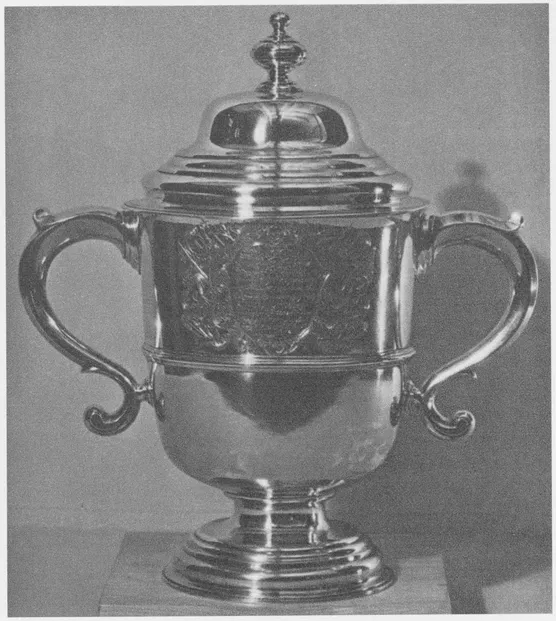
Plate II
The richness of the metal and beauty of form in the Queen Anne style is enhanced by the finely cast panelled bandles and engraved ornamental inscription of this monumental two-handled covered cup by Jacob Hurd, a presentation piece of 1744, honoring an early naval victory in King George’s War
Conyers received his silver not in sheets as does the silversmith today but in the form of coins or pieces outmoded in style. In either case his first task was to melt the silver and refine it to true standard and pour it into his ingott, then hammer out a sheet on his large forging anvill until the required thickness of metal was achieved, depending upon the object to be fashioned. Then cutting with sheers a circular piece of flat metal, the diameter of which was equal to the length of the profile line of the piece desired, he inscribed with the compasses a series of concentric circles to act as guides for the hammer strokes. As silver becomes brittle under hammering, it was necessary to soften the metal by heating it in a charcoal forge fanned by hand bellows. This process is known as annealing and to handle the red-hot silver Conyers used his nealing tongs. As the metal hardened, he proceeded to shape the vessel on the raising anvill, using a series of hammers, keeping the metal malleable by repeated annealing operations. Such parts as spouts, covers, and handles were made separately and applied. Mouldings were fashioned on the drawing bench in the engines for swage...
Table of contents
Title Page
Copyright Page
Table of Contents
COLOR PLATES
BLACK AND WHITE PLATES
Chapter one - The Silversmith
Chapter Two - The Seventeenth Century
Chapter three - The Baroque of the William & Mary Style, 1700-1715
Chapter four - Transplanted Queen Anne, 1715-1750
Chapter five - The Exuberance of the Rococo, 1750—1785
Chapter six - The Classical Reserve of the Federal Style, 1785-1810
Chapter seven - The Vagaries of 19th-Century Taste
Bibliography
Trusted by 375,005 students
Access to over 1.5 million titles for a fair monthly price.