- 288 pages
- English
- ePUB (mobile friendly)
- Available on iOS & Android
eBook - ePub
Algebraic Theories
About this book
This in-depth introduction to classical topics in higher algebra provides rigorous, detailed proofs for its explorations of some of mathematics' most significant concepts, including matrices, invariants, and groups.
Algebraic Theories studies all of the important theories; its extensive offerings range from the foundations of higher algebra and the Galois theory of algebraic equations to finite linear groups (including Klein's "icosahedron" and the theory of equations of the fifth degree) and algebraic invariants. The full treatment includes matrices, linear transformations, elementary divisors and invariant factors, and quadratic, bilinear, and Hermitian forms, both singly and in pairs. The results are classical, with due attention to issues of rationality. Elementary divisors and invariant factors receive simple, natural introductions in connection with the classical form and a rational, canonical form of linear transformations. All topics are developed with a remarkable lucidity and discussed in close connection with their most frequent mathematical applications.

Frequently asked questions
Yes, you can cancel anytime from the Subscription tab in your account settings on the Perlego website. Your subscription will stay active until the end of your current billing period. Learn how to cancel your subscription.
No, books cannot be downloaded as external files, such as PDFs, for use outside of Perlego. However, you can download books within the Perlego app for offline reading on mobile or tablet. Learn more here.
Perlego offers two plans: Essential and Complete
- Essential is ideal for learners and professionals who enjoy exploring a wide range of subjects. Access the Essential Library with 800,000+ trusted titles and best-sellers across business, personal growth, and the humanities. Includes unlimited reading time and Standard Read Aloud voice.
- Complete: Perfect for advanced learners and researchers needing full, unrestricted access. Unlock 1.4M+ books across hundreds of subjects, including academic and specialized titles. The Complete Plan also includes advanced features like Premium Read Aloud and Research Assistant.
We are an online textbook subscription service, where you can get access to an entire online library for less than the price of a single book per month. With over 1 million books across 1000+ topics, we’ve got you covered! Learn more here.
Look out for the read-aloud symbol on your next book to see if you can listen to it. The read-aloud tool reads text aloud for you, highlighting the text as it is being read. You can pause it, speed it up and slow it down. Learn more here.
Yes! You can use the Perlego app on both iOS or Android devices to read anytime, anywhere — even offline. Perfect for commutes or when you’re on the go.
Please note we cannot support devices running on iOS 13 and Android 7 or earlier. Learn more about using the app.
Yes, you can access Algebraic Theories by Leonard Dickson in PDF and/or ePUB format, as well as other popular books in Mathematics & Algebra. We have over one million books available in our catalogue for you to explore.
Information
CHAPTER XIII
GROUPS OF THE REGULAR SOUDS;
QUINTIC EQUATIONS
QUINTIC EQUATIONS
121. Introduction. The first part of this chapter gives a theory of the invariants of each finite group of linear transformations on two variables. These groups are isomorphic to groups of rotations leaving unaltered the various regular solids. The final part is an application to the resolvents of the general equation of the fifth degree and furnishes a method of solving the latter. The subject plays an important rôle in the theories of elliptic modular functions and automorphic functions.
The theory is due to Klein, whose book1 is a classic, but presents difficulties to beginners on account of the introduction of ideas from many branches of mathematics. We shall give a simple exposition of the essentials of this interesting theory.
122. Linear fractional transformation on z corresponding to a rotation. To readers acquainted with the theory of functions of a complex variable there is available2 a short proof of the desired formula (7). We shall give here a strictly elementary proof.
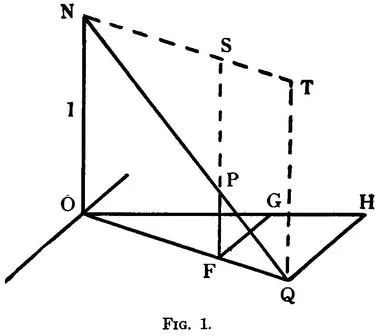
We first define the stereographic projection of a sphere upon a plane. Employ a rectangular coordinate system in space. The sphere with radius unity and center at the origin O has the equation

From the point N = (0, 0, 1) project an arbitrary point P = (ξ, η, ζ) of the sphere to a point Q = (x, y) of the ξη-plane.
Let T be the fourth vertex of the rectangle having sides ON and OQ. Let SPF be parallel to NO. Let FG and QH be parallel to the η-axis. Then OG = ξ, FG = η, PF = ζ, OH = x, QH = y. Since the triangles NSP and NTQ are similar,


Hence

By (1),

whence

Write z = x + iy. Formulas (2) and (3) establish a one-to-one correspondence between the points of the unit sphere and the points of the complex z-plane, provided we agree to identify all points at infinity in the z-plane (so that z = ∞ alone corresponds to N).
Let E = (λ, μ, v) and P = (ξ, η, ζ) be any points on the sphere having radius unity and center at the origin O. Write

whence

Consider the rotation about an axis OE through angle α counterclockwise when viewed from E toward O. Let it replace (ξ, η, ζ) by (ξ', η', ζ'). We employ the formulas (28) of §46 which represent the rotation, with a1, a2, a3 replaced by a, b, c, and w1, w2, w3 replaced by ξ, η, ζ, and p1, p2, p3 replaced by ξ', η', ζ'.
Write z = x + iy, w = x − iy. Then (3) become

Hence

where e = bd − ac + i(ad + bc) = (b + ia) (d + ic). Replacing 1 − c2 − d2 by the equal value a2 + b2, we get

Similarly,

Writing z' = x' + iy', and employing (2) in accents, we get


THEOREM 1. Every rotation corresponds to a transformation (7).
EXERCISES
1. By (4) and (7), with λ = μ = 0, v = 1, prove that the rotation about the ζ-axis ON through angle α counterclockwise viewed from N is represented by

2. Prove (8) by use of the formulas from analytic geometry,

123. The tetrahedral group. Consider a cube inscribed in a sphere with the center O and radius unity. Four of its vertices 1, 2, 3, 4, shown in Fig. 2, are the vertices of a regular tetrahedron. Their diametral points 1', 2', 3', 4' are the verti...
Table of contents
- Cover
- Title
- Copyright
- Preface
- Contents
- I. Introduction to Algebraic Invariants
- II. Further Theory of Covariants of Binary Forms
- III. Matrices, Bilinear Forms, Linear Equations
- IV. Quadratic and Hermitian Forms, Symmetric and Hermitian Bilinear Forms
- V. Theory of Linear Transformations, Invariant Factors and Elementary Divisors
- VI. Pairs of Bilinear, Quadratic, and Hermitian Forms
- VII. First Principles of Groups of Substitutions
- VIII. Fields, Reducible and Irreducible Functions
- IX. Group of an Equation for a Given Field
- X. Equations Solvable by Radicals
- XI. Constructions with Ruler and Compasses
- XII. Reduction of Equations to Normal Forms
- XIII. Groups of the Regular Solids; Quintic Equations
- XIV. Representations of a Finite Group as a Linear Group; Group Characters
- Subject Index
- Author index













