![]()
Publisher’s Note
For many centuries, the peoples of China’s remote southwestern regions of Guizhou and Yunnan have created rich, beautiful batik fabrics using an age-old wax-resist technique. From early childhood, girls of the Miao people of Guizhou and the Bai and Yi of Yunnan province, learn embroidery and batik from their mothers and grandmothers. Batik designs become a part of the fabric of life, decorating a wide array of household items: kerchiefs, bedsheets, quilt covers, curtains, wrapping cloths, sleeve trimmings, baby carriers, and many more. In the mountainous, inaccessible provinces they call home, the women are surrounded by natural splendor. Thus, they draw on familiar and beloved plants, birds, and animals of their native regions to create designs of remarkable beauty and ingenuity, steeped in the natural elements that surround them on every side.
Among these native folk artists, the technique of creating indigo batik has been developed to a high level of refinement. Molten beeswax is used to paint patterns onto white cloth. After dipping the cloth in indigo dye, the wax is removed in boiling water, resulting in fabric designs of great harmony and beauty. The indigo used as the dye in batik work is made from local plants that supply a dye of remarkable purity, depth and brightness of color. Filtered through the imaginations and creative abilities of the artists, the designs formed by the white lines and dots against the blue background provide the onlooker with a rich and vibrant visual experience. After the dyeing process, the undyed fabric remains clear white, though there are fine blue lines in the white areas, a characteristic feature of batik. These “ice lines” are created by cracks in the wax through which the blue dye seeps during the dyeing process, and they help give the batik its unity and coherence.
Composition is an important part of batik design. Nearly all compositions stress harmony and balance. The placement of compositional elements is also governed by the traditional Chinese love of decorative elaboration and intricate surface pattern. In addition, many compositions feature decorative borders that outline the space in which the design is enclosed, while others opt for open borders, in which only the edges of the fabric being decorated define the pictorial shape and the field for decoration. Where borders enclose the design, the borders become graphic devices in themselves, relating to the other elements in the design, and uniting its various features.
Although they enhance and embellish a wide range of items, the designs created by batik artists are not merely decorative. For the girls and women who design these motifs, their work is imbued with hopes and desires for a happy life, and embodies their ideals and love of beauty. As a result, batik designs are permeated with a rich symbolism that has developed over generations. Peaches, pomegranates, and peonies, for example, possess a number of symbolic associations: peaches are associated with long life; pomegranates with posterity and abundant offspring; peonies with spring, love and affection, and female beauty. These and many other symbolic associations give indigo batik its deeper meanings and help express the hopes and aspirations of its creators.
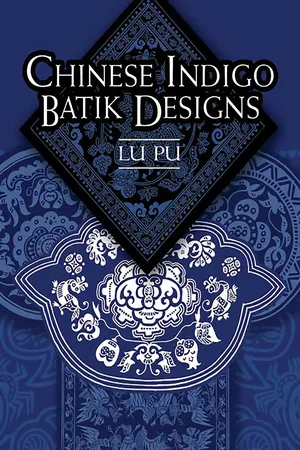
In this book are 110 authentic batik designs collected over many years by the Chinese artist Lu Pu, who became a passionate advocate for the preservation of this ancient folk art. Brought together here, the motifs represent the best of Lu Pu’s collection, as well as forming an invaluable resource for artists, designers, craftspeople, and any lover of traditional Chinese folk art.
2323__perlego__chapter_divider_...