The plane strain and generalized plane stress boundary value problems of linear elasticity are the focus of this graduate-level text, which formulates and solves these problems by employing complex variable theory. The text presents detailed descriptions of the three basic methods that rely on series representation, Cauchy integral representation, and the solution via continuation. Its five-part treatment covers functions of a complex variable, the basic equations of two-dimensional elasticity, plane and half-plane problems, regions with circular boundaries, and regions with curvilinear boundaries. Worked examples and sets of problems appear throughout the text. 1971 edition. 26 figures.
In this chapter some of the basic definitions and properties of functions of a complex variable are stated as a preliminary to their use in later sections. It is hoped that sufficient detail has been included to enable readers to resolve points of difficulty without frequent recourse to the standard texts on this subject.7, 28, 43, 44
1.1 Basic definitions
In the following it will be assumed that all definitions refer to curves and regions lying entirely in the complex plane.
An arc is a continuous non-intersecting line which has a continuously varying tangent except at a finite number of points. A contour is a simple closed arc, for example an ellipse.
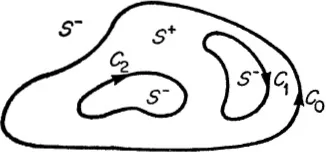
We shall refer to an open connected set in the plane as a region. When a region which we denote by S+ has one or more non-intersecting contours as its boundary, the positive sense of description of each contour is taken to be that for which the region S+ lies to the left. For example when S+ is bounded internally by the contours C1, C2, . . ., Cn and externally by the contour C0, then C1, C2, . . ., Cn have a clockwise sense of description and C0 anticlockwise. This is illustrated in Figure 1.1 for the case n = 2. We denote the open set exterior to S+ and the bounding contours by S− so that on moving in the positive sense along a bounding contour, S+ lies to the left and S− to the right. In general S+ is a multiply connected region, being simply connected only when S+ is bounded by a single contour C0.
Figure 1.1
1.2 Complex functions
Let S be an arbitrary point set in the complex plane, if to each point z0 = x0 + iy0 of S there corresponds a complex number u(x0, y0) + iv(x0, y0) we say that a complex function θ(z) has been defined on S. The value of the function is
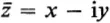
at the point z = x + iy where u, v are real functions of the variables x, y. We note that a specific functional dependence on z rather than say
is not assumed by this notation. For example
is a complex function.
In view of the relati...
Table of contents
Cover
Title Page
Copyright Page
Preface
Contents
Introduction
1 Functions of a Complex Variable
2 The Basic Equations of Two-Dimensional Elasticity
3 Plane and Half-Plane Problems
4 Regions with Circular Boundaries
5 Regions with Curvilinear Boundaries
Bibliography
Summary of Formulae
Answers to the Examples
Index
Trusted by 375,005 students
Access to over 1.5 million titles for a fair monthly price.
Study more efficiently using our study tools.
Frequently asked questions
Yes, you can cancel anytime from the Subscription tab in your account settings on the Perlego website. Your subscription will stay active until the end of your current billing period. Learn how to cancel your subscription
No, books cannot be downloaded as external files, such as PDFs, for use outside of Perlego. However, you can download books within the Perlego app for offline reading on mobile or tablet. Learn how to download books offline
Perlego offers two plans: Essential and Complete
Essential is ideal for learners and professionals who enjoy exploring a wide range of subjects. Access the Essential Library with 800,000+ trusted titles and best-sellers across business, personal growth, and the humanities. Includes unlimited reading time and Standard Read Aloud voice.
Complete: Perfect for advanced learners and researchers needing full, unrestricted access. Unlock 1.5M+ books across hundreds of subjects, including academic and specialized titles. The Complete Plan also includes advanced features like Premium Read Aloud and Research Assistant.
Both plans are available with monthly, semester, or annual billing cycles.
We are an online textbook subscription service, where you can get access to an entire online library for less than the price of a single book per month. With over 1.5 million books across 990+ topics, we’ve got you covered! Learn about our mission
Look out for the read-aloud symbol on your next book to see if you can listen to it. The read-aloud tool reads text aloud for you, highlighting the text as it is being read. You can pause it, speed it up and slow it down. Learn more about Read Aloud
Yes! You can use the Perlego app on both iOS and Android devices to read anytime, anywhere — even offline. Perfect for commutes or when you’re on the go. Please note we cannot support devices running on iOS 13 and Android 7 or earlier. Learn more about using the app
Yes, you can access Complex Variable Methods in Elasticity by A. H. England in PDF and/or ePUB format, as well as other popular books in Mathematics & Applied Mathematics. We have over 1.5 million books available in our catalogue for you to explore.