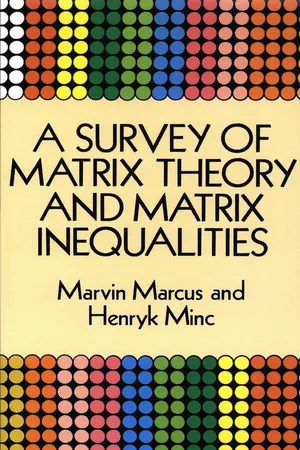
Written for advanced undergraduate students, this highly regarded book presents an enormous amount of information in a concise and accessible format. Beginning with the assumption that the reader has never seen a matrix before, the authors go on to provide a survey of a substantial part of the field, including many areas of modern research interest.
Part One of the book covers not only the standard ideas of matrix theory, but ones, as the authors state, "that reflect our own prejudices," among them Kronecker products, compound and induced matrices, quadratic relations, permanents, incidence matrices and generalizations of commutativity.
Part Two begins with a survey of elementary properties of convex sets and polyhedra and presents a proof of the Birkhoff theorem on doubly stochastic matrices. This is followed by a discussion of the properties of convex functions and a list of classical inequalities. This material is then combined to yield many of the interesting matrix inequalities of Weyl, Fan, Kantorovich and others. The treatment is along the lines developed by these authors and their successors and many of their proofs are included. This chapter contains an account of the classical Perron Frobenius-Wielandt theory of indecomposable nonnegative matrices and ends with some important results on stochastic matrices.
Part Three is concerned with a variety of results on the localization of the characteristic roots of a matrix in terms of simple functions of its entries or of entries of a related matrix. The presentation is essentially in historical order, and out of the vast number of results in this field the authors have culled those that seemed most interesting or useful. Readers will find many of the proofs of classical theorems and a substantial number of proofs of results in contemporary research literature.
- 208 pages
- English
- ePUB (mobile friendly)
- Available on iOS & Android
eBook - ePub
A Survey of Matrix Theory and Matrix Inequalities
About this book
Information
Survey of Matrix Theory
I
1 Introductory Concepts
1.1 Matrices and vectors
In this book we will be dealing with the following sets:
(i) The field of real numbers R.
(ii) The field of complex numbers C.
(iii) The ring of all integers (positive, negative, and zero) I.
(iv) The set of all nonnegative real numbers P.
(v) The ring of polynomials in some indeterminate (“variable”) λ with real (complex) coefficients R[λ] (C[λ]).
Let F be any one of these sets and suppose that a11, a12, a13, ···, amn is a collection of mn elements in F. The rectangular array of these elements

consisting of m rows and n columns is called an m × n matrix. We write A = (aij). A more formal but less suggestive definition is this: a matrix A is a function on the set of pairs of integers (i,j), 1 ≤ i ≤ m, 1 ≤ j ≤ n, with values in F in which aij designates the value of A at the pair (i,j). The array 1.1(1) is then just a convenient way of exhibiting the range of the function A. The element aij is called the (i,j) entry of A. The ith row of A is the sequence ai1, ai2, ···, ain, and the jth column is the sequence a1j, a2j, ···, amj. Since the aij are in F, we say that A is an m × n matrix over F. The totality of such matrices will be designated by Mm,n(F). In case n = m, we say that A is an n-square matrix. Denote by Mn(F) the set of all n-square matrices over F. A row (column) vector over F is just an element of M1,n(F) (Mm,1(F)). If A ∈ Mm,n(F), then A(i) = (ai1, ···, ain ∈ M1,n(F), (i = 1, ···, m), designates the ith row vector of A. Similarly, the column vector A(i) ∈ Mm,1(F) designates the m × 1 matrix whose (i,j) entry is aij, (i = 1, ···, m). The (i,j) entry of A is sometimes designated by Aij also. In general, a k-vector v over F is just an ordered k-tuple of elements of F, (a1, a2, ···, ak); ai...
Table of contents
- Cover
- Title Page
- Dedication
- Preface
- Contents
- I. Survey of Matrix Theory
- II. Convexity And Matrices
- III. Localization of Characteristic Roots
- Index
Trusted by 375,005 students
Access to over 1.5 million titles for a fair monthly price.
Study more efficiently using our study tools.
Frequently asked questions
Yes, you can cancel anytime from the Subscription tab in your account settings on the Perlego website. Your subscription will stay active until the end of your current billing period. Learn how to cancel your subscription
No, books cannot be downloaded as external files, such as PDFs, for use outside of Perlego. However, you can download books within the Perlego app for offline reading on mobile or tablet. Learn how to download books offline
Perlego offers two plans: Essential and Complete
- Essential is ideal for learners and professionals who enjoy exploring a wide range of subjects. Access the Essential Library with 800,000+ trusted titles and best-sellers across business, personal growth, and the humanities. Includes unlimited reading time and Standard Read Aloud voice.
- Complete: Perfect for advanced learners and researchers needing full, unrestricted access. Unlock 1.5M+ books across hundreds of subjects, including academic and specialized titles. The Complete Plan also includes advanced features like Premium Read Aloud and Research Assistant.
We are an online textbook subscription service, where you can get access to an entire online library for less than the price of a single book per month. With over 1.5 million books across 990+ topics, we’ve got you covered! Learn about our mission
Look out for the read-aloud symbol on your next book to see if you can listen to it. The read-aloud tool reads text aloud for you, highlighting the text as it is being read. You can pause it, speed it up and slow it down. Learn more about Read Aloud
Yes! You can use the Perlego app on both iOS and Android devices to read anytime, anywhere — even offline. Perfect for commutes or when you’re on the go.
Please note we cannot support devices running on iOS 13 and Android 7 or earlier. Learn more about using the app
Please note we cannot support devices running on iOS 13 and Android 7 or earlier. Learn more about using the app
Yes, you can access A Survey of Matrix Theory and Matrix Inequalities by Marvin Marcus,Henryk Minc in PDF and/or ePUB format, as well as other popular books in Mathematics & Algebra. We have over 1.5 million books available in our catalogue for you to explore.