An Introduction to Fourier Series and Integrals
eBook - ePub

An Introduction to Fourier Series and Integrals

  1. 112 pages
  2. English
  3. ePUB (mobile friendly)
  4. Available on iOS & Android
eBook - ePub

An Introduction to Fourier Series and Integrals

About this book

A compact, sophomore-to-senior-level guide, Dr. Seeley's text introduces Fourier series in the way that Joseph Fourier himself used them: as solutions of the heat equation in a disk. Emphasizing the relationship between physics and mathematics, Dr. Seeley focuses on results of greatest significance to modern readers.
Starting with a physical problem, Dr. Seeley sets up and analyzes the mathematical modes, establishes the principal properties, and then proceeds to apply these results and methods to new situations. The chapter on Fourier transforms derives analogs of the results obtained for Fourier series, which the author applies to the analysis of a problem of heat conduction. Numerous computational and theoretical problems appear throughout the text.

Frequently asked questions

Yes, you can cancel anytime from the Subscription tab in your account settings on the Perlego website. Your subscription will stay active until the end of your current billing period. Learn how to cancel your subscription.
At the moment all of our mobile-responsive ePub books are available to download via the app. Most of our PDFs are also available to download and we're working on making the final remaining ones downloadable now. Learn more here.
Perlego offers two plans: Essential and Complete
  • Essential is ideal for learners and professionals who enjoy exploring a wide range of subjects. Access the Essential Library with 800,000+ trusted titles and best-sellers across business, personal growth, and the humanities. Includes unlimited reading time and Standard Read Aloud voice.
  • Complete: Perfect for advanced learners and researchers needing full, unrestricted access. Unlock 1.4M+ books across hundreds of subjects, including academic and specialized titles. The Complete Plan also includes advanced features like Premium Read Aloud and Research Assistant.
Both plans are available with monthly, semester, or annual billing cycles.
We are an online textbook subscription service, where you can get access to an entire online library for less than the price of a single book per month. With over 1 million books across 1000+ topics, we’ve got you covered! Learn more here.
Look out for the read-aloud symbol on your next book to see if you can listen to it. The read-aloud tool reads text aloud for you, highlighting the text as it is being read. You can pause it, speed it up and slow it down. Learn more here.
Yes! You can use the Perlego app on both iOS or Android devices to read anytime, anywhere — even offline. Perfect for commutes or when you’re on the go.
Please note we cannot support devices running on iOS 13 and Android 7 or earlier. Learn more about using the app.
Yes, you can access An Introduction to Fourier Series and Integrals by Robert T. Seeley in PDF and/or ePUB format, as well as other popular books in Mathematics & Mathematics Reference. We have over one million books available in our catalogue for you to explore.

Information

1
Image
Dirichlet's Problem and
Poisson’s Theorem
This entire chapter discusses a single problem that lies at the heart of the subject of Fourier series. In physical terms, it is to determine the steady state temperature distribution in a disk when the boundary temperatures are known; the mathematical formulation is known as Dirichlet's problem. Starting from scratch, we arrive at a solution in the form of a series Σ anr|n|einθ, called a trigonometric series. The attempt to verify that this can actually be made to solve the heat problem leads to Poisson’s theorem, one of the most important and attractive elementary theorems of analysis. A number of important consequences are evolved below, but these few only suggest the importance of Poisson’s theorem. Echoes of the proof, and of the integral representation on which it is based, appear frequently in mathematics even today.
1-1. THE EQUATION OF STEADY STATE HEAT CONDUCTION
The first step in solving heat problems (as in most problems of mathematical physics) is to find a differential equation governing the situation. Since we are concerned with a disk, the natural coordinates are polar. The temperature at the point with coordinates (r, θ) is denoted by u(r, θ).
In order to find the relevant equation, consider any section of the disk given by
image
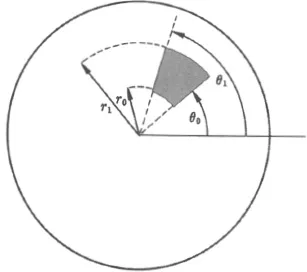
(see Fig. 1-1). Since we are considering a steady state, the rate at which heat flows into this section must be 0; otherwise the average temperature would change with time. Now it is a basic postulate of heat conduction that the rate at which heat crosses a curve C is proportional to the integral along C of the normal derivative ∂u/∂n of the temperature distribution. Here ∂u/∂n is the derivative of u with respect to arc length along any curve perpendicular to C. When C is the side θ — θ1 of the portion given in (1-1), we can take these perpendicular curves to be given by r = constant. Then, since the length of a circular arc is the angle times the radius, along
image
FIGURE 1-1.Derivation of the heat equation in polar coordinates.
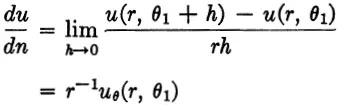
θ = θ1 the normal derivative is
image
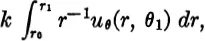
and the rate at which heat flows into the section in Fig. 1-1 along the boundary θ = θ1 is
image
where k is the conductivity. Adding corresponding expressions for the other three boundaries and setting the net flow equal to zero, we get
image
If we divide by θ1 — θ0 and let θ1 θ0this yields
image
(The first term comes from Leibnitz’s rule, and the second from the fundam...
Table of contents

  1. Cover
  2. Title Page
  3. Copyright Page
  4. Editors’ Foreword
  5. Preface
  6. Contents
  7. Introduction
  8. 1. Dirichlet’s Problem and Poisson’s Theorem
  9. 2. The Method of Separation of Variables
  10. 3. Some Applications of Poisson’s Theorem
  11. 4. Fourier Transforms.
  12. Bibliography
  13. Answers to Exercises
  14. Index