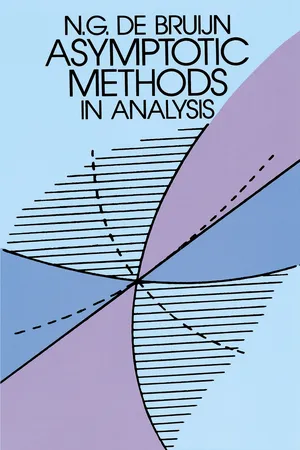
"A reader looking for interesting problems tackled often by highly original methods, for precise results fully proved, and for procedures fully motivated, will be delighted." — Mathematical Reviews. Asymptotics is not new. Its importance in many areas of pure and applied mathematics has been recognized since the days of Laplace. Asymptotic estimates of series, integrals, and other expressions are commonly needed in physics, engineering, and other fields. Unfortunately, for many years there was a dearth of literature dealing with this difficult but important topic. Then, in 1958, Professor N. G. de Bruijn published this pioneering study. Widely considered the first text on the subject — and the first comprehensive coverage of this broad field — the book embodied an original and highly effective approach to teaching asymptotics. Rather than trying to formulate a general theory (which, in the author's words, "leads to stating more and more about less and less") de Bruijn teaches asymptotic methods through a rigorous process of explaining worked examples in detail. Most of the important asymptotic methods are covered here with unusual effectiveness and clarity: "Every step in the mathematical process is explained, its purpose and necessity made clear, with the result that the reader not only has no difficulty in following the rigorous proofs, but even turns to them with eager expectation." (Nuclear Physics). Part of the attraction of this book is its pleasant, straightforward style of exposition, leavened with a touch of humor and occasionally even using the dramatic form of dialogue. The book begins with a general introduction (fundamental to the whole book) on O and o notation and asymptotic series in general. Subsequent chapters cover estimation of implicit functions and the roots of equations; various methods of estimating sums; extensive treatment of the saddle-point method with full details and intricate worked examples; a brief introduction to Tauberian theorems; a detailed chapter on iteration; and a short chapter on asymptotic behavior of solutions of differential equations. Most chapters progress from simple examples to difficult problems; and in some cases, two or more different treatments of the same problem are given to enable the reader to compare different methods. Several proofs of the Stirling theorem are included, for example, and the problem of the iterated sine is treated twice in Chapter 8. Exercises are given at the end of each chapter. Since its first publication, Asymptotic Methods in Analysis has received widespread acclaim for its rigorous and original approach to teaching a difficult subject. This Dover edition, with corrections by the author, offers students, mathematicians, engineers, and physicists not only an inexpensive, comprehensive guide to asymptotic methods but also an unusually lucid and useful account of a significant mathematical discipline.
This question is about as difficult to answer as the question “What is mathematics?” Nevertheless, we shall have to find some explanation for the word asymptotics.
It often happens that we want to evaluate a certain number, defined in a certain way, and that the evaluation involves a very large number of operations so that the direct method is almost prohibitive. In such cases we should be very happy to have an entirely different method for finding information about the number, giving at least some useful approximation to it. And usually this new method gives (as remarked by Laplace) the better results in proportion to its being more necessary: its accuracy improves when the number of operations involved in the definition increases. A situation like this is considered to belong to asymptotics.
This statement is very vague indeed. However, if we try to be more precise, a definition of the word asymptotics either excludes everything we are used to call asymptotics, or it includes almost the whole of mathematical analysis. It is hard to phrase the definition in such a way that Stirling’s formula (1.1.1) belongs to asymptotics, and that a formula like
does not. The obvious reason why the latter formula is not called an asymptotic formula is that it belongs to a part of analysis that already has got a name: the integral calculus. The safest and not the vaguest definition is the following one: Asymptotics is that part of analysis which considers problems of the type dealt with in this book.
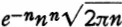
A typical asymptotic result, and one of the oldest, is Stirling’s formula just mentioned:
For each n, the number n! can be evaluated without any theoretical difficulty, and the larger n is, the larger the number of necessary operations becomes. But Stirling’s formula gives a decent approximation
, and the larger n is, the smaller its relative error becomes.
Several proofs of (1.1.1) and of its generalizations will be given in this book (see secs. 3.7, 3.10, 4.5, 6.9).
We quote another famous asymptotic formula, much deeper than the previous one and beyond the scope of this book. If x is a positive number, we denote by π(x) the number of primes not exceeding x. Then the so-called Prime Number Theorem states that 1)
The above formulas are limit formulas, and therefore they have, as they stand, litiile valu...
Table of contents
Cover
Title Page
Copyright Page
Contents
Preface
Ch. 1. Introduction
Ch. 2. Implicit Functions
Ch. 3. Summation
Ch. 4. The Laplace Method for Integrals
Ch. 5. The Saddle Point Method
Ch. 6. Applications of the Saddle Point Method
Ch. 7. Indirect Asymptotics
Ch. 8. Iterated Functions
Ch. 9. Differential Equations
INDEX
Trusted by 375,005 students
Access to over 1.5 million titles for a fair monthly price.
Study more efficiently using our study tools.
Frequently asked questions
Yes, you can cancel anytime from the Subscription tab in your account settings on the Perlego website. Your subscription will stay active until the end of your current billing period. Learn how to cancel your subscription
No, books cannot be downloaded as external files, such as PDFs, for use outside of Perlego. However, you can download books within the Perlego app for offline reading on mobile or tablet. Learn how to download books offline
Perlego offers two plans: Essential and Complete
Essential is ideal for learners and professionals who enjoy exploring a wide range of subjects. Access the Essential Library with 800,000+ trusted titles and best-sellers across business, personal growth, and the humanities. Includes unlimited reading time and Standard Read Aloud voice.
Complete: Perfect for advanced learners and researchers needing full, unrestricted access. Unlock 1.5M+ books across hundreds of subjects, including academic and specialized titles. The Complete Plan also includes advanced features like Premium Read Aloud and Research Assistant.
Both plans are available with monthly, semester, or annual billing cycles.
We are an online textbook subscription service, where you can get access to an entire online library for less than the price of a single book per month. With over 1.5 million books across 990+ topics, we’ve got you covered! Learn about our mission
Look out for the read-aloud symbol on your next book to see if you can listen to it. The read-aloud tool reads text aloud for you, highlighting the text as it is being read. You can pause it, speed it up and slow it down. Learn more about Read Aloud
Yes! You can use the Perlego app on both iOS and Android devices to read anytime, anywhere — even offline. Perfect for commutes or when you’re on the go. Please note we cannot support devices running on iOS 13 and Android 7 or earlier. Learn more about using the app
Yes, you can access Asymptotic Methods in Analysis by N. G. de Bruijn in PDF and/or ePUB format, as well as other popular books in Mathematics & Mathematical Analysis. We have over 1.5 million books available in our catalogue for you to explore.