Readable and systematic, this volume offers coherent presentations of not only the general theory of linear equations with a single integration, but also of applications to differential equations, the calculus of variations, and special areas in mathematical physics. Topics include the solution of Fredholm’s equation expressed as a ratio of two integral series in lambda, free and constrained vibrations of an elastic string, and auxiliary theorems on harmonic functions. Discussion of the Hilbert-Schmidt theory covers boundary problems for ordinary linear differential equations, vibration problems, and flow of heat in a bar. 1924 edition.
1. Linear Integral Equation of the First Kind.—An equation of the form
is said to be a linear integral equation of the first kind. The functions K(x, t) and f(x) and the limits a and b are known. It is proposed so to determine the unknown function u that (1) is satisfied for all values of x in the closed interval a
x
b. K(x, t) is called the kernel of this equation.
Instead of equation (1), we have often to deal with equations of exactly the same form in which the upper limit of integration is the variable x. Such an equation is seen to be a special case of (1) in which the kernel K(x, t) vanishes when t > x, since it then makes no difference whether x or b is used as the upper limit of integration.
The characteristic feature of this equation is that the unknown function u occurs under a definite integral. Hence equation (1) is called an integral equation and, since u occurs linearly, equation (1) is called a linear integral equation.
2. Abel’s Problem.—As an illustration of the way in which integral equations arise, we give here a statement of Abel’s problem.
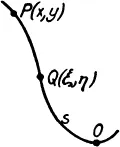
FIG. 1.
Given a smooth curve situated in a vertical plane. A particle starts from rest at any point P. Let us find, under the action of gravity, the time T of descent to the lowest point O. Choose O as the origin of coordinates, the x-axis vertically upward, and the y-axis horizontal. Let the coordinates of P be (x, y), of Q be (ξ, η), and s the arc OQ.
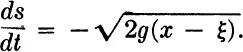
The velocity of the particle at Q is
Hence
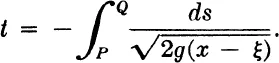
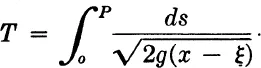
The whole time of descent is, then,
If the shape of the curve is given, then s can be expressed in terms of ξ and hence ds can be expressed in terms of ξ. Let
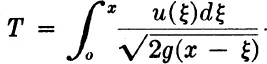
Then
Abel set himself the problem1 of finding that curve for which the time T of descent is a given function of x, say f(x). Our problem, then, is to find the unknown function u from the equation
This is a linear integral equation of the first kind for the determination of u.
3. Linear Integral Equation of the Second Kind.—An equation of the form
is said to be a linear integral equation of the second kind.
K(x, t) is called the kernel of this equation. The functions K(x, t) and f(x) and the limits a and b are known. The function u is unknown.
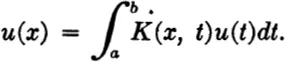
The equation
is known as Volterra’s linear integral equation of the second kind.
If f(x) ≡ 0, then
This equation is said to be a, homogeneous linear int...
Table of contents
Cover Page
Title Page
Copyright Page
Preface
Contents
Chapter I: Introductory
Chapter II: Solution of Integral Equation of Second Kind by Successive Substitutions
Chapter III: Solution of Fredholm’s Equation Expressed as Ratio of Two Integral Series in λ
Chapter IV: Applications of the Fredholm Theory
Chapter V: Hilbeht-Schmidt Theory of Integral Equations with Symmetric Kernels
Chapter VI: Applications of the Hilbert-Schmidt Theory
Index
Trusted by 375,005 students
Access to over 1.5 million titles for a fair monthly price.
Study more efficiently using our study tools.
Frequently asked questions
Yes, you can cancel anytime from the Subscription tab in your account settings on the Perlego website. Your subscription will stay active until the end of your current billing period. Learn how to cancel your subscription
No, books cannot be downloaded as external files, such as PDFs, for use outside of Perlego. However, you can download books within the Perlego app for offline reading on mobile or tablet. Learn how to download books offline
Perlego offers two plans: Essential and Complete
Essential is ideal for learners and professionals who enjoy exploring a wide range of subjects. Access the Essential Library with 800,000+ trusted titles and best-sellers across business, personal growth, and the humanities. Includes unlimited reading time and Standard Read Aloud voice.
Complete: Perfect for advanced learners and researchers needing full, unrestricted access. Unlock 1.5M+ books across hundreds of subjects, including academic and specialized titles. The Complete Plan also includes advanced features like Premium Read Aloud and Research Assistant.
Both plans are available with monthly, semester, or annual billing cycles.
We are an online textbook subscription service, where you can get access to an entire online library for less than the price of a single book per month. With over 1.5 million books across 990+ topics, we’ve got you covered! Learn about our mission
Look out for the read-aloud symbol on your next book to see if you can listen to it. The read-aloud tool reads text aloud for you, highlighting the text as it is being read. You can pause it, speed it up and slow it down. Learn more about Read Aloud
Yes! You can use the Perlego app on both iOS and Android devices to read anytime, anywhere — even offline. Perfect for commutes or when you’re on the go. Please note we cannot support devices running on iOS 13 and Android 7 or earlier. Learn more about using the app
Yes, you can access Linear Integral Equations by William Vernon Lovitt in PDF and/or ePUB format, as well as other popular books in Mathematics & Differential Equations. We have over 1.5 million books available in our catalogue for you to explore.