Laocoon
eBook - ePub

Laocoon

An Essay upon the Limits of Painting and Poetry

  1. 272 pages
  2. English
  3. ePUB (mobile friendly)
  4. Available on iOS & Android
eBook - ePub

Laocoon

An Essay upon the Limits of Painting and Poetry

About this book

According to Greek mythology, Laocoon was a Trojan priest who, along with his two sons, offended the gods. As punishment, the three were strangled by sea serpents. The discovery in 1506 of an ancient Greek sculpture showing the three figures in their death agony not only gave rise to renewed interest in the classical period but also created repercussions in the art world. It was this work of art that German dramatist and critic Gotthold Lessing used as a point of reference for his essay Laocoon. Originally published in 1766, Lessing's inspired meditation on the distinguishing characteristics of painting and poetry became a turning point in the study of Western art. His essay on the origins, forms, and influences of these art forms aided in framing modern conceptions of the artistic medium and helped establish modernist views of the uniqueness of the individual arts.
A breakthrough vision in aesthetics, Laocoon is essential reading for anyone interested in poetry, art history, and the fine arts.

Frequently asked questions

Yes, you can cancel anytime from the Subscription tab in your account settings on the Perlego website. Your subscription will stay active until the end of your current billing period. Learn how to cancel your subscription.
No, books cannot be downloaded as external files, such as PDFs, for use outside of Perlego. However, you can download books within the Perlego app for offline reading on mobile or tablet. Learn more here.
Perlego offers two plans: Essential and Complete
  • Essential is ideal for learners and professionals who enjoy exploring a wide range of subjects. Access the Essential Library with 800,000+ trusted titles and best-sellers across business, personal growth, and the humanities. Includes unlimited reading time and Standard Read Aloud voice.
  • Complete: Perfect for advanced learners and researchers needing full, unrestricted access. Unlock 1.4M+ books across hundreds of subjects, including academic and specialized titles. The Complete Plan also includes advanced features like Premium Read Aloud and Research Assistant.
Both plans are available with monthly, semester, or annual billing cycles.
We are an online textbook subscription service, where you can get access to an entire online library for less than the price of a single book per month. With over 1 million books across 1000+ topics, we’ve got you covered! Learn more here.
Look out for the read-aloud symbol on your next book to see if you can listen to it. The read-aloud tool reads text aloud for you, highlighting the text as it is being read. You can pause it, speed it up and slow it down. Learn more here.
Yes! You can use the Perlego app on both iOS or Android devices to read anytime, anywhere — even offline. Perfect for commutes or when you’re on the go.
Please note we cannot support devices running on iOS 13 and Android 7 or earlier. Learn more about using the app.
Yes, you can access Laocoon by Gotthold Ephraim Lessing,Ellen Frothingham in PDF and/or ePUB format, as well as other popular books in Philosophy & Aesthetics in Philosophy. We have over one million books available in our catalogue for you to explore.

Information

NOTES TO THE LAOCOON.

e9780486170381_i0012.webp
NOTE 1, p. 8.

ANTIOCHUS (Anthol. lib. ii. cap. 4). Hardouin, in his commentary on Pliny (lib. xxxv. sect. 36), attributes this epigram to a certain Piso. But among all the Greek epigrammatists there is none of this name.

NOTE 2, p. 9.

FOR this reason Aristotle commanded that his pictures should not be shown to young persons, in order that their imagination might be kept as free as possible from all disagreeable images. (Polit. lib. viii. cap. 5, p. 526, edit. Conring.) Boden, indeed, would read Pausanias in this passage instead of Pauson, because that artist is known to have painted lewd figures (de Umbra poetica comment. 1, p. xiii). As if we needed a philosophic law-giver to teach us the necessity of keeping from youth such incentives to wantonness! A comparison of this with the well-known passage in the “Art of Poesy” would have led him to withhold his conjecture. There are commentators, as Kühn on Ælian (Var. Hist. lib. iv. cap. 3), who suppose the difference mentioned by Aristotle as existing between Polygnotus, Dionysius, and Pauson to consist in this : that Polygnotus painted gods and heroes; Dionysius, men; and Pauson, animals. They all painted human figures; and the fact that Pauson once painted a horse, does not prove him to have been a painter of animals as Boden supposes him to have been. Their rank was determined by the degree of beauty they gave their human figures ; and the reason that Dionysius could paint nothing but men, and was therefore called pre-eminently the anthropographist, was that he copied too slavishly, and could not rise into the domain of the ideal beneath which it would have been blasphemy to represent gods and heroes.

NOTE 3, p. II.

THE serpent has been erroneously regarded as the peculiar symbol of a god of medicine. But Justin Martyr expressly says (Apolog. ii. p. 55, edit. Sylburgh), παρ
e9780486170381_img_8049.gif
παντ
e9780486170381_img_8054.gif
τ
e9780486170381_img_8182.gif
ν νομιζοµ
e9780486170381_img_8051.gif
νων παρ’
e9780486170381_img_8017.gif
μ
e9780486170381_img_8054.gif
ν ϑε
e9780486170381_img_8182.gif
ν,
e9780486170381_img_8004.gif
e9780486170381_img_632.gif
ις σ
e9780486170381_img_973.gif
μβολον μ
e9780486170381_img_941.gif
γα κα
e9780486170381_img_8054.gif
μυστ
e9780486170381_img_8053.gif
ριον
e9780486170381_img_7936.gif
ναγ
e9780486170381_img_940.gif
e9780486170381_img_632.gif
εται
; and a number of monuments might be mentioned where the serpent accompanies deities having no connection with health.

NOTE 4, p. 12.

LOOK through all the works of art mentioned by Pliny, Pausanias, and the rest, examine all the remaining statues, bas-reliefs, and pictures of the ancients, and nowhere will you find a fury. I except figures that are rather symbolical than belonging to art, such as those generally represented on coins. Yet Spence, since he insisted on having furies, would have done better to borrow them from coins than introduce them by an ingenious conceit into a work where they certainly do not exist. (Seguini Numis. p. 178. Spanheim. de Præst. Numism. Dissert. xiii. p. 639. Les Césars de Julien, par Spanheim, p. 48. In his Polymetis he says (dial. xvi.) : “Though furies are very uncommon in the works of the ancient artists, yet there is one subject in which they are generally introduced by them. I mean the death of Meleager, in the relievos of which they are often represented as encouraging or urging Althæa to burn the fatal brand on which the life of her only son depended. Even a woman’s resentment, you see, could not go so far without a little help from the devil. In a copy of one of these relievos, published in the ‘Admiranda,’ there are two women standing by the altar with Althæa, who are probably meant for furies in the original, (for who but furies would assist at such a sacrifice?) though the copy scarce represents them horrid enough for that character. But what is most to be observed in that piece is the round disc beneath the centre of it, with the evident head of a fury upon it. This might be what Althæa addressed her prayers to whenever she wished ill to her neighbors, or whenever she was going to do any very evil action. Ovid introduces her as invoking the furies on this occasion in particular, and makes her give more than one reason for her doing so.” (Metamorph. viii. 479.)
In this way we might make every thing out of any thing. “Who but furies,” asks Spence, “would have a...
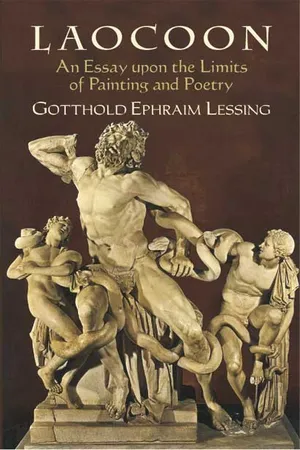
Table of contents

  1. Title Page
  2. Copyright Page
  3. Table of Contents
  4. TRANSLATOR’S PREFACE.
  5. PREFACE.
  6. I.
  7. II.
  8. III.
  9. IV.
  10. V.
  11. VI.
  12. VII.
  13. VIII.
  14. IX.
  15. X.
  16. XI.
  17. XII.
  18. XIII.
  19. XIV.
  20. XV.
  21. XVI.
  22. XVII.
  23. XVIII.
  24. XIX.
  25. XX.
  26. XXI.
  27. XXII.
  28. XXIII.
  29. XXIV.
  30. XXV.
  31. XXVI.
  32. XXVII.
  33. XXVIII.
  34. XXIX.
  35. NOTES TO THE LAOCOON.
  36. INDEX.
  37. DOVER BOOKS