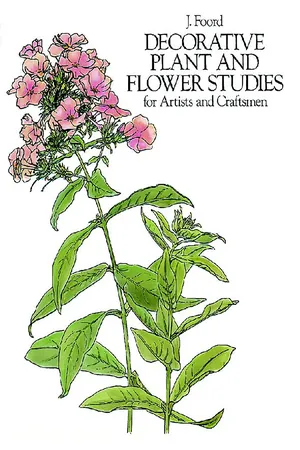
88 royalty-free drawings of 40 plants and flowers — Daffodil, Apple and other more or less familiar species — distinguished by their grace, impeccable draftsmanship, and botanical accuracy. Extensive texts include botanical history, peculiar characteristics, folklore, poetic renderings, and more. An artist's sourcebook imbued with the spirit of poetry!
- 144 pages
- English
- ePUB (mobile friendly)
- Available on iOS & Android
eBook - ePub
Decorative Plant and Flower Studies for Artists and Craftsmen
About this book
Information
Topic
DesignSubtopic
Graphic DesignTable of Contents
DOVER PICTORIAL ARCHIVE SERIES
Title Page
Copyright Page
INTRODUCTORY NOTE - BY MR. LEWIS F. DAY.
AUTHOR’S PREFACE.
APPLE BLOSSOM.
THE EVENING PRIMROSE.
PYRUS SPECTABILIS.
THE DAFFODIL.
BROOM.
THE FLOWERING RUSH.
THE TULIP TREE.
COBIA SCANDENS.
THE HOLLYHOCK.
THE RHODODENDRON.
THE MARROW.
REST HARROW.
THE ASH.
THE PRIVET.
THE ARBUTUS, OR THE STRAWBERRY TREE.
THE ARBUTUS, OR THE STRAWBERRY TREE.
MOUNTAIN RANUNCULUS.
THE CUCKOO FLOWER.
THE YELLOW IRIS.
THE NARCISSUS.
THE BLUEBELL, OR WILD HYACINTH.
PYRUS JAPONICA.
THE PURPLE ANEMONE.
SALSIFY.
DIERVILLA ROSEA.
SPIDERWORT.
THE RED CAMPION.
MEADOW CRANESBILL.
THE CORN SOW THISTLE.
THE FOXGLOVE.
JACOB’S LADDER.
THE WINTER CHERRY.
PHLOX.
KERRIA JAPONICA.
SWEET SULTAN.
CLEMATIS VITICELLA.
THE AZALEA.
THE OLEANDER.
BARLEY.
THE SNOWBERRY.
THE SPINDLE TREE.
APPLE BLOSSOM.
Nat. Ord. Rosaceæ
FEW of our English flowers are richer in decorative qualities than the various fruit blossoms : the apple, the cherry, the pear, and the plum all being so full of delicate beauty, both of form and colour, that it is difficult to give preference to either ; while some of the many varieties of the black thorn in our hedges are quite equal to the cultivated trees in the material they offer to the designer. Among these the apple has perhaps an advantage in coming rather later than the others, when the young foliage has already made considerable growth, so that its flowers are set among the fresh soft green of the young leaves instead of on bare stems, and also that it has a more clustered arrangement than the plum or the black-thorn, the flowers springing from the branch in well grouped masses surrounded by the radiating foliage, instead of in their more scattered growth.
The apple does not often grow to a great height, but old trees sometimes reach thirty or thirty-five feet; occasionally even more. The growth is full of character, the gnarled grey stems dividing into twisted knotted branches, which spread in a more or less horizontal direction, often with a pendulous droop in the smaller boughs at the extremities. The young trees are generally more erect, but the growth differs slightly in different varieties, though all retain the same general characteristics. The drawing of the stems is full of interest and delicate form, with sudden turns and sharp angles, and with the thickened ringed bark at the joints. The leaves are ovate, tapering to a point, with flexible stems which give a valuable effect of looseness in the clustered grouping ; the edges are irregularly serrated, the netted veining strong and clear, and the lower sides of the leaves are soft and woolly, and of a pale grey, contrasting with the stronger colour of the upper surface. In the young leaves, as seen at the time of the blossom, this is of a bright fresh green, but later they grow much darker, and greyer and more reserved in colour. On the young shoots their order is generally alternate, but in the older growth it is irregular, forming clusters of radiating leaves surrounding the flowers, or leafy terminals in which the beautiful folding of the opening leaves should be noticed, and the long pointed bracts at the base of the stalk.
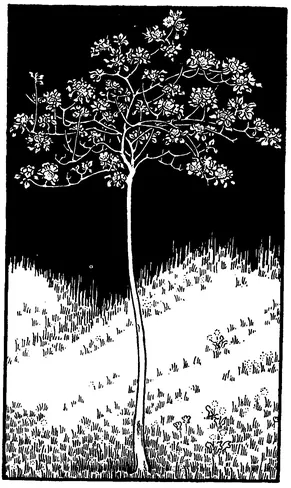
The flowers grow in well-massed umbels, those in the centre being the first to open, surrounded by later buds. Each blossom has five long pointed sepals which are folded over the bud, then, opening with the flower, gradually become reflexed, lying back against the stem ; five concave petals, opening out to a broad cup-shaped cor...
Table of contents
- DOVER PICTORIAL ARCHIVE SERIES
- Title Page
- Copyright Page
- INTRODUCTORY NOTE - BY MR. LEWIS F. DAY.
- AUTHOR’S PREFACE.
- Table of Contents
- APPLE BLOSSOM.
- THE EVENING PRIMROSE.
- PYRUS SPECTABILIS.
- THE DAFFODIL.
- BROOM.
- THE FLOWERING RUSH.
- THE TULIP TREE.
- COBIA SCANDENS.
- THE HOLLYHOCK.
- THE RHODODENDRON.
- THE MARROW.
- REST HARROW.
- THE ASH.
- THE PRIVET.
- THE ARBUTUS, OR THE STRAWBERRY TREE.
- THE ARBUTUS, OR THE STRAWBERRY TREE.
- MOUNTAIN RANUNCULUS.
- THE CUCKOO FLOWER.
- THE YELLOW IRIS.
- THE NARCISSUS.
- THE BLUEBELL, OR WILD HYACINTH.
- PYRUS JAPONICA.
- THE PURPLE ANEMONE.
- SALSIFY.
- DIERVILLA ROSEA.
- SPIDERWORT.
- THE RED CAMPION.
- MEADOW CRANESBILL.
- THE CORN SOW THISTLE.
- THE FOXGLOVE.
- JACOB’S LADDER.
- THE WINTER CHERRY.
- PHLOX.
- KERRIA JAPONICA.
- SWEET SULTAN.
- CLEMATIS VITICELLA.
- THE AZALEA.
- THE OLEANDER.
- BARLEY.
- THE SNOWBERRY.
- THE SPINDLE TREE.
Trusted by 375,005 students
Access to over 1.5 million titles for a fair monthly price.
Study more efficiently using our study tools.
Frequently asked questions
Yes, you can cancel anytime from the Subscription tab in your account settings on the Perlego website. Your subscription will stay active until the end of your current billing period. Learn how to cancel your subscription
No, books cannot be downloaded as external files, such as PDFs, for use outside of Perlego. However, you can download books within the Perlego app for offline reading on mobile or tablet. Learn how to download books offline
Perlego offers two plans: Essential and Complete
- Essential is ideal for learners and professionals who enjoy exploring a wide range of subjects. Access the Essential Library with 800,000+ trusted titles and best-sellers across business, personal growth, and the humanities. Includes unlimited reading time and Standard Read Aloud voice.
- Complete: Perfect for advanced learners and researchers needing full, unrestricted access. Unlock 1.5M+ books across hundreds of subjects, including academic and specialized titles. The Complete Plan also includes advanced features like Premium Read Aloud and Research Assistant.
We are an online textbook subscription service, where you can get access to an entire online library for less than the price of a single book per month. With over 1.5 million books across 990+ topics, we’ve got you covered! Learn about our mission
Look out for the read-aloud symbol on your next book to see if you can listen to it. The read-aloud tool reads text aloud for you, highlighting the text as it is being read. You can pause it, speed it up and slow it down. Learn more about Read Aloud
Yes! You can use the Perlego app on both iOS and Android devices to read anytime, anywhere — even offline. Perfect for commutes or when you’re on the go.
Please note we cannot support devices running on iOS 13 and Android 7 or earlier. Learn more about using the app
Please note we cannot support devices running on iOS 13 and Android 7 or earlier. Learn more about using the app
Yes, you can access Decorative Plant and Flower Studies for Artists and Craftsmen by J. Foord in PDF and/or ePUB format, as well as other popular books in Design & Graphic Design. We have over 1.5 million books available in our catalogue for you to explore.