![]()
1
INTRODUCTION
“Geometry and analysis, differential and integral calculus deal continually, even though perhaps in disguised expression, with infinite sets.” Thus wrote F. Hausdorff (1914) in his Fundamentals of the Theory of Sets. To attain a genuine understanding and mastery of these various branches of mathematics requires a knowledge of their common foundation, namely, the theory of sets.
We may ask, what are the things with which mathematics concerns itself? They are, in every case, sets of numbers or sets of points—generally infinite sets, that is, sets which contain an infinite number of things.
The reader may question the idea of approaching the infinite by means of mathematical analysis, thus bringing it under the control of mathematical laws and formulas. But this approach is the essence of the theory of sets. For this purpose, our concept of the infinite must be separated from vague emotional ideas and from the infinite of nonmathematical realms (the infinite of metaphysics).
Before Cantor’s time, the infinite in mathematics was an obscure and unpredictable area. Even Gauss, in 1831, was of the opinion that: “The infinite is only a ‘manner of speaking’ in that one actually talks of limits which certain ratios approach as closely as desired, while other ratios are permitted to grow larger without bounds.” Gauss, himself, rejected the use of an “infinite number,” as something which is never permitted in mathematics. He recognized the infinite only in the sense of a process of becoming infinite in the limit:
….
One of Cantor’s predecessors, Bolzano,* recognized that the infinite in mathematics was replete with paradoxes (contradictions) obstructing arithmetical treatment of the subject. It was Cantor, however, who taught us how to calculate with the “infinite” through his introduction of clearly determined and sharply differentiated infinite numbers, with well-defined operations upon them: “… It concerned an extension; that is, a continuation of the sequence of real integers beyond the infinite. As daring as this might seem, I not only express the hope, but also the firm conviction that, in time, this extension will come to be looked upon as thoroughly simple, acceptable, and natural.”
After a ten-year delay, when he had come to recognize that his concepts were indispensable to the further development of mathematics, Cantor decided to publish his creation. In this work, he generalized the laws and rules applied to finite numbers so that they would extend beyond the domain of these numbers. He explained how one could compute with infinite sets, using the same methods that are applied to finite sets. With a few clearly defined concepts such as order (going back to Dedekind), power or cardinal number, denumerability, etc., he raised the theory of sets to a science which no longer contained fundamental barriers between the finite and the infinite—one that made the infinite understandable.
Today we know that Cantor, as Hilbert has said, thereby “created one of the most fertile and powerful branches of mathematics; a paradise from which no one can drive us out.” The theory of sets stands as one of the boldest and most beautiful creations of the human mind; its construction of concepts and its methods of proof have reanimated and revitalized all branches of mathematical study. The theory of sets, indeed, is the most impressive example of the validity of Cantor’s statement that, “The essence of mathematics lies in its freedom.”
Mathematics exercises its freedom in asking questions. Who has not at some time posed questions of the following kind?
Are there more whole numbers than there are even numbers?
Does an unbounded straight line contain more points than a line segment?
Does a plane contain fewer points than space?
Are the rational points densely situated on the number scale?
In particular, what do ∞ + 1, and ∞ ·3, and ∞2 denote?
People refrained from discussing these questions publicly since such inquiries seemed naive or stupid and, above all, because they appeared to have no answer. However, the theory of sets gives clear answers possessing mathematical precision to all these questions, when the questions are properly phrased.
The foundation of the general theory of sets has now been established for over half a century. To understand it calls for scarcely any prerequisite technical knowledge. All that is necessary is an interest in establishing the “infinitely large” and a patience for grasping somewhat difficult concepts. Even though the theory of sets starts in the intuitive-concrete, it nevertheless climbs to a very high degree of abstraction.
This book is an introduction to the theory of sets. In the first few pages the fundamental concepts will be developed through the use of well-known finite sets. Although the theory of finite sets is nothing else than mere arithmetic and permutations and combinations, yet it helps to provide the terminology and symbolism of set theory. These concepts will provide the basis for the subsequent treatment of the infinite sets. The general theory of sets ends with a discussion of ordered sets. A few important theorems on point sets are appended in a supplement. Definitions that produce paradoxes are merely alluded to in the concluding paragraphs.
*In a work published in 1851 after his death.
![]()
2
FINITE SETS
I. Set, Element, Equality of Sets
1. What is a set? It is not that which we usually refer to in our everyday speech, when we speak of a large 3 of people, of ships, or of things. Rather:
A set is a collection of definite distinct objects of our perception or of our thought, which are called elements of the set*
2. The following are examples of sets:
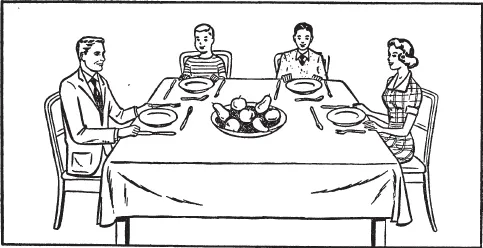
(a) In Figure 1, the four persons sitting at the table form a set of four persons because they are four definite distinct objects of our perception. Father A, mother A, son Fred A, and son Peter A are to be considered as a whole, as a set called family A. The four chairs form a set of four elements; the four spoons, the four forks, the four knives, the four plates; each form a set of four elements. All the eating utensils can be considered as forming one set B, a set of 12 elements, provided we define the elements of B to consist of the eating utensils.
In the fruit bowl there is a set of seven pieces of fruit. We can also say: the bowl contains a set of four apples and set of three pears.
Notice that the elements belonging to a set are determined by the distinguishing characteristics of the set. For each thing considered, one must be able to say whether or not it is an element of the set. The set of all male members of family A hence contains the elements, father A, son Fred A, and son Peter A. The set of female members of family A contains only one element—mother A. In mathematics there can also be a set so small that it has only one element. In order to have greater generality, it is also convenient to have an empty set.
An empty set contains no element.
The set of plums in the fruit bowl (Figure 1) is an example of an empty set or a null-set.
(b) If a senior class has 15 students, these 15 elements form the set of seniors. The defining property of this set is: each of its elements is a student of this senior class.
Suppose the classroom for these 15 students contains a set of 15 seats only. If the 15 senior students would occupy the 15 seats in every possible way, then, by the laws of permutations, * there would be 15! = 1,307,674,368,000 different arra...